How to Answer “Tell Me About Yourself” in Any Interview (With Examples)
Learn how to answer the most common interview question, “Tell Me About Yourself,” with proven structures, examples for freshers and experienced professionals, and expert
How to Answer "Tell Me About Yourself" in Any Interview (With Examples)
If you've attended even one interview, you've probably heard the question:
"Tell me about yourself."
It sounds simple, but many candidates struggle to answer it effectively.
Some candidates start talking about their childhood. Others simply repeat their resume. Both approaches can reduce the impact of an otherwise strong introduction.
In this guide, you'll learn how to answer this question confidently and professionally.
Why Interviewers Ask This Question
Interviewers ask this question to:
Understand your professional background
Evaluate your communication skills
Learn about your relevant experience
Set the direction for the rest of the interview
Your answer creates the first impression, so it's important to get it right.
The Best Structure to Follow
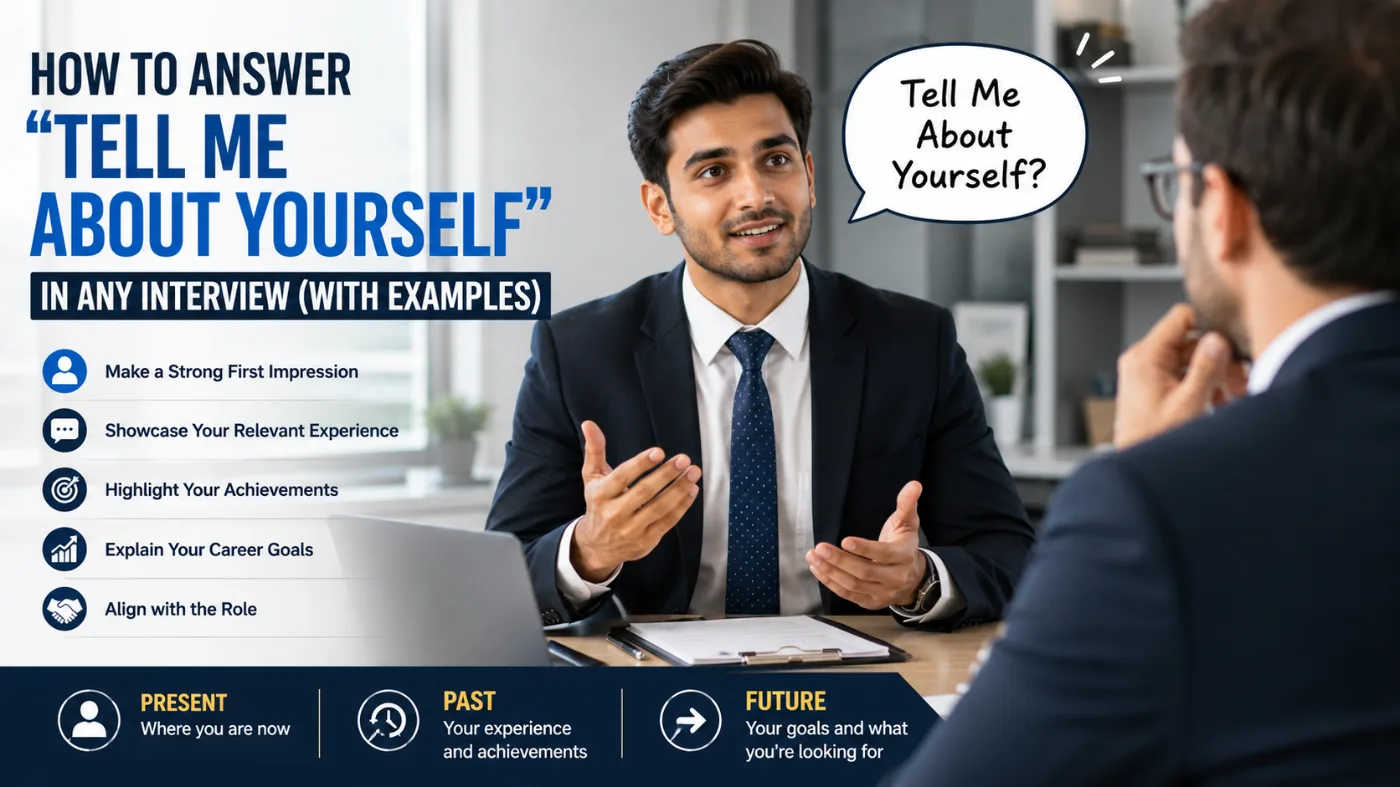
A simple formula is:
Present → Past → Future
Present
Explain your current role or situation.
Past
Briefly discuss your experience, education, or major achievements.
Future
Explain why you're interested in the role and what you're looking for next.
This structure keeps your answer organized and easy to follow.
Example for Freshers
"Hello, my name is Rahul Sharma. I recently completed my Bachelor's degree in Computer Science. During my studies, I worked on several projects involving Java, Spring Boot, and SQL. I also completed internships where I gained practical experience in software development and problem-solving. I'm now looking for an opportunity where I can apply my technical skills, continue learning, and contribute to real-world projects."
Example for Experienced Software Developers
"Hello, my name is Ashish Kumar Pandey. I am a Java Developer with nearly four years of experience in designing, developing, and maintaining Spring Boot microservice-based applications. Throughout my career, I have worked with technologies such as PostgreSQL, MySQL, Kafka, RabbitMQ, ActiveMQ, IBM MQ, and cloud integrations. I have been involved in developing enterprise integrations, troubleshooting production issues, and delivering scalable solutions for clients. Currently, I am looking for opportunities where I can contribute to large-scale systems, enhance my technical expertise, and take on greater responsibilities."
Common Mistakes to Avoid
1. Sharing Personal Life Stories
Interviewers are generally interested in your professional background, not your entire life history.
Avoid lengthy discussions about:
Childhood
Family background
Personal hobbies unrelated to the role
2. Reading Your Resume Word for Word
The interviewer already has your resume.
Use the introduction to summarize your journey instead of reading every line.
3. Giving Very Short Answers
A response like:
"I am a software developer with four years of experience."
is too brief and doesn't provide enough information.
4. Speaking for Too Long
Your introduction should usually take between 60 and 90 seconds.
Avoid turning it into a five-minute speech.
Tips for a Strong Introduction
Speak confidently
Maintain a clear structure
Focus on relevant experience
Mention key technologies or skills
Highlight achievements where possible
End with why you're interested in the role
How to Practice This Question
The best way to improve is by practicing aloud.
Many candidates know what they want to say but struggle when speaking in a real interview.
Practice your introduction multiple times and record yourself if possible. Pay attention to:
Confidence
Clarity
Speaking pace
Filler words
Overall structure
Regular mock interviews can help you become comfortable answering this question naturally.
Final Thoughts
"Tell Me About Yourself" is often the first question in an interview and sets the tone for the entire conversation.
A strong answer should be professional, structured, and relevant to the role you're applying for.
Remember the simple formula:
Present → Past → Future
With preparation and practice, you can turn this common interview question into an opportunity to make a strong first impression and stand out from other candidates.