Top 30 Behavioral Interview Questions and Answers (With Sample Responses)
Prepare for your next job interview with the most commonly asked behavioral interview questions and answers. Includes sample responses and expert tips to help you succeed
Top 30 Behavioral Interview Questions and Answers (With Sample Responses)
Technical skills may help you get shortlisted, but behavioral interviews often determine whether you receive the job offer.
Companies use behavioral questions to understand how you've handled situations in the past because past behavior is often the best predictor of future performance.
If you're preparing for an interview, these are some of the most common behavioral interview questions you should practice.
What Are Behavioral Interview Questions?
Behavioral interview questions focus on real situations you've experienced.
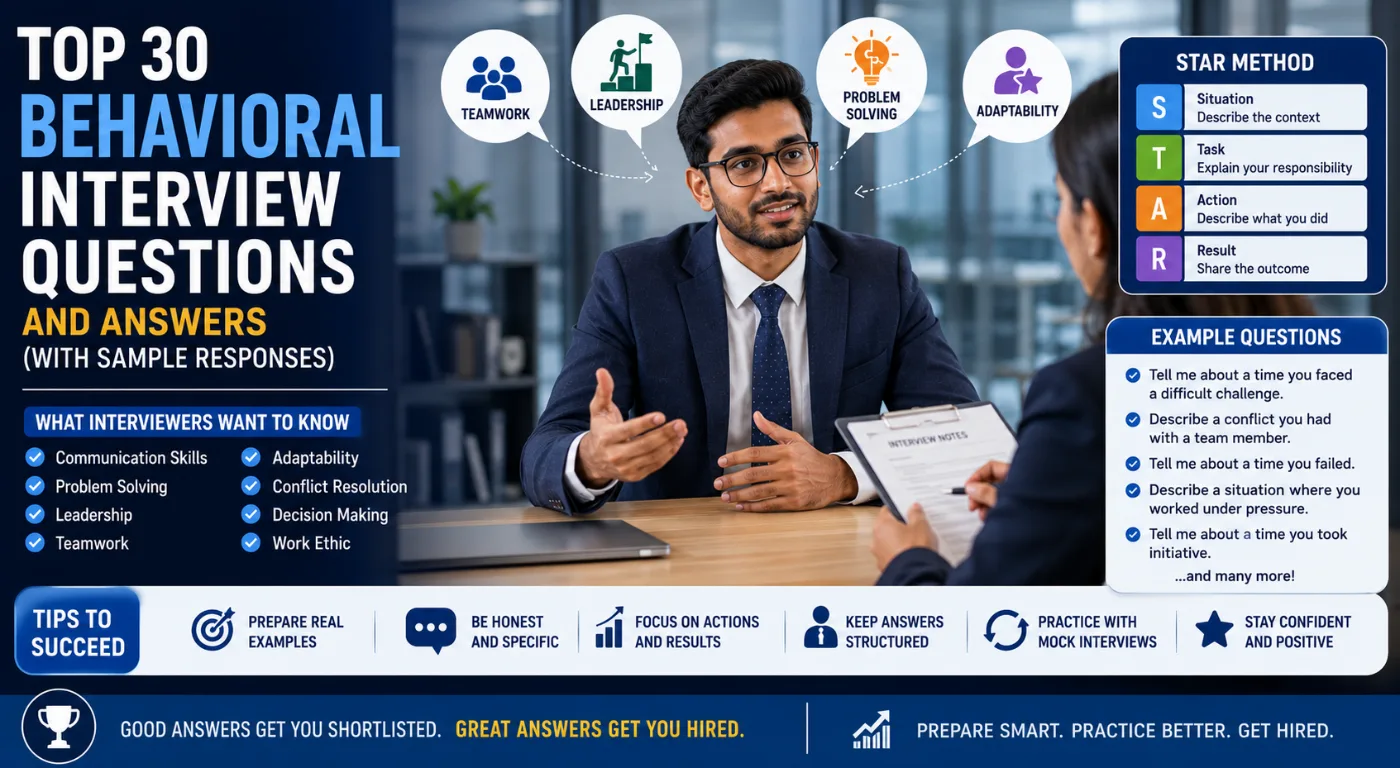
Interviewers want to evaluate:
Communication skills
Leadership abilities
Teamwork
Problem-solving
Conflict resolution
Adaptability
A popular way to answer these questions is using the STAR Method.
STAR Method
Situation
Describe the context.
Task
Explain your responsibility.
Action
Describe what you did.
Result
Share the outcome.
1. Tell Me About Yourself
Keep your answer focused on:
Current role
Relevant experience
Key achievements
Career goals
Avoid discussing unrelated personal details.
2. Tell Me About a Time You Faced a Difficult Problem
Interviewers want to understand:
Problem-solving ability
Decision-making process
Technical thinking
Sample Answer
"In a production environment, our API response times suddenly increased. After investigating logs and database queries, I identified a missing index causing performance issues. After implementing the index and optimizing queries, response time improved by nearly 70%."
3. Describe a Conflict You Had With a Team Member
This question evaluates professionalism.
Interviewers want to see:
Emotional intelligence
Communication skills
Collaboration
Avoid blaming others.
4. Tell Me About a Time You Failed
Companies want candidates who learn from mistakes.
A strong answer includes:
What happened
What you learned
What changed afterward
5. Describe a Situation Where You Worked Under Pressure
Examples:
Production outages
Tight deadlines
Critical customer issues
Explain how you remained calm and prioritized tasks.
6. Tell Me About a Time You Showed Leadership
Leadership doesn't always require a management title.
Examples:
Mentoring teammates
Leading a project
Coordinating releases
7. Describe a Time You Missed a Deadline
Be honest.
Focus on:
Root cause
Corrective action
Lessons learned
8. Tell Me About a Time You Took Initiative
Employers value proactive employees.
Examples:
Automation improvements
Process optimization
Cost reduction ideas
9. Describe a Difficult Decision You Had to Make
Explain:
Options considered
Risks involved
Final outcome
10. Tell Me About a Time You Received Critical Feedback
Great candidates:
Listen carefully
Accept feedback
Improve continuously
Most Common Behavioral Interview Questions
11. Describe a Time You Handled a Difficult Customer
12. Tell Me About a Time You Made a Mistake
13. Describe a Situation Where You Went Beyond Expectations
14. Tell Me About a Time You Worked With a Difficult Colleague
15. Describe a Time You Solved a Complex Problem
16. Tell Me About a Successful Project
17. Describe a Situation Where You Had Multiple Priorities
18. Tell Me About a Time You Adapted to Change
19. Describe a Time You Improved a Process
20. Tell Me About a Time You Learned Something New Quickly
Behavioral Interview Questions for Software Engineers
These are frequently asked in software engineering interviews.
21. Describe a Major Production Issue You Solved
22. Tell Me About a Challenging Bug
23. Explain a Performance Optimization You Implemented
24. Describe a Difficult Technical Decision
25. Tell Me About a Project You're Most Proud Of
Leadership Behavioral Questions
26. How Do You Handle Team Conflicts?
27. Describe a Time You Motivated Others
28. Tell Me About a Time You Delegated Work
29. Describe a Leadership Challenge
30. Tell Me About a Time You Influenced a Decision
Common Mistakes Candidates Make
Giving Theoretical Answers
Behavioral questions require real examples.
Speaking Too Generally
Provide specific situations and measurable results.
Blaming Others
Focus on your actions and learning.
Not Preparing Stories
Most candidates know the questions but struggle to recall examples during interviews.
How to Practice Behavioral Interview Questions
The best approach is to prepare 8-10 professional stories that cover:
Successes
Failures
Leadership
Teamwork
Problem-solving
Conflict resolution
You can then adapt these stories to answer multiple behavioral interview questions.
Mock interviews are particularly effective because they help candidates practice delivering answers naturally instead of memorizing scripts.
Final Thoughts
Behavioral interview questions are often the deciding factor between equally qualified candidates.
Companies want professionals who can:
Communicate effectively
Solve problems
Work with teams
Learn from mistakes
Adapt to challenges
By preparing real examples and practicing your responses, you'll significantly improve your chances of success in any interview.