Top 50 AI Engineer Interview Questions and Answers for Experienced Professionals (2026 Guide)
Prepare for AI Engineer interviews with 50 commonly asked questions covering LLMs, RAG, machine learning, vector databases, prompt engineering, and AI system design.
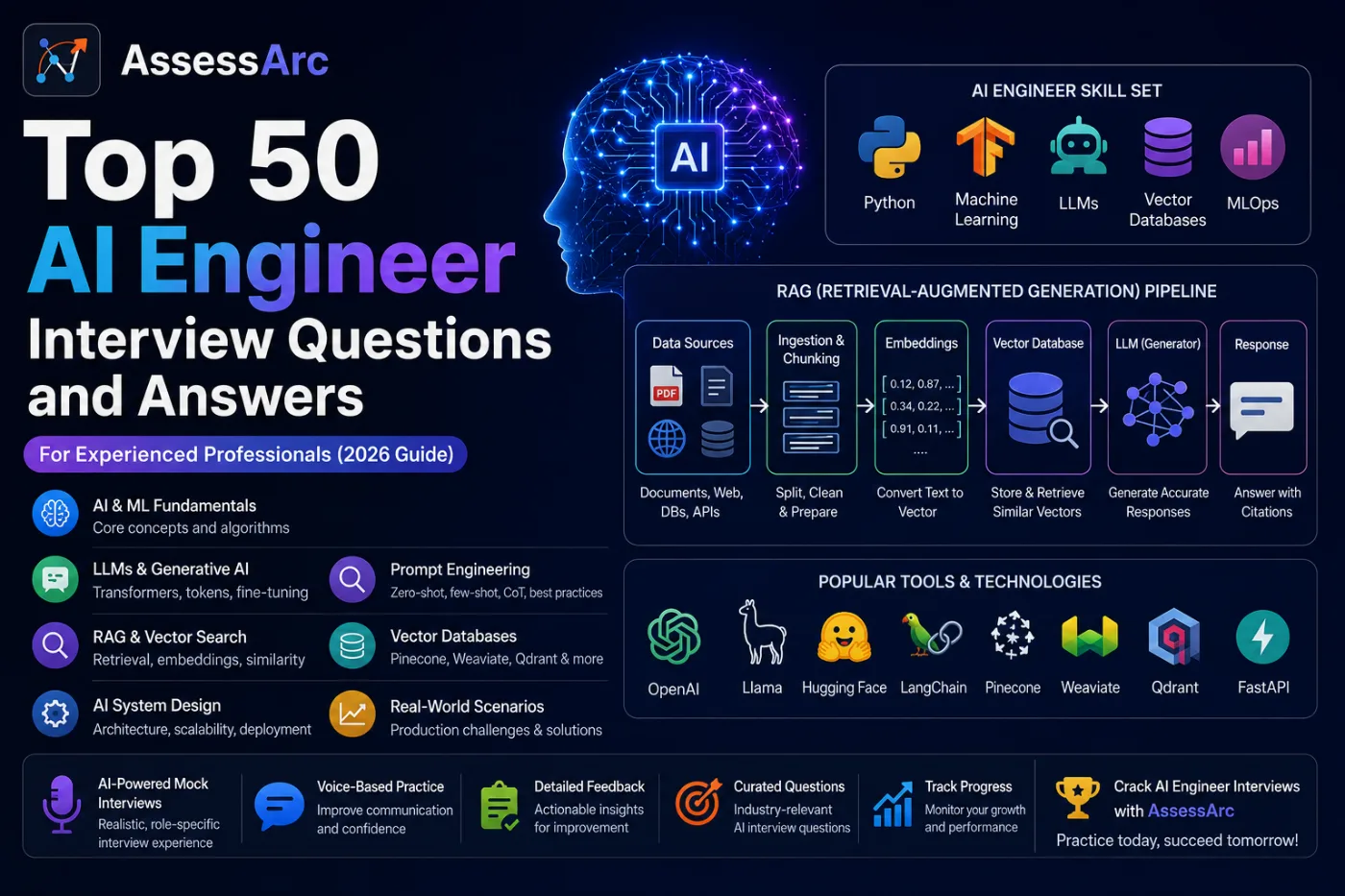
Top 50 AI Engineer Interview Questions and Answers for Experienced Professionals (2026 Guide)
Table of Contents
AI Fundamentals
Machine Learning Concepts
Large Language Models (LLMs)
RAG (Retrieval-Augmented Generation)
Prompt Engineering
Vector Databases
AI System Design
Real-World AI Scenarios
Common Interview Mistakes
How AssessArc Helps
Conclusion
Introduction
AI Engineers are among the most sought-after professionals in today's technology industry.
Organizations are rapidly adopting:
Large Language Models (LLMs)
Generative AI
RAG Systems
AI Agents
Vector Databases
Prompt Engineering
As a result, interviewers now focus on both theoretical AI concepts and real-world implementation challenges.
Whether you're applying for roles at startups, product companies, or large enterprises, understanding modern AI architectures is essential.
This guide covers the top 50 AI Engineer interview questions and answers frequently asked in 2026.
AI Fundamentals
1. What is Artificial Intelligence?
Answer
Artificial Intelligence (AI) refers to systems that can perform tasks requiring human intelligence.
Examples:
Speech Recognition
Image Classification
Language Translation
Recommendation Systems
2. What is the Difference Between AI, ML, and Deep Learning?
Answer
AI | Machine Learning | Deep Learning |
|---|---|---|
Broad Concept | Subset of AI | Subset of ML |
Mimics Intelligence | Learns from Data | Uses Neural Networks |
3. What is Machine Learning?
Answer
Machine Learning is a branch of AI where systems learn patterns from data without explicit programming.
4. What Are the Main Types of Machine Learning?
Answer
Supervised Learning
Unsupervised Learning
Reinforcement Learning
5. What is Supervised Learning?
Answer
Models learn from labeled data.
Examples:
Spam Detection
House Price Prediction
6. What is Unsupervised Learning?
Answer
Models discover patterns from unlabeled data.
Examples:
Customer Segmentation
Clustering
7. What is Reinforcement Learning?
Answer
Agents learn through rewards and penalties.
Examples:
Robotics
Game Playing AI
8. What is Overfitting?
Answer
When a model performs well on training data but poorly on unseen data.
9. How Can You Reduce Overfitting?
Answer
More Data
Regularization
Dropout
Cross Validation
10. What is Bias vs Variance?
Answer
Bias = Underfitting
Variance = Overfitting
Goal:
Balance both.
Machine Learning Concepts
11. What is a Training Dataset?
Answer
Data used to train machine learning models.
12. What is a Test Dataset?
Answer
Data used to evaluate model performance.
13. What is Precision?
Answer
Precision measures correctness of positive predictions.
14. What is Recall?
Answer
Recall measures how many actual positives are identified.
15. What is F1 Score?
Answer
Harmonic mean of Precision and Recall.
16. What is a Confusion Matrix?
Answer
A table used to evaluate classification models.
Contains:
TP
FP
TN
FN
17. What is Feature Engineering?
Answer
Creating meaningful input features to improve model performance.
18. What is Cross Validation?
Answer
Technique for evaluating model performance on different data splits.
19. What is Gradient Descent?
Answer
Optimization algorithm used to minimize model loss.
20. What is Regularization?
Answer
Technique used to reduce overfitting.
Examples:
L1
L2
Large Language Models (LLMs)
21. What is a Large Language Model (LLM)?
Answer
An LLM is a neural network trained on massive text datasets to understand and generate human language.
Examples:
GPT
Gemini
Claude
Llama
22. What is a Transformer?
Answer
Transformer is the neural network architecture behind modern LLMs.
Introduced attention mechanisms.
23. What is Self-Attention?
Answer
Mechanism allowing models to understand relationships between words.
24. What is Tokenization?
Answer
Process of converting text into smaller units called tokens.
25. What is Context Window?
Answer
Maximum amount of information an LLM can process at one time.
26. What is Fine-Tuning?
Answer
Training a pre-trained model on domain-specific data.
27. What is Instruction Tuning?
Answer
Training models to follow user instructions effectively.
28. What is Hallucination in AI?
Answer
When an LLM generates incorrect or fabricated information.
29. How Can Hallucinations Be Reduced?
Answer
RAG
Better Prompting
Fine-Tuning
Validation Layers
30. What is Temperature in LLMs?
Answer
Controls randomness of generated responses.
Low temperature = More deterministic.
High temperature = More creative.
Retrieval-Augmented Generation (RAG)
31. What is RAG?
Answer
Retrieval-Augmented Generation combines retrieval systems with LLMs.
Allows models to use external knowledge.
32. Why is RAG Important?
Answer
Benefits:
Reduces hallucinations
Improves accuracy
Uses latest information
33. What are Embeddings?
Answer
Numerical representations of text used for semantic search.
34. What is Semantic Search?
Answer
Search based on meaning rather than exact keywords.
35. What is Chunking?
Answer
Breaking large documents into smaller pieces for retrieval.
36. What is a Vector Database?
Answer
Database optimized for storing and searching embeddings.
Examples:
Pinecone
Weaviate
Qdrant
Milvus
37. What is Similarity Search?
Answer
Finding vectors closest to a query vector.
38. What Metrics Are Used in Vector Search?
Answer
Cosine Similarity
Euclidean Distance
Dot Product
39. What Are Common RAG Challenges?
Answer
Poor Retrieval
Hallucinations
Chunking Issues
Latency
40. How Would You Improve a RAG System?
Answer
Better Chunking
Metadata Filtering
Hybrid Search
Re-ranking Models
Prompt Engineering
41. What is Prompt Engineering?
Answer
Designing prompts to guide AI models toward desired outputs.
42. What is Zero-Shot Prompting?
Answer
Model receives no examples.
Only instructions.
43. What is Few-Shot Prompting?
Answer
Prompt includes examples before the actual task.
44. What is Chain-of-Thought Prompting?
Answer
Encourages step-by-step reasoning.
45. What Makes a Good Prompt?
Answer
Good prompts are:
Clear
Specific
Structured
Context-rich
Real-World AI Scenario Questions
46. How Would You Build a Resume-Based Interview AI?
Answer
Architecture:
Resume Upload
Resume Parsing
Question Generation
Voice Interaction
Evaluation Engine
Feedback Report
47. How Would You Reduce LLM Costs in Production?
Answer
Prompt Optimization
Caching
Smaller Models
RAG Architecture
48. How Would You Design an AI Chatbot for Company Documents?
Answer
Use:
Document Ingestion
Embeddings
Vector Database
RAG Pipeline
LLM
49. How Would You Monitor AI Application Quality?
Answer
Track:
Latency
Hallucination Rate
User Feedback
Retrieval Accuracy
50. What Are Interviewers Looking for in AI Engineer Interviews?
Answer
Interviewers evaluate:
AI Fundamentals
Can you explain ML concepts?
LLM Knowledge
Do you understand modern AI systems?
RAG Experience
Can you build production AI solutions?
System Design
Can you scale AI applications?
Real-World Experience
Have you deployed AI systems?
Common AI Engineer Interview Mistakes
❌ Memorizing buzzwords without understanding
❌ Weak understanding of RAG
❌ No knowledge of vector databases
❌ Ignoring system design
❌ Focusing only on prompting
❌ No production experience examples
How AssessArc Helps You Prepare for AI Engineer Interviews
AssessArc helps candidates practice:
AI Engineer Interviews
Generative AI Interviews
Machine Learning Interviews
RAG System Design Questions
Prompt Engineering Discussions
through AI-powered voice interviews, intelligent follow-up questions, personalized feedback, and detailed performance reports.
Conclusion
AI Engineering is rapidly becoming one of the most valuable skills in technology.
Mastering LLMs, RAG, embeddings, vector databases, prompt engineering, and AI system design can significantly improve your interview performance.
Practice these AI Engineer interview questions regularly and confidently explain concepts to maximize your chances of landing your next AI role.