Amazon Interview Preparation Guide 2026: Complete Roadmap to Crack Amazon Software Engineering Interviews
Complete Amazon interview preparation guide covering coding, system design, leadership principles, and mock interviews.
Amazon Interview Preparation Guide 2026: Complete Roadmap to Crack Amazon Software Engineering Interviews
Amazon is one of the most sought-after employers in the technology industry.
Every year, hundreds of thousands of candidates apply for Software Engineer, SDE-1, SDE-2, Senior Engineer, Cloud Engineer, Data Engineer, and Solutions Architect positions at Amazon.
The challenge?
Amazon interviews are designed to test much more than coding skills.
Candidates are evaluated on:
Problem Solving
Coding Ability
System Design
Leadership Principles
Ownership
Communication Skills
Project Experience
The good news is that Amazon interviews follow a predictable structure.
If you understand what Amazon evaluates and prepare strategically, your chances of success increase dramatically.
This guide covers everything you need to know about Amazon interview preparation in 2026.
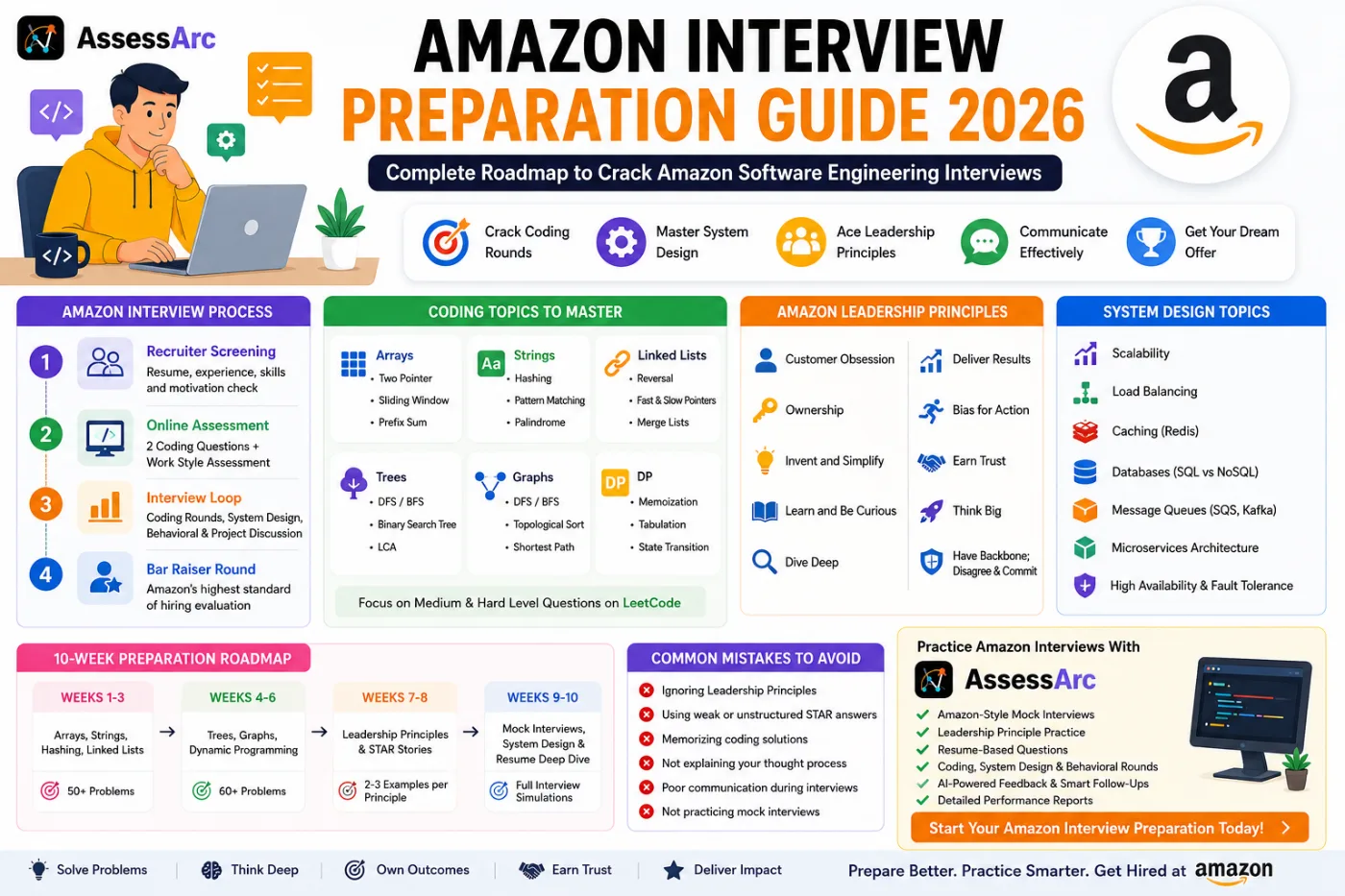
Understanding Amazon's Interview Process
Before preparing, you must understand the hiring process.
The exact interview flow varies by role and level, but most Software Development Engineer interviews follow a similar structure.
Step 1: Recruiter Screening
The recruiter evaluates:
Resume
Experience
Technical background
Role fit
Common questions include:
Tell me about yourself.
Why Amazon?
What projects have you worked on?
Why are you looking for a change?
Step 2: Online Assessment
Many Amazon roles include an Online Assessment (OA).
The OA generally includes:
Coding Problems
Typically 2 coding questions.
Work Style Assessment
Behavioral evaluation based on Amazon Leadership Principles.
Logical Reasoning
Role-dependent.
Step 3: Technical Interviews
Candidates typically face:
Coding Interviews
System Design Interviews
Project Discussions
Behavioral Interviews
Step 4: Bar Raiser Round
Amazon's famous Bar Raiser process evaluates whether a candidate raises Amazon's hiring standards.
This round often carries significant weight in the final decision.
What Amazon Looks For
Amazon evaluates candidates differently from many companies.
Technical skills are important, but Amazon places enormous emphasis on behavior and ownership.
The major evaluation areas are:
Coding Skills
Can you solve problems efficiently?
Problem Solving
Can you break down complex problems?
System Design
Can you build scalable systems?
Leadership Principles
Can you demonstrate Amazon values?
Ownership
Do you take responsibility for outcomes?
Communication
Can you explain decisions clearly?
Amazon Coding Interview Preparation
Coding remains a major component of Amazon interviews.
Candidates should master:
Arrays
Common topics:
Sliding Window
Prefix Sum
Two Pointer
Popular Questions:
Two Sum
Best Time to Buy and Sell Stock
Product of Array Except Self
Strings
Frequently asked:
Longest Substring
Group Anagrams
Valid Parentheses
Linked Lists
Topics:
Reversal
Merge Lists
Cycle Detection
Popular Questions:
Reverse Linked List
Merge Two Sorted Lists
Trees
Amazon frequently asks:
Tree Traversal
Binary Search Trees
Lowest Common Ancestor
Graphs
Important concepts:
BFS
DFS
Topological Sort
Common Questions:
Number of Islands
Clone Graph
Dynamic Programming
Frequently appears in SDE interviews.
Examples:
House Robber
Coin Change
Longest Common Subsequence
Best Resources for Amazon Coding Preparation
LeetCode
Focus on:
Amazon Tagged Questions
Medium Problems
Hard Problems
Quality matters more than quantity.
HackerRank
Good for fundamentals.
CodeSignal
Useful for online assessment preparation.
Amazon Leadership Principles: The Most Important Difference
This is where many candidates fail.
Amazon interviews heavily focus on Leadership Principles.
You must prepare examples for each principle.
Customer Obsession
Questions:
Tell me about a time you helped a customer.
How did you prioritize customer needs?
Ownership
Questions:
Describe a situation where you took responsibility beyond your role.
Tell me about a time you fixed a problem nobody owned.
Invent and Simplify
Questions:
Tell me about a process improvement.
Describe a solution you simplified.
Learn and Be Curious
Questions:
What new technology did you learn recently?
How do you stay updated?
Dive Deep
Questions:
Describe a difficult technical problem.
How did you investigate the root cause?
Deliver Results
Questions:
Tell me about a project with a tight deadline.
How did you ensure success?
Bias for Action
Questions:
Describe a fast decision you made.
What was the outcome?
Earn Trust
Questions:
Tell me about a conflict.
How did you build credibility?
STAR Method: Your Secret Weapon
Amazon strongly prefers STAR-format answers.
STAR stands for:
Situation
Background context.
Task
Your responsibility.
Action
What you did.
Result
Outcome and impact.
Example
Instead of saying:
"I improved system performance."
Say:
Situation:
System processing was slow during peak traffic.
Task:
I was responsible for improving throughput.
Action:
Implemented Kafka-based asynchronous processing.
Result:
Processing speed improved by 45%.
This structured approach aligns perfectly with Amazon interviews.
Amazon System Design Interview Preparation
For experienced candidates, system design is critical.
Common questions include:
Design Amazon Cart
Topics:
Scalability
Consistency
Availability
Design Order Processing System
Topics:
Distributed Systems
Event Processing
Design Notification Service
Topics:
Queues
Retry Logic
Design URL Shortener
Classic architecture problem.
Design E-Commerce Search
Relevant to Amazon's business.
Key System Design Concepts
Candidates should understand:
Scalability
Horizontal vs Vertical
Caching
Redis
Databases
SQL vs NoSQL
Message Queues
Kafka
SQS
Load Balancing
Traffic Distribution
Microservices
Service Separation
Resume Deep Dive Preparation
Amazon interviewers frequently spend significant time discussing projects.
Example:
If your resume includes:
Spring Boot
Kafka
AWS
Expect questions such as:
Why Kafka?
What failures occurred?
How did you monitor the system?
What tradeoffs were considered?
Many candidates fail because they prepare coding questions but neglect project discussions.
Practice Amazon Interviews With AssessArc
One of the most effective ways to prepare for Amazon interviews is through realistic mock interviews.
AssessArc helps candidates practice:
Amazon-style coding interviews
Leadership Principle questions
Behavioral interviews
System design discussions
Resume-based project deep dives
Unlike generic interview preparation tools, AssessArc generates personalized interview questions based on:
Resume
Projects
Technologies
Experience
This creates a much more realistic Amazon interview simulation.
Candidates can practice:
SDE-1 Interviews
SDE-2 Interviews
Java Developer Interviews
Backend Engineering Interviews
Cloud Engineering Interviews
Data Engineering Interviews
while receiving detailed AI-powered feedback.
10-Week Amazon Interview Preparation Roadmap
Weeks 1-3
Focus:
Arrays
Strings
Hash Maps
Linked Lists
Target:
50+ problems
Weeks 4-6
Focus:
Trees
Graphs
Dynamic Programming
Target:
60+ problems
Weeks 7-8
Focus:
Leadership Principles
STAR Stories
Prepare:
2-3 examples per principle
Weeks 9-10
Focus:
Mock Interviews
Resume Discussions
System Design
Target:
Multiple full interview simulations
Common Amazon Interview Mistakes
Ignoring Leadership Principles
This is the biggest mistake.
Weak STAR Answers
Unstructured responses hurt performance.
Memorizing Coding Solutions
Interviewers test thinking.
Poor Communication
Amazon values clarity.
Not Practicing Mock Interviews
Interview experience matters.
Amazon Interview Preparation Checklist
Before your interview, ensure you can:
✅ Solve medium LeetCode questions consistently
✅ Explain time complexity
✅ Explain space complexity
✅ Discuss system design tradeoffs
✅ Answer Leadership Principle questions
✅ Use STAR format naturally
✅ Explain every project on your resume
✅ Handle follow-up questions confidently
Best Platforms for Amazon Interview Preparation
AssessArc
Best overall preparation platform because it combines:
AI mock interviews
Leadership Principle practice
Resume-based questions
Technical interviews
Behavioral interviews
System design discussions
LeetCode
Best for coding preparation.
Interviewing.io
Best for human coding interviews.
Exponent
Best for system design learning.
Pramp
Best free peer interview platform.
Why Mock Interviews Are Critical for Amazon
Amazon interviews are unique because candidates must balance:
Coding
Behavioral Questions
Leadership Principles
System Design
Communication
Mock interviews help candidates:
Improve confidence
Practice STAR responses
Handle follow-up questions
Identify weaknesses
This often makes the difference between rejection and an offer.
Final Verdict
Amazon interviews are difficult but highly structured.
Candidates who prepare strategically have a major advantage.
Success requires mastery of:
Coding
Data Structures
Algorithms
Leadership Principles
Behavioral Interviews
System Design
Resume Discussions
Many candidates focus only on coding and ignore Leadership Principles.
This is one of the biggest reasons candidates fail Amazon interviews.
Platforms such as AssessArc can help candidates prepare more effectively through Amazon-style mock interviews, resume-based questioning, leadership principle discussions, and realistic interview simulations.
If your goal is to receive an Amazon offer in 2026, combine coding preparation with behavioral practice and consistent mock interviews for the best chance of success.