How AI Follow-Up Questions Make AssessArc Feel Like a Real Interviewer
Discover how AssessArc's AI-powered follow-up questions create realistic mock interview conversations. Learn how Sarah AI analyzes answers, asks intelligent follow-up que
How AI Follow-Up Questions Make AssessArc Feel Like a Real Interviewer
Introduction
Most candidates prepare for interviews by searching for common interview questions, reading answers, watching YouTube videos, and practicing coding problems. While these methods can improve theoretical knowledge, they often fail to prepare candidates for the most challenging part of a real interview—the follow-up questions.
In an actual interview, answering the first question correctly is rarely enough.
Experienced interviewers don't simply move to the next topic after hearing an answer. They listen carefully, analyze the response, identify gaps, and ask follow-up questions to understand how deeply a candidate knows a subject.
This is where many candidates struggle.
They prepare for questions.
Interviewers evaluate conversations.
To bridge this gap, AssessArc introduced Intelligent AI Follow-Up Questions, a feature designed to make mock interviews feel much closer to real interview conversations.
Instead of acting like a question bank, Sarah AI behaves more like an interviewer—listening, analyzing, and exploring important topics when deeper discussion is needed.
The Biggest Problem With Traditional Mock Interviews
Most mock interview platforms follow a simple pattern:
Ask a question
Record an answer
Generate feedback
Move to the next question
The process works well for reviewing concepts but fails to simulate how actual interviews work.
Imagine a candidate interviewing for a Java Developer role.
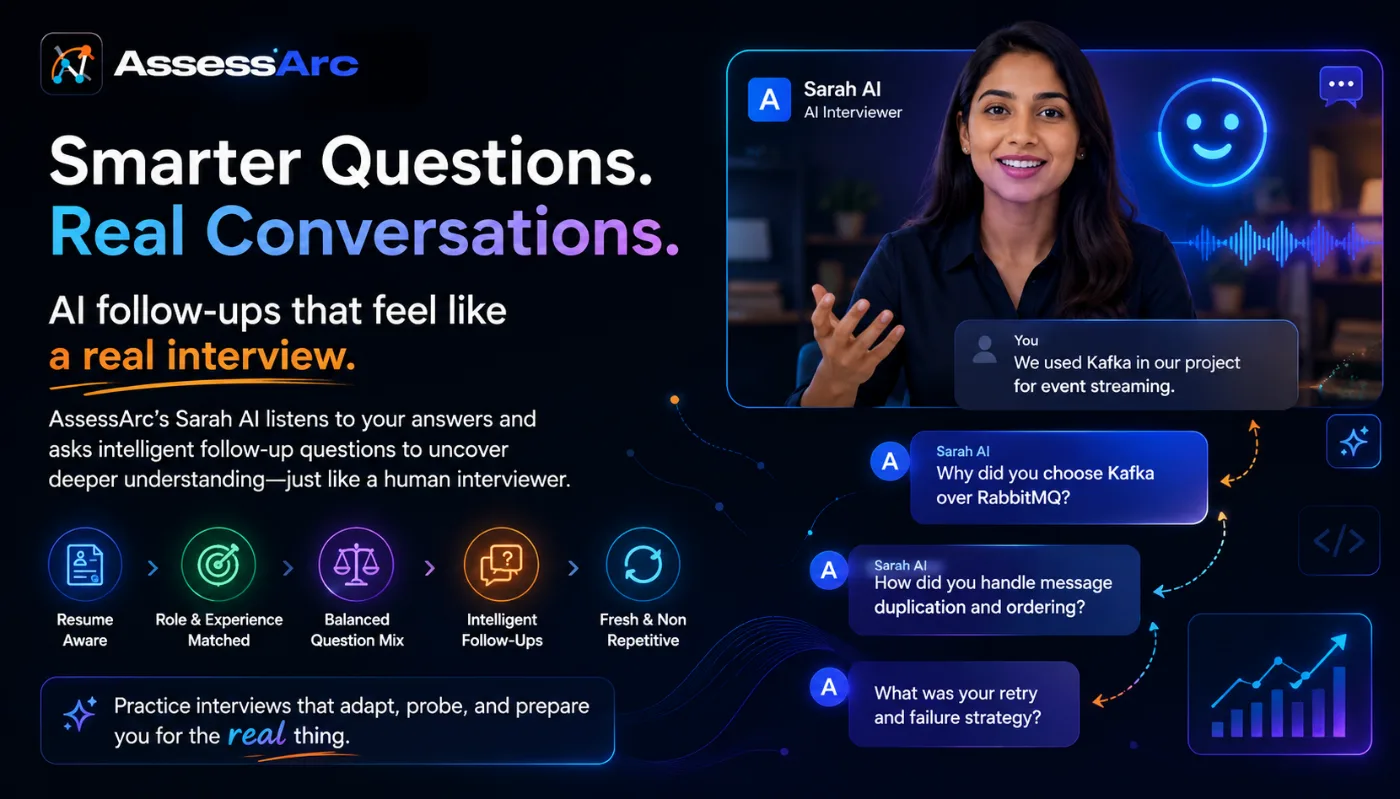
Question: Why did you use Kafka in your project?
Candidate: We used Kafka because it handles high throughput and supports asynchronous communication between microservices.
In many mock interview platforms, the conversation ends there.
The next question appears.
However, a real interviewer would immediately become curious about the candidate's experience.
They may ask:
Why Kafka instead of RabbitMQ?
How did you handle failed messages?
What retry strategy did you implement?
How did you prevent duplicate processing?
How did you monitor consumer lag?
How did you guarantee message ordering?
Suddenly, the discussion becomes much deeper.
These follow-up questions reveal whether the candidate has practical experience or simply knows the theory.
Unfortunately, most candidates never get an opportunity to practice these conversations before their actual interview.
Real Interviews Are Conversations, Not Questionnaires
One of the biggest misconceptions about interview preparation is believing that interviews are simply a collection of questions.
In reality, interviews are conversations.
A senior engineer interviewing a candidate does not work through a checklist and move on.
Instead, they:
Listen carefully
Analyze responses
Explore interesting topics
Investigate knowledge gaps
Challenge assumptions
Ask follow-up questions
Their goal is not to test memorization.
Their goal is to understand how a candidate thinks.
This is why experienced interviewers often spend several minutes discussing a single answer.
A simple question can evolve into an architecture discussion, a production troubleshooting scenario, or a deep technical conversation.
Traditional mock interview platforms struggle to replicate this behavior.
AssessArc was built to solve exactly that problem.
Introducing AssessArc's Question Intelligence System
At AssessArc, we wanted interview practice to feel more realistic.
That meant building an AI interviewer that could do more than ask questions.
Sarah AI needed to:
Understand context
Analyze answers
Identify important topics
Explore implementation details
Ask relevant follow-up questions
This became the foundation of AssessArc's Question Intelligence System.
Rather than relying on a fixed question bank, Sarah AI dynamically generates and adapts interview conversations based on each candidate's profile and responses.
The objective isn't to ask more questions.
The objective is to ask better questions.
Questions that reveal knowledge.
Questions that expose weaknesses.
Questions that encourage deeper thinking.
Questions that feel like they came from a real interviewer.
How AssessArc Creates Personalized Interview Conversations
Every interview inside AssessArc starts with context.
Before asking the first question, Sarah AI analyzes multiple factors including:
Resume content
Skills
Technologies
Projects
Experience level
Target role
This allows AssessArc to create interviews tailored to each candidate.
Example 1
Role: Java Developer
Experience: 4 Years
Potential focus areas:
Spring Boot
Microservices
Kafka
System Design
Performance Optimization
Production Scenarios
Example 2
Role: Data Analyst
Experience: Fresher
Potential focus areas:
SQL
Excel
Statistics
Data Visualization
Business Cases
Project Discussions
The result is a personalized interview rather than a generic set of questions.
Building a Balanced Question Mix
Real interviews rarely focus on a single category.
A candidate may encounter technical questions, behavioral questions, project discussions, coding challenges, and architecture conversations within the same interview.
To reflect this reality, AssessArc balances multiple question types.
Concept Questions
These questions evaluate technical fundamentals.
Examples:
What is Dependency Injection?
What is Kafka?
What is a Circuit Breaker?
Resume Deep Dives
Questions generated from technologies and projects mentioned in the resume.
Examples:
Explain the payment system you built.
Why did you choose PostgreSQL?
What challenges did you face in production?
Scenario-Based Questions
Questions designed to evaluate decision-making.
Examples:
How would you debug a memory leak?
What would you do if Kafka consumer lag suddenly increased?
How would you scale a microservice handling millions of requests?
Coding Discussions
Technical problem-solving conversations.
Examples:
Design an LRU Cache.
Optimize this SQL query.
Improve the performance of this API.
Behavioral Questions
Questions that evaluate communication and professional experience.
Examples:
Tell me about a difficult production issue.
Describe a conflict within your team.
Explain a decision you regret.
Traditional Mock Interviews vs AssessArc
The easiest way to understand the value of AI Follow-Up Questions is through comparison.
Traditional Mock Interview
Question: Why did you use Kafka?
Candidate: Because Kafka handles high throughput.
System: Answer recorded.
Next Question: What is Docker?
The platform moves forward without understanding whether the candidate has real-world Kafka experience.
AssessArc Interview
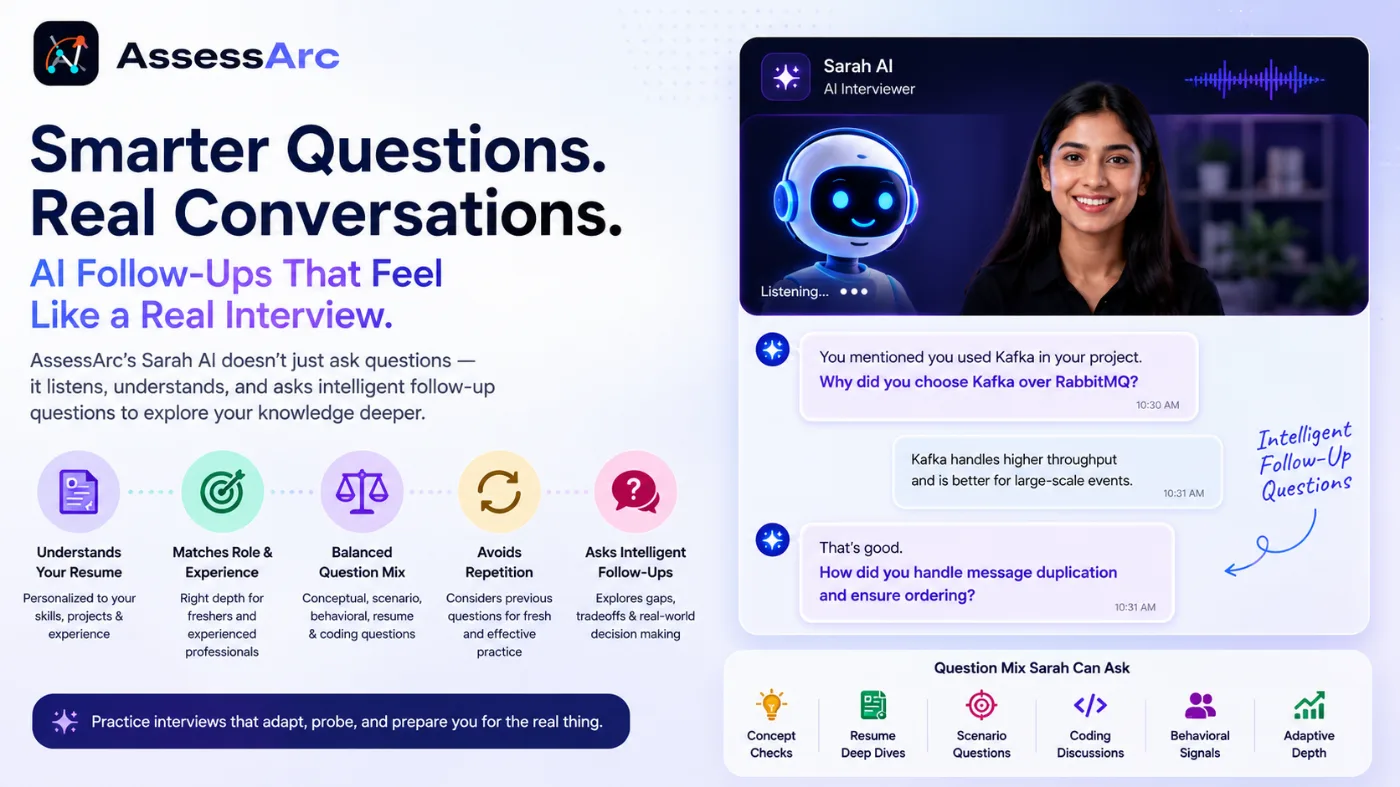
Sarah AI: Why did you use Kafka?
Candidate: Because Kafka handles high throughput.
Sarah AI: Why did your team choose Kafka instead of RabbitMQ?
Candidate: Because our event volume was significantly higher.
Sarah AI: How did you handle failed message processing?
Candidate: We implemented retry topics and dead-letter topics.
Sarah AI: How did you prevent duplicate processing?
Candidate: We used idempotent consumers and unique transaction identifiers.
At this point Sarah AI is evaluating:
Technical depth
Architecture decisions
Production experience
Problem-solving ability
Communication skills
This feels much closer to a real interview conversation.
Why AI Follow-Up Questions Matter
Follow-up questions reveal information that standard questions often miss.
They Reveal Technical Depth
Many candidates know definitions.
Fewer candidates understand implementation details.
They Reveal Practical Experience
Follow-up questions help distinguish real project experience from theoretical knowledge.
They Reveal Decision Making
Interviewers want to understand:
Why a technology was chosen
What alternatives existed
What trade-offs were considered
They Reveal Communication Skills
Candidates must explain:
Technical concepts
Project decisions
Architecture choices
Production challenges
Clearly and confidently.
Benefits of Intelligent Follow-Up Questions
AssessArc's follow-up questioning system provides several important benefits.
1. Identify Hidden Knowledge Gaps
Candidates often discover weaknesses they didn't know existed.
Examples include:
Kafka retry strategies
Redis cache invalidation
Database indexing
System design trade-offs
API performance optimization
2. Improve Communication Skills
Knowing a concept and explaining a concept are different skills.
AssessArc helps candidates practice:
Technical discussions
Architecture explanations
Trade-off analysis
Project storytelling
3. Build Confidence
The more realistic the interview practice, the more confident candidates become during actual interviews.
4. Prepare for Senior-Level Interviews
Senior interviews focus heavily on:
Decision making
Trade-offs
Production challenges
Architecture discussions
AssessArc helps candidates prepare for these conversations.
What Makes AssessArc Different?
AssessArc combines multiple intelligence layers to create realistic interview experiences.
Question Intelligence
Sarah AI analyzes:
✅ Resume context
✅ Skills and technologies
✅ Experience level
✅ Previous interview flow
✅ Question history
Balanced Question Mix
Sarah can generate:
Concept Questions
Resume Deep Dives
Scenario-Based Questions
Coding Discussions
Behavioral Questions
Architecture Conversations
Adaptive Depth
When an answer reveals an important knowledge gap or technical decision, Sarah AI can ask a focused follow-up question to explore the topic further.
This creates interviews that feel significantly more human and realistic.
The Future of Interview Preparation
The future of interview preparation is not larger question banks.
It is smarter interviewers.
Candidates don't need hundreds of random questions.
They need meaningful conversations.
They need personalized feedback.
They need realistic interview simulations.
They need systems that understand context and adapt to their answers.
That is exactly what AssessArc's AI Follow-Up Questions are designed to deliver.
Conclusion
The most important part of an interview is often not the first answer.
It is what comes next.
The explanation.
The reasoning.
The trade-offs.
The decisions.
The discussion.
Real interviewers evaluate candidates through conversations, not questionnaires.
With Intelligent AI Follow-Up Questions, AssessArc helps candidates experience those conversations before they walk into their actual interview.
Because successful interviews are not about memorizing answers.
They are about understanding concepts, explaining decisions, and confidently handling the deeper questions that follow.