Why Follow-Up Questions Matter in AI Mock Interviews (And How AssessArc Makes Practice Feel Real)
Discover how AssessArc uses AI-powered follow-up interview questions to simulate real interview conversations. Learn why adaptive questioning improves interview preparati
Why Follow-Up Questions Matter in AI Mock Interviews (And How AssessArc Makes Practice Feel Real)
Introduction
Most mock interview platforms ask a question, wait for an answer, provide feedback, and move on.
Real interviews don't work that way.
In an actual interview, experienced interviewers listen carefully to your response and often ask follow-up questions to explore your understanding, challenge your assumptions, or uncover gaps in your knowledge.
This is one of the biggest reasons candidates feel confident during practice but struggle during real interviews.
To solve this problem, AssessArc has introduced intelligent AI-powered follow-up questioning that makes interview practice feel much closer to a real conversation with a human interviewer.
The Problem with Traditional Mock Interviews
Many interview preparation platforms rely on static question banks.
The process usually looks like this:
Question 1
Candidate answers
Question 2
Candidate answers
Question 3
The interview continues in a fixed sequence regardless of what the candidate says.
This creates several problems:
No Deeper Exploration
If a candidate gives a vague answer, the system moves on.
In a real interview, the interviewer would ask:
Can you explain that further?
Why did you choose that approach?
What alternatives did you consider?
What challenges did you face?
No Knowledge Validation
A candidate might mention a technology or architecture pattern without fully understanding it.
Traditional systems rarely verify whether the knowledge is genuine.
Unrealistic Interview Experience
Real interviews are conversations.
Static question-answer flows often feel like quizzes instead of interviews.
How Human Interviewers Actually Evaluate Candidates
Experienced interviewers do not simply read questions from a list.
They continuously analyze:
The quality of your answer
Your confidence
Technical depth
Practical experience
Decision-making ability
When something interesting appears in your answer, they ask a follow-up question.
For example:
Initial Question
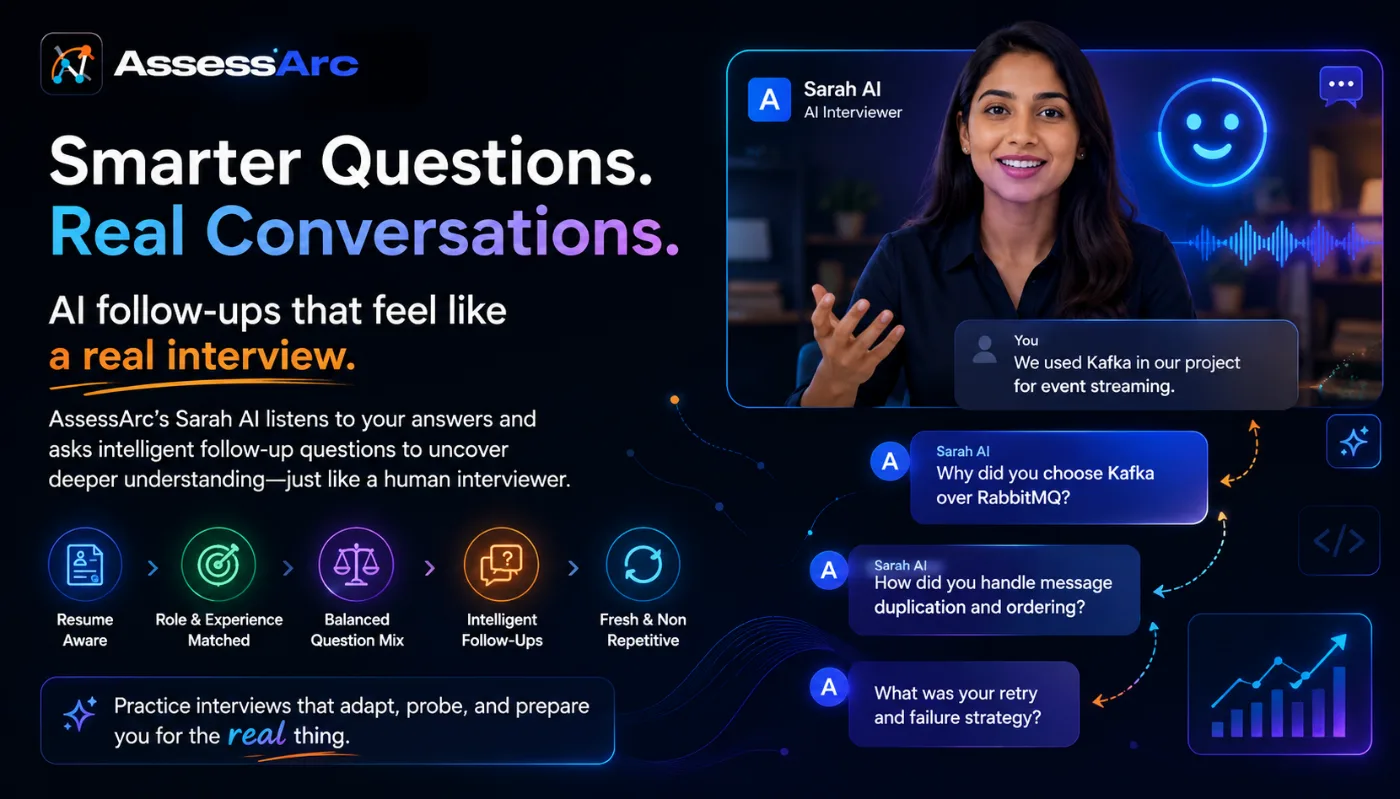
What is Kafka and why did you use it?
Candidate Answer
We used Kafka to improve communication between microservices.
Human Follow-Up
Why did you choose Kafka instead of RabbitMQ?
Candidate Answer
Because Kafka handles higher throughput.
Human Follow-Up
How did you handle message duplication?
Human Follow-Up
What was your retry strategy?
Human Follow-Up
How did you ensure ordering?
This chain of questioning helps interviewers understand whether the candidate has real production experience or only theoretical knowledge.
Introducing Adaptive Follow-Up Questions in AssessArc
AssessArc now includes intelligent follow-up questioning powered by Sarah AI.
Instead of simply moving to the next question, Sarah can analyze the interview conversation and decide whether a focused follow-up question is valuable.
The goal is not to ask endless questions.
The goal is to simulate how a real interviewer thinks.
When an answer reveals:
An important knowledge gap
A technical tradeoff
A production scenario
An architecture decision
A project detail worth exploring
Sarah may ask a relevant follow-up question before moving forward.
This creates a more realistic interview experience.
How AssessArc Generates Interview Questions
AssessArc does not rely on a fixed question bank.
Sarah AI builds interview questions using multiple signals.
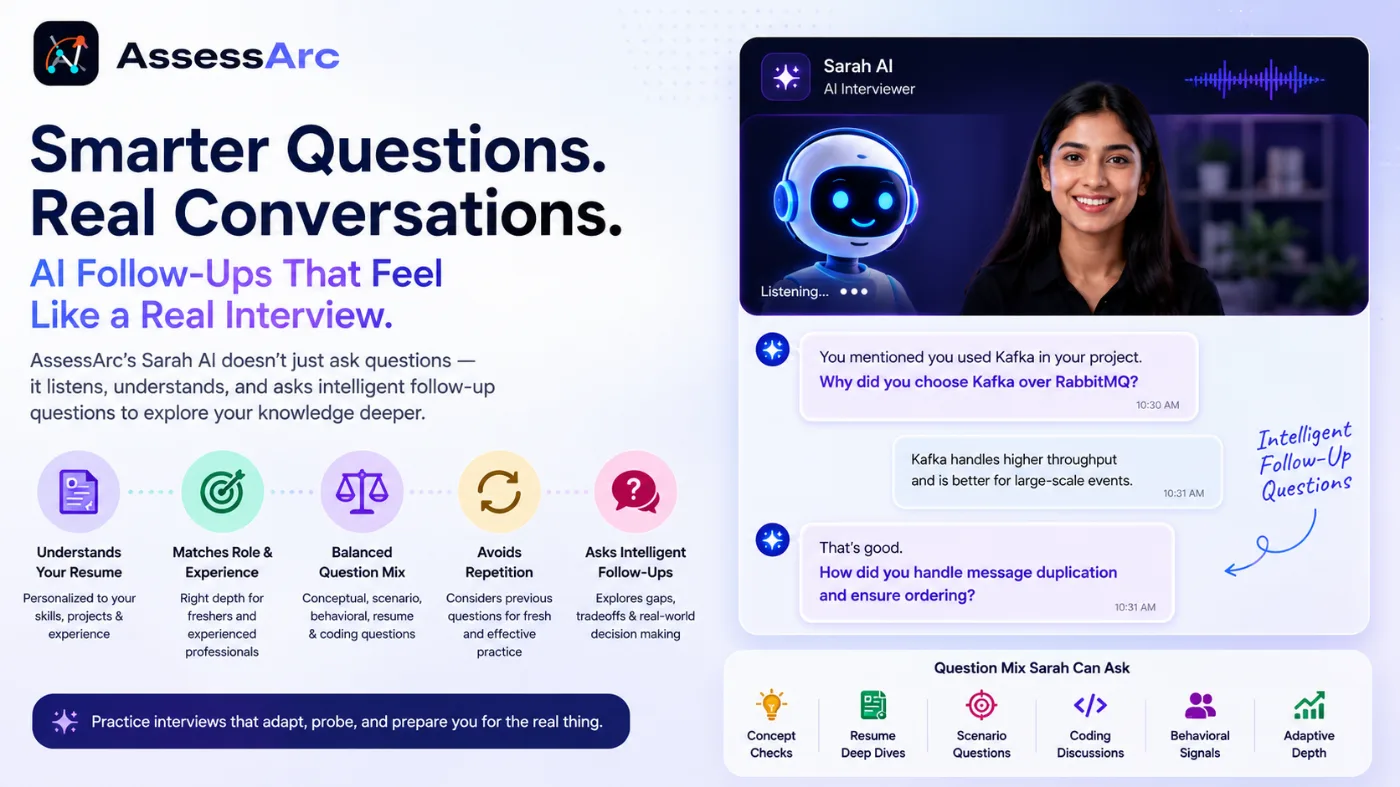
1. Resume Understanding
Sarah studies:
Skills
Projects
Technologies
Work experience
Responsibilities
Achievements
Instead of asking generic questions, the interview becomes personalized.
For example, if your resume mentions:
Spring Boot
Kafka
Microservices
PostgreSQL
Sarah can generate questions specifically related to those technologies.
2. Role-Based Intelligence
Different roles require different interview strategies.
A fresher Java developer may receive:
OOP concepts
Collections
Exception handling
Project explanation
An experienced Java developer may receive:
Microservices architecture
Kafka scalability
Database optimization
Distributed transactions
Production troubleshooting
The interview depth adapts to experience level.
3. Balanced Question Mix
Real interviews are rarely limited to one category.
AssessArc balances multiple question types:
Concept Questions
Fundamental technical understanding.
Examples:
What is dependency injection?
What is polymorphism?
Resume-Based Questions
Questions generated from your actual experience.
Examples:
Explain the payment archiving system mentioned in your project.
Why did you choose Cosmos DB?
Scenario-Based Questions
Real-world problem-solving situations.
Examples:
What would you do if Kafka starts lagging?
How would you debug a memory leak?
Behavioral Questions
Communication and decision-making evaluation.
Examples:
Describe a challenging situation.
Tell me about a production issue you handled.
Coding Discussions
Technical problem-solving and implementation thinking.
4. Intelligent Follow-Up Questions
This is where the interview becomes more realistic.
If Sarah identifies something important in your answer, she may continue with one focused follow-up question.
For example:
Candidate:
"We used caching to improve performance."
Follow-Up:
"What cache invalidation strategy did you use?"
Candidate:
"We implemented microservices."
Follow-Up:
"How did services communicate with each other?"
Candidate:
"We used Kafka."
Follow-Up:
"How did you handle failed message processing?"
These follow-ups help uncover deeper understanding.
Why Follow-Up Questions Improve Interview Preparation
They Reveal Knowledge Gaps
Many candidates believe they understand a topic until a follow-up question is asked.
The second question often exposes areas that need improvement.
They Build Confidence
When candidates practice handling deeper discussions, real interviews become less intimidating.
They Improve Communication
Candidates learn how to explain:
Technical decisions
Tradeoffs
Architecture choices
Production challenges
more clearly and confidently.
They Simulate Real Interviews
Most importantly, follow-up questions make the experience feel closer to what candidates face in actual hiring processes.
Example: Traditional Mock Interview vs AssessArc
Traditional Mock Interview
Question:
What is Kafka?
Answer:
Kafka is a messaging platform.
Next Question:
What is Docker?
AssessArc Interview
Question:
What is Kafka?
Answer:
Kafka is a messaging platform.
Follow-Up:
Why did your team choose Kafka instead of RabbitMQ?
Answer:
Because Kafka handles large-scale events.
Follow-Up:
How did you handle retries and failed messages?
Follow-Up:
How did you ensure message ordering?
This deeper conversation provides significantly better interview practice.
Who Benefits Most from Follow-Up Questions?
Freshers
Follow-up questions help freshers:
Understand fundamentals better
Explain projects clearly
Gain interview confidence
Experienced Developers
Follow-up questions help experienced professionals:
Prepare for senior-level interviews
Discuss architecture decisions
Explain production systems
Handle scenario-based questioning
Career Switchers
Candidates moving into new roles can test whether they truly understand the technologies listed on their resumes.
The Future of AI Interview Preparation
The future of interview preparation is not about larger question banks.
It is about smarter conversations.
Candidates need practice that feels realistic, adaptive, and personalized.
By combining:
Resume understanding
Role awareness
Scenario-based questioning
Behavioral evaluation
Coding discussions
Intelligent follow-up questions
AssessArc is helping candidates experience interviews that are much closer to real hiring conversations.
Final Thoughts
Real interviewers do not simply ask questions.
They listen, analyze, challenge, and explore.
That is exactly why follow-up questions matter.
With intelligent adaptive questioning, AssessArc helps candidates move beyond memorized answers and prepare for the deeper conversations that happen in real interviews.
If you want mock interview practice that feels closer to an actual interview rather than a static question bank, intelligent follow-up questioning can make a significant difference in your preparation journey.