Why Most Candidates Fail Technical Interviews Even When They Know the Answers
Many candidates know the technical concepts but still fail interviews. Learn the common reasons candidates get rejected and how AI mock interviews help improve interview
Why Most Candidates Fail Technical Interviews Even When They Know the Answers
Introduction
One of the biggest surprises candidates experience after an interview is rejection despite knowing the answers to most technical questions.
Many software engineers leave interviews feeling confident.
They solved coding problems.
They answered Java, Spring Boot, React, SQL, or system design questions correctly.
Yet the result is often the same:
"We have decided to move forward with other candidates."
This raises an important question:
If technical knowledge is enough, why do so many candidates still fail interviews?
The answer is simple.
Interviewers evaluate much more than correctness.
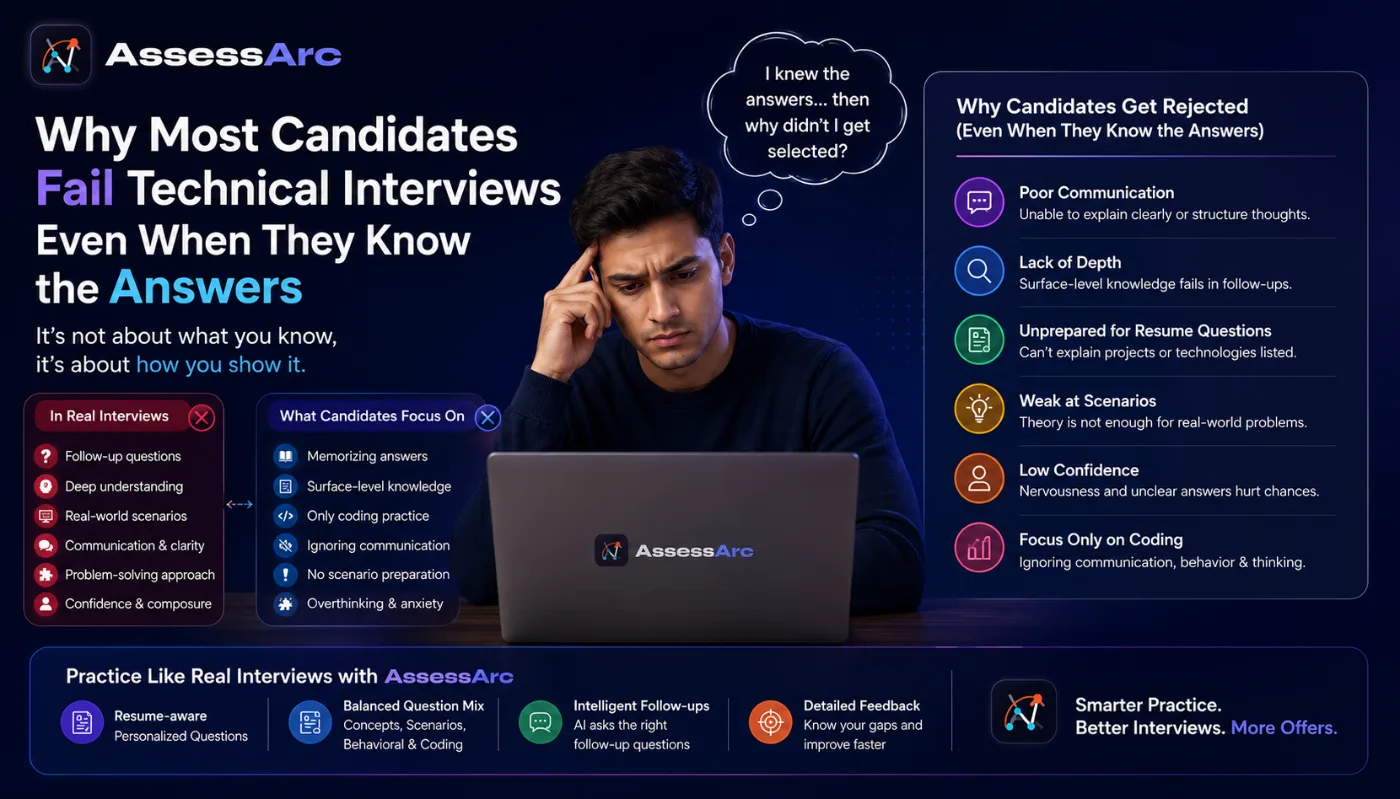
They assess communication, confidence, depth of understanding, problem-solving approach, decision-making, and real-world experience.
Understanding these factors can dramatically improve your interview success rate.
Interviewers Are Not Looking for Google Answers
Most technical concepts can be found online in seconds.
Interviewers know this.
They are not testing whether you memorized definitions.
Instead, they want to understand:
How deeply you understand a topic
Whether you can explain it clearly
How you make technical decisions
Whether you can apply knowledge in real situations
For example:
Weak Answer
"What is Kafka?"
"Kafka is a distributed messaging system."
Correct?
Yes.
Impressive?
Not really.
Strong Answer
"Kafka is a distributed event streaming platform we used in our microservices architecture. We chose Kafka because we needed high throughput and reliable asynchronous communication between services."
Both answers are technically correct.
But the second answer demonstrates practical experience.
Poor Communication Is a Major Reason for Rejection
Many candidates know the answer internally but struggle to explain it.
Interviewers cannot evaluate what remains inside your head.
They can only evaluate what you communicate.
Common communication mistakes include:
Giving one-line answers
Speaking without structure
Jumping between topics
Using unnecessary jargon
Not explaining decisions
Example
Question:
Why did you choose microservices?
Weak answer:
"Because microservices are scalable."
Strong answer:
"We chose microservices because different modules had independent scaling requirements. It also allowed separate deployments and reduced dependency between teams."
The second answer demonstrates reasoning.
Reasoning is what interviewers evaluate.
Lack of Depth Gets Exposed Quickly
Many candidates prepare surface-level answers.
This works until follow-up questions begin.
Example:
Candidate:
"We implemented Redis caching."
Interviewer:
"What cache invalidation strategy did you use?"
Candidate:
"Umm..."
The problem isn't Redis.
The problem is shallow understanding.
Experienced interviewers use follow-up questions to verify whether experience is genuine.
Resume-Based Questions Cause Unexpected Failures
Candidates often underestimate resume-based interviews.
Anything written on your resume becomes fair game.
Suppose your resume says:
Kafka
Kubernetes
Spring Boot
Microservices
The interviewer assumes you understand them.
If you cannot explain implementation details, it raises concerns.
This is why candidates should prepare every project and technology listed on their resume.
Scenario-Based Questions Matter More Than Theory
Modern interviews increasingly focus on scenarios.
Interviewers ask questions such as:
Production service is down. What do you do?
Kafka consumer lag is increasing. How would you investigate?
Database latency suddenly doubles. What's your approach?
These questions reveal:
Problem-solving ability
Practical experience
Decision-making skills
Companies value these skills because real jobs involve solving problems rather than reciting definitions.
Confidence and Clarity Influence Hiring Decisions
Confidence does not mean speaking loudly.
Confidence means:
Explaining concepts clearly
Staying calm under pressure
Thinking logically
Admitting uncertainty when necessary
Interviewers often prefer candidates who confidently explain their thinking process over candidates who provide rushed answers.
Coding Is Not the Only Evaluation Area
Many candidates focus exclusively on coding questions.
However, interviews typically evaluate multiple dimensions:
Technical Knowledge
Fundamentals and concepts.
Problem Solving
How you approach unfamiliar challenges.
Communication
How effectively you explain ideas.
Behavioral Skills
Teamwork, ownership, conflict resolution.
System Thinking
Architecture and scalability decisions.
Ignoring any one of these areas can reduce your chances.
Why Mock Interviews Help
Mock interviews expose weaknesses before real interviews do.
Candidates often discover:
Communication issues
Missing concepts
Weak project explanations
Poor confidence
Incomplete answers
The earlier these issues are identified, the easier they are to fix.
How AI Mock Interviews Improve Preparation
Traditional preparation often involves:
Reading articles
Watching videos
Memorizing questions
The problem?
Learning and interviewing are different skills.
Interviewing requires practice.
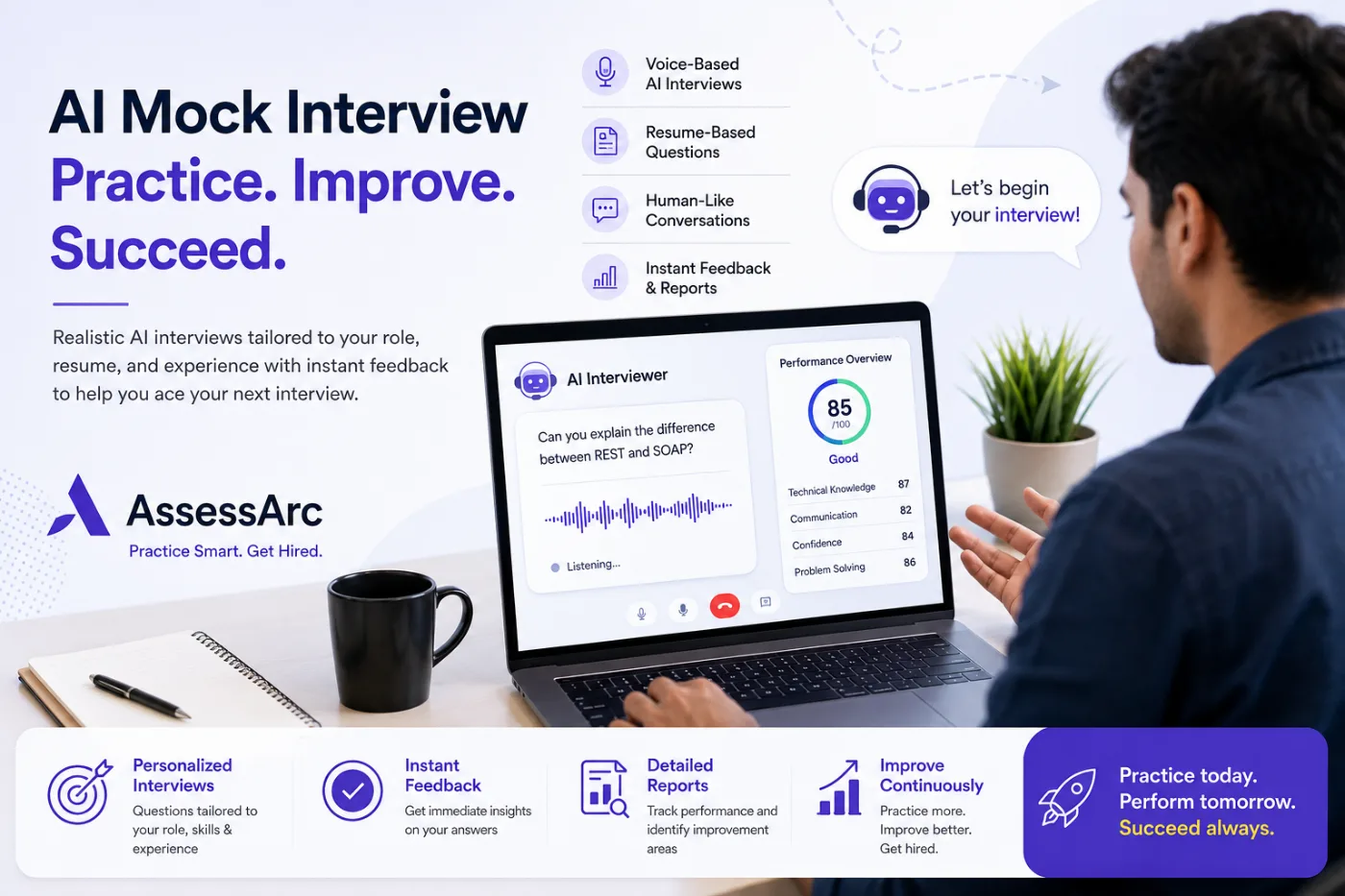
AI-powered mock interviews help candidates:
Practice speaking answers
Improve communication
Handle follow-up questions
Explain projects better
Receive performance feedback
This creates a more realistic preparation experience.
How AssessArc Helps Candidates Prepare Better
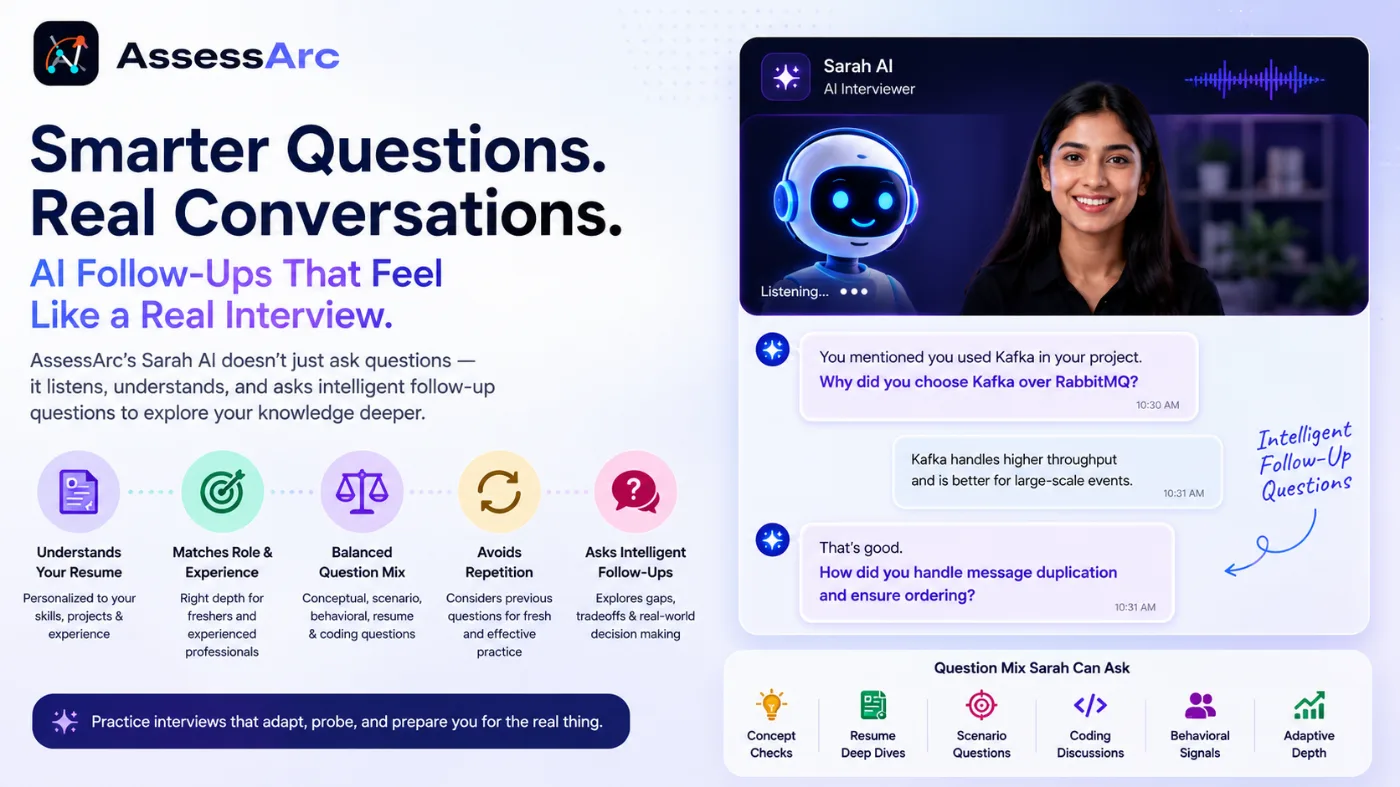
AssessArc simulates real interview conversations using Sarah AI.
Instead of asking random questions, AssessArc:
Understands your resume
Adapts to your role and experience
Generates personalized questions
Mixes conceptual and scenario-based questions
Asks intelligent follow-up questions
Provides detailed feedback after every interview
The goal is not simply to test knowledge.
The goal is to help candidates improve interview performance.
Final Thoughts
Most candidates do not fail because they lack technical knowledge.
They fail because they struggle to communicate that knowledge effectively.
Real interviews evaluate much more than correctness.
They evaluate understanding, confidence, decision-making, communication, and practical experience.
The best preparation strategy is not memorization.
It is realistic interview practice.
The more interview conversations you experience before the actual interview, the more confident and prepared you become.
And that can often make the difference between rejection and an offer letter.