How to Crack a Java Developer Interview in 2026: Complete Roadmap
Learn the complete roadmap to crack Java developer interviews in 2026. Covers Core Java, Spring Boot, Microservices, Kafka, System Design, and interview preparation strat
How to Crack a Java Developer Interview in 2026: Complete Roadmap
Java continues to be one of the most in-demand technologies for backend development, enterprise applications, cloud platforms, and microservices.
However, many candidates spend months preparing and still struggle during interviews.
The reason is simple:
Most candidates focus only on learning technologies but don't prepare according to what companies actually ask.
This roadmap will help you prepare effectively for Java developer interviews in 2026.
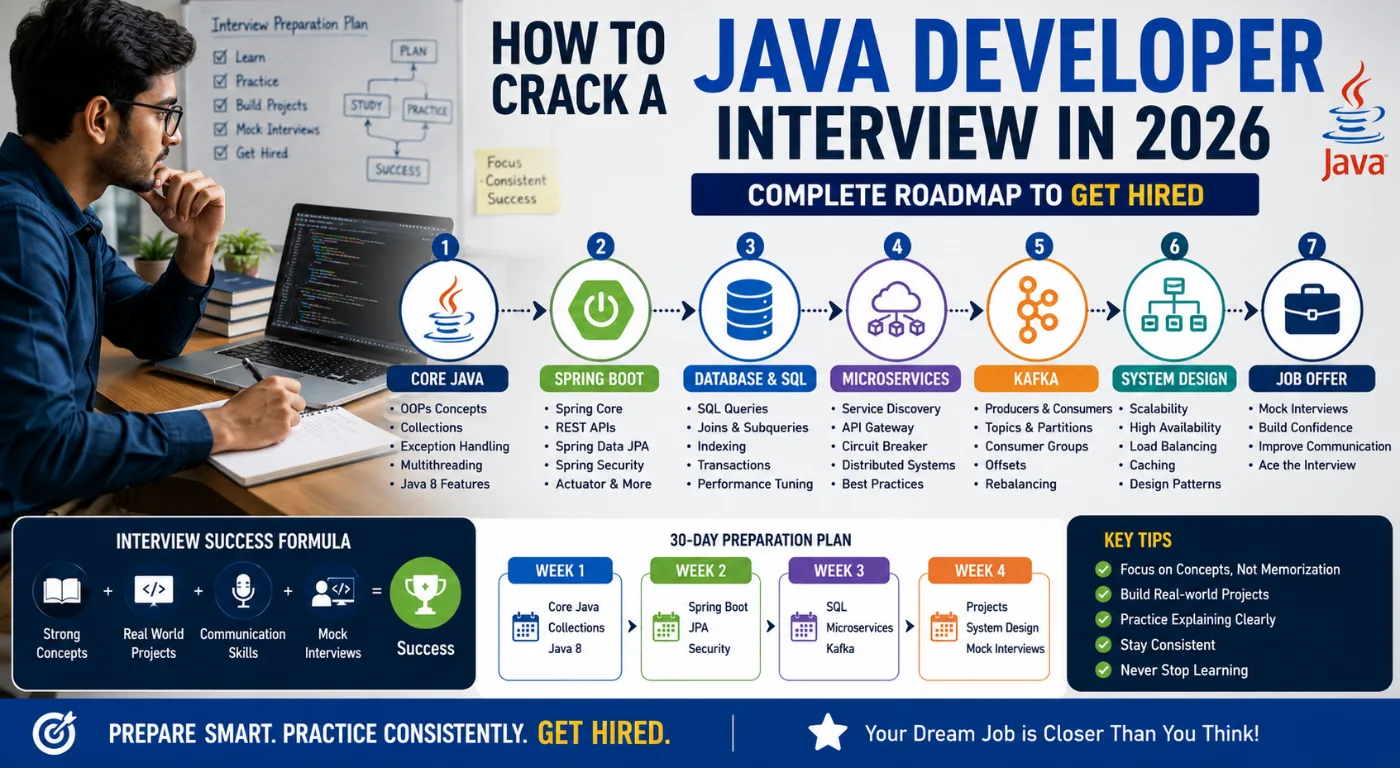
Step 1: Master Core Java
Every Java interview starts with Core Java fundamentals.
Important topics include:
OOP Concepts
Encapsulation
Inheritance
Polymorphism
Abstraction
Collections Framework
ArrayList
LinkedList
HashMap
HashSet
ConcurrentHashMap
Exception Handling
Checked Exceptions
Unchecked Exceptions
Custom Exceptions
Java 8 Features
Streams
Lambda Expressions
Functional Interfaces
Optional API
Multithreading
Thread Lifecycle
Synchronization
Executor Framework
Callable and Future
CompletableFuture
Interview Tip:
Most experienced Java interviews contain at least 30-40% Core Java questions.
Step 2: Learn Spring Boot Thoroughly
Spring Boot is almost mandatory for modern Java backend roles.
Focus on:
Dependency Injection
Bean Lifecycle
REST APIs
Validation
Exception Handling
Spring Security
JWT Authentication
Spring Data JPA
Caching
Actuator
Interview Tip:
Don't just memorize annotations. Understand why they are used.
Step 3: Master Database Concepts
Interviewers frequently ask database-related questions.
Topics:
SQL
Joins
Subqueries
Indexes
Group By
Normalization
Performance Optimization
Query Optimization
Indexing Strategies
Execution Plans
Transactions
ACID Properties
Isolation Levels
Step 4: Understand Microservices
Many companies now use microservice architectures.
Topics:
Service Discovery
API Gateway
Circuit Breaker
Distributed Transactions
Event-Driven Architecture
Inter-Service Communication
Interviewers often ask:
"Why did your team choose Microservices instead of Monolithic Architecture?"
Be prepared with practical examples.
Step 5: Learn Kafka
Kafka has become a common requirement for backend developers.
Topics:
Producer
Consumer
Consumer Groups
Partitions
Offsets
Rebalancing
Message Ordering
Retry Mechanisms
Production Question:
"What happens when a consumer crashes?"
This is one of the most commonly asked Kafka questions.
Step 6: Prepare Real Project Explanations
Many candidates fail because they cannot explain their projects properly.
Prepare answers for:
Project Overview
Architecture
Responsibilities
Challenges
Performance Improvements
Production Issues
A strong project discussion often creates a better impression than theoretical answers.
Step 7: Learn Basic System Design
For developers with 3+ years experience, system design questions are becoming increasingly common.
Examples:
Design URL Shortener
Design Notification System
Design Chat Application
Design Payment System
Focus on:
Scalability
Availability
Fault Tolerance
Step 8: Prepare Behavioral Questions
Technical knowledge alone is not enough.
Common questions:
Tell me about yourself.
Why are you changing jobs?
Describe a conflict you handled.
Tell us about a difficult production issue.
Use the STAR method:
Situation
Task
Action
Result
Step 9: Practice Mock Interviews
Many candidates know the answers but struggle during actual interviews.
Common reasons:
Nervousness
Poor communication
Lack of confidence
Difficulty organizing thoughts
Mock interviews help bridge this gap by simulating real interview conditions.
Common Mistakes Candidates Make
Learning Too Many Technologies
Depth is more important than quantity.
Ignoring Projects
Projects are often discussed more than certifications.
Skipping Communication Practice
Strong communication significantly improves interview performance.
Not Practicing Real Interviews
Knowledge without practice rarely leads to success.
30-Day Java Interview Preparation Plan
Week 1
Core Java
Collections
Java 8
Week 2
Spring Boot
JPA
Security
Week 3
SQL
Microservices
Kafka
Week 4
Projects
System Design
Mock Interviews
Final Thoughts
Cracking a Java developer interview in 2026 requires more than just technical knowledge.
Successful candidates combine:
Strong Core Java
Spring Boot Expertise
Database Knowledge
Microservices Understanding
Kafka Concepts
Project Experience
Communication Skills
The best preparation strategy is to learn concepts, apply them in projects, and regularly practice mock interviews to gain confidence before the real interview.