Meta Interview Preparation Guide 2026: Complete Roadmap to Crack Meta Software Engineering Interviews
Complete Meta interview preparation guide covering coding, system design, behavioral interviews and mock interview practice for 2026.
Meta Interview Preparation Guide 2026: Complete Roadmap to Crack Meta Software Engineering Interviews
Meta (formerly Facebook) is one of the most competitive technology companies in the world.
Every year, thousands of software engineers apply for roles across:
Facebook
Instagram
WhatsApp
Messenger
Threads
Reality Labs
Meta AI
The challenge?
Meta interviews are designed to identify exceptional engineers who can solve complex problems at scale.
Candidates are expected to demonstrate:
Strong coding skills
Deep problem-solving ability
System design expertise
Communication skills
Product thinking
Technical leadership
The good news is that Meta interviews follow a structured process.
If you understand how Meta evaluates candidates and prepare strategically, your chances of receiving an offer increase significantly.
This guide covers everything you need to know about Meta interview preparation in 2026.
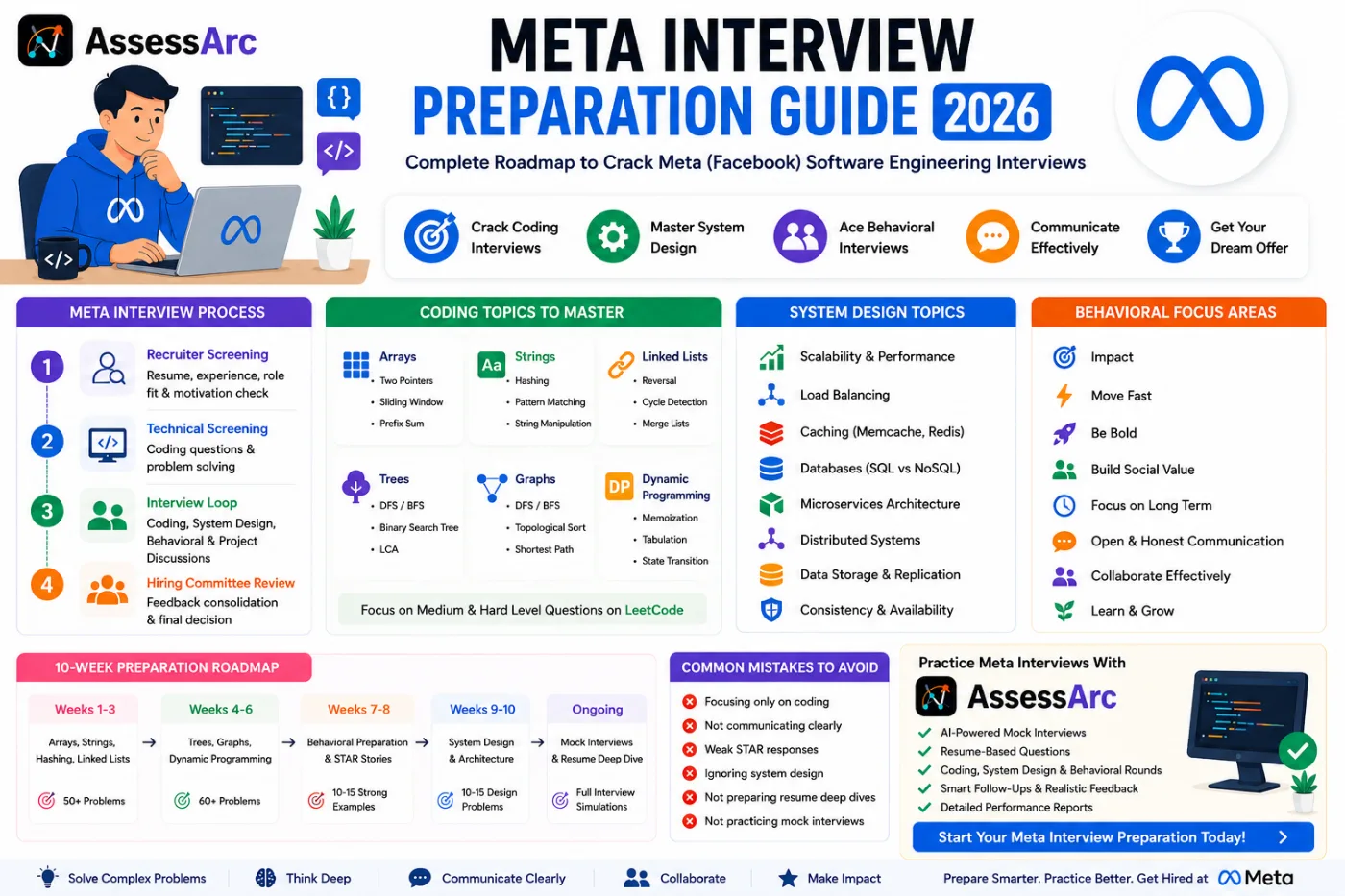
Understanding Meta's Interview Process
The exact process varies by role and experience level, but most Software Engineer interviews follow a similar structure.
Step 1: Recruiter Screening
The recruiter evaluates:
Resume
Experience
Technical skills
Role fit
Common questions:
Tell me about yourself.
Why Meta?
What projects have you worked on recently?
What technologies do you use daily?
Step 2: Technical Screening
This usually includes:
Coding Problems
Live coding session.
Problem Solving
Interviewers evaluate thinking process.
Communication
Ability to explain solutions clearly.
Step 3: Virtual / Onsite Interview Loop
Typically includes:
Coding Interviews
2–3 rounds
System Design
For experienced candidates
Behavioral Interviews
Culture and collaboration assessment
Project Deep Dive
Resume-based discussions
Step 4: Hiring Committee Review
Interview feedback is reviewed before final hiring decisions.
What Meta Looks For
Meta is known for having one of the strongest engineering cultures in the industry.
Interviewers typically evaluate:
Coding Excellence
Can you write efficient code quickly?
Problem Solving
Can you solve unfamiliar problems?
Execution Speed
Can you move fast without sacrificing quality?
Communication
Can you explain clearly?
Impact
Have you delivered meaningful results?
Collaboration
Can you work effectively with teams?
Meta Coding Interview Preparation
Coding interviews are the most important part of Meta's hiring process.
You should master the following topics.
Arrays
Very common at Meta.
Topics:
Sliding Window
Two Pointers
Prefix Sum
Popular Questions:
Two Sum
Product of Array Except Self
Container With Most Water
Strings
Topics:
Hash Maps
Pattern Matching
String Processing
Popular Questions:
Group Anagrams
Longest Substring Without Repeating Characters
Linked Lists
Topics:
Reversal
Fast & Slow Pointers
Cycle Detection
Popular Questions:
Reverse Linked List
Linked List Cycle
Trees
Meta frequently asks tree-based problems.
Topics:
DFS
BFS
Binary Trees
BST
Popular Questions:
Lowest Common Ancestor
Binary Tree Level Order Traversal
Graphs
Important concepts:
DFS
BFS
Topological Sort
Popular Questions:
Number of Islands
Clone Graph
Dynamic Programming
Frequently appears for experienced candidates.
Examples:
House Robber
Coin Change
Longest Increasing Subsequence
Best Resources for Meta Coding Preparation
LeetCode
Meta interviews are heavily aligned with LeetCode-style questions.
Focus on:
Meta Tagged Questions
Medium Problems
Hard Problems
Target:
150–250 quality problems.
HackerRank
Useful for strengthening fundamentals.
CodeSignal
Helpful for online assessments.
Meta System Design Interview Preparation
For mid-level and senior engineers, system design becomes critical.
Meta operates products used by billions of people.
Interviewers expect candidates to think at scale.
Common Meta System Design Questions
Design Facebook News Feed
Topics:
Ranking
Scalability
Data Distribution
Design Instagram
Topics:
Media Storage
Feed Generation
Design WhatsApp
Topics:
Messaging Architecture
Real-Time Communication
Design Facebook Messenger
Topics:
Delivery Guarantees
Presence Systems
Design URL Shortener
Classic system design problem.
Key Concepts to Master
Scalability
Horizontal Scaling
Vertical Scaling
Caching
Redis
Memcached
Databases
SQL
NoSQL
Load Balancing
Traffic Distribution
Microservices
Service Decomposition
Distributed Systems
Replication
Partitioning
Consistency
Event-Driven Architecture
Kafka
Message Queues
Meta Behavioral Interview Preparation
Many candidates underestimate behavioral interviews.
Meta wants engineers who can:
Deliver impact
Move fast
Collaborate
Learn continuously
Common Meta Behavioral Questions
Tell Me About Yourself
Prepare a concise professional story.
Tell Me About a Project You're Proud Of
Focus on:
Problem
Solution
Impact
Describe a Difficult Technical Challenge
Interviewers evaluate:
Problem-solving
Technical depth
Tell Me About a Conflict
Demonstrate collaboration and maturity.
Describe a Failure
Show learning and growth.
Why Meta?
Avoid generic answers.
Discuss:
Products
Engineering culture
Scale
AI innovation
STAR Method for Meta Interviews
Meta interviewers appreciate structured answers.
Use STAR format.
Situation
Context.
Task
Responsibility.
Action
Steps taken.
Result
Measurable outcome.
Example
Instead of saying:
"I improved performance."
Say:
Situation:
API latency increased during peak traffic.
Task:
I was responsible for improving response times.
Action:
Implemented Redis caching and query optimization.
Result:
Latency reduced by 55%.
This demonstrates impact clearly.
Resume Deep Dive Preparation
Meta interviewers often spend significant time discussing projects.
Example:
If your resume contains:
React
Node.js
Kafka
AWS
Expect questions such as:
Why did you choose this architecture?
What scaling challenges occurred?
How did you handle failures?
What would you improve today?
Many candidates fail because they prepare coding questions but cannot explain their projects in depth.
Practice Meta Interviews With AssessArc
One of the most effective ways to prepare for Meta interviews is through realistic mock interviews.
AssessArc helps candidates practice:
Meta-style coding interviews
Behavioral interviews
System design discussions
Resume-based project deep dives
Technical communication
Unlike generic interview preparation tools, AssessArc generates personalized interview questions based on:
Resume
Skills
Experience
Projects
This creates realistic Meta interview simulations.
Candidates can practice:
Software Engineer Interviews
Backend Developer Interviews
Full Stack Interviews
React Interviews
Java Interviews
Cloud Engineering Interviews
while receiving detailed AI-powered feedback.
10-Week Meta Interview Preparation Roadmap
Weeks 1–3
Focus:
Arrays
Strings
Hash Maps
Linked Lists
Target:
50+ problems
Weeks 4–6
Focus:
Trees
Graphs
Dynamic Programming
Target:
60+ problems
Weeks 7–8
Focus:
Behavioral Questions
Resume Deep Dives
Prepare:
10–15 strong stories
Weeks 9–10
Focus:
System Design
Mock Interviews
Communication Practice
Target:
Multiple full interview simulations
Common Meta Interview Mistakes
Focusing Only on Coding
Behavioral interviews matter.
Weak Communication
Meta values clarity.
Poor System Design Preparation
Critical for experienced candidates.
Ignoring Resume Questions
Project discussions are heavily tested.
Not Practicing Mock Interviews
Interview confidence comes from practice.
Meta Interview Preparation Checklist
Before your interview, ensure you can:
✅ Solve medium and hard LeetCode problems
✅ Explain time complexity
✅ Explain space complexity
✅ Discuss architecture tradeoffs
✅ Explain every project on your resume
✅ Handle follow-up questions confidently
✅ Communicate clearly
✅ Discuss impact and outcomes
Best Platforms for Meta Interview Preparation
AssessArc
Best overall platform because it combines:
AI mock interviews
Resume-based questions
Coding interviews
Behavioral interviews
System design discussions
Detailed performance reports
LeetCode
Best for coding preparation.
Interviewing.io
Best for human mock interviews.
Exponent
Best for system design learning.
Pramp
Best free peer interview platform.
Why Mock Interviews Matter for Meta
Meta interviews move quickly.
Candidates must:
Think fast
Communicate clearly
Solve problems efficiently
Explain technical decisions
Mock interviews help candidates:
Improve confidence
Handle pressure
Refine communication
Identify weaknesses
This often becomes the difference between rejection and receiving an offer.
Final Verdict
Meta interviews are challenging because they combine:
Coding
System Design
Behavioral Evaluation
Project Discussions
Communication Skills
Many candidates spend months solving coding questions but never practice real interview conversations.
This creates a significant preparation gap.
Platforms such as AssessArc help bridge that gap through Meta-style mock interviews, personalized resume-based questioning, system design discussions, behavioral interview preparation, and detailed AI feedback.
If your goal is to receive a Meta offer in 2026, combine coding preparation with communication practice, system design training, and realistic mock interviews for the best chance of success.