Top 25 Java Interview Questions and Answers for Experienced Developers
Prepare for your next Java interview with the most commonly asked Java interview questions and answers for experienced developers. Covers Spring Boot, Collections, Multit
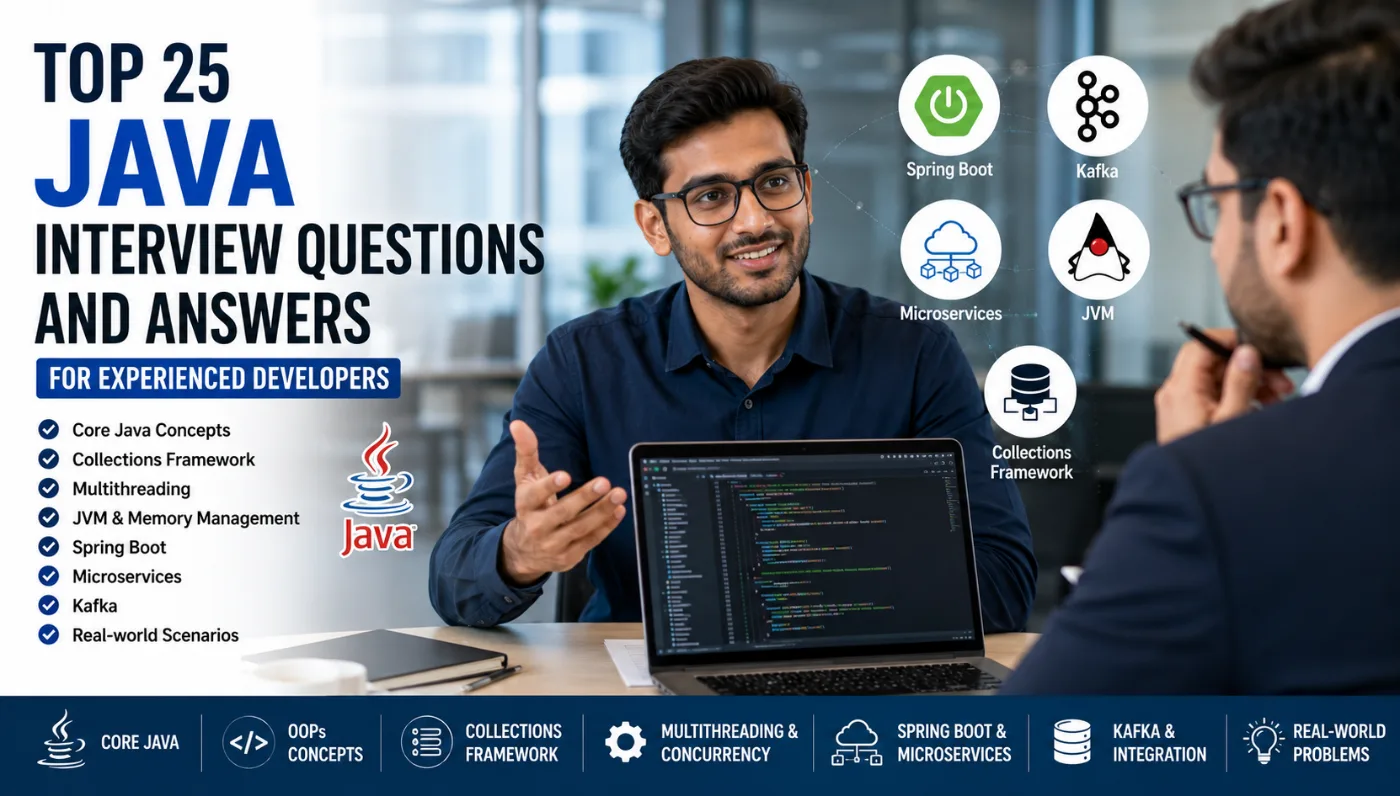
Top 25 Java Interview Questions and Answers for Experienced Developers
Java continues to be one of the most in-demand programming languages for enterprise applications, microservices, cloud-native systems, and backend development.
If you're preparing for a Java developer interview, understanding both core Java concepts and real-world production scenarios is essential.
Here are some of the most frequently asked Java interview questions for experienced developers.
1. What is the difference between JDK, JRE, and JVM?
JDK
Java Development Kit used for developing Java applications.
JRE
Java Runtime Environment used for running Java applications.
JVM
Java Virtual Machine responsible for executing Java bytecode.
2. Why is Java Platform Independent?
Java code is compiled into bytecode, which can run on any system that has a JVM installed.
This follows the principle:
Write Once, Run Anywhere.
3. Difference Between == and equals()?
==
Compares object references.
equals()
Compares actual object content.
Example:
String s1 = new String("Java");
String s2 = new String("Java");

System.out.println(s1 == s2);      // false
System.out.println(s1.equals(s2)); // true
4. What Happens When You Create a String?
String name = "Java";
The string is stored in the String Pool if it doesn't already exist.
String Pool helps optimize memory usage.
5. What is Immutable Class?
An immutable object cannot be modified after creation.
Example:
String
LocalDate
LocalDateTime
Benefits:
Thread safety
Better caching
Predictable behavior
6. Difference Between ArrayList and LinkedList?
ArrayList
Faster random access
Backed by dynamic array
LinkedList
Faster insertion/deletion
Uses doubly linked list
7. Difference Between HashMap and ConcurrentHashMap?
HashMap
Not thread-safe
ConcurrentHashMap
Thread-safe
Supports concurrent access
Better performance than synchronized collections
8. Explain HashMap Internal Working
HashMap stores data using:
Bucket Array
Hashing
Linked List
Red Black Tree (Java 8+)
Steps:
Calculate hash.
Find bucket index.
Store key-value pair.
Handle collisions.
9. What is Multithreading?
Multithreading allows multiple tasks to execute concurrently within the same application.
Benefits:
Better resource utilization
Improved responsiveness
Higher throughput
10. Difference Between Runnable and Callable?
Runnable
No return value
Cannot throw checked exceptions
Callable
Returns result
Can throw checked exceptions
11. What is Executor Service?
Executor Service manages thread creation and lifecycle using thread pools.
Example:
ExecutorService service =
Executors.newFixedThreadPool(10);
Benefits:
Better performance
Reusable threads
Controlled resource management
12. What is Deadlock?
Deadlock occurs when two or more threads wait indefinitely for resources held by each other.
13. What is Synchronization?
Synchronization ensures only one thread accesses critical code at a time.
Example:
synchronized void updateBalance() {
}
14. What is Optional?
Optional helps avoid NullPointerException.
Example:
Optional<User> user =
userRepository.findById(id);
15. Difference Between findFirst() and findAny()?
findFirst()
Returns first element.
findAny()
Returns any matching element, especially useful in parallel streams.
16. What is Dependency Injection?
Dependency Injection is a design pattern where dependencies are provided by the framework instead of being created manually.
Spring manages this using its IoC container.
17. What is Spring Bean Scope?
Common scopes:
Singleton
Prototype
Request
Session
Singleton is the default scope.
18. What is AOP?
Aspect-Oriented Programming helps separate cross-cutting concerns.
Examples:
Logging
Security
Transaction Management
19. Difference Between @Component, @Service, and @Repository?
All are Spring-managed beans.
@Component
Generic bean.
@Service
Business layer bean.
@Repository
Database layer bean with exception translation.
20. What is Microservice Architecture?
Microservices divide large applications into smaller independently deployable services.
Benefits:
Scalability
Independent deployment
Fault isolation
21. What is Circuit Breaker Pattern?
Circuit Breaker prevents repeated calls to failing services.
States:
Closed
Open
Half Open
Common implementation:
Resilience4j
22. What is Kafka?
Apache Kafka is a distributed event streaming platform used for high-throughput messaging.
Common use cases:
Event-driven systems
Real-time analytics
Microservice communication
23. What is Consumer Group in Kafka?
A Consumer Group allows multiple consumers to share message processing workload.
Each partition can be consumed by only one consumer within the same group.
24. What Happens If a Kafka Consumer Crashes?
Kafka performs consumer rebalance.
Another consumer in the group takes ownership of the partitions and continues processing.
25. Tell Us About a Production Issue You Solved
This question is extremely common for experienced candidates.
A strong answer should include:
Problem
Impact
Root Cause
Solution
Result
Interviewers are often more interested in how you solve real-world problems than theoretical knowledge.
Final Thoughts
Java interviews for experienced developers typically focus on:
Core Java
Collections
Multithreading
JVM
Spring Boot
Microservices
Kafka
Production troubleshooting
The best preparation strategy is to combine theoretical understanding with practical examples from your projects.
Mock interviews can help identify knowledge gaps, improve communication skills, and prepare you for real interview scenarios before facing actual employers.