Top 50 Spring Boot Interview Questions and Answers for 2026
Prepare for your next Spring Boot interview with the top 50 most frequently asked Spring Boot interview questions and answers. Covers Microservices, Security, JPA, REST A
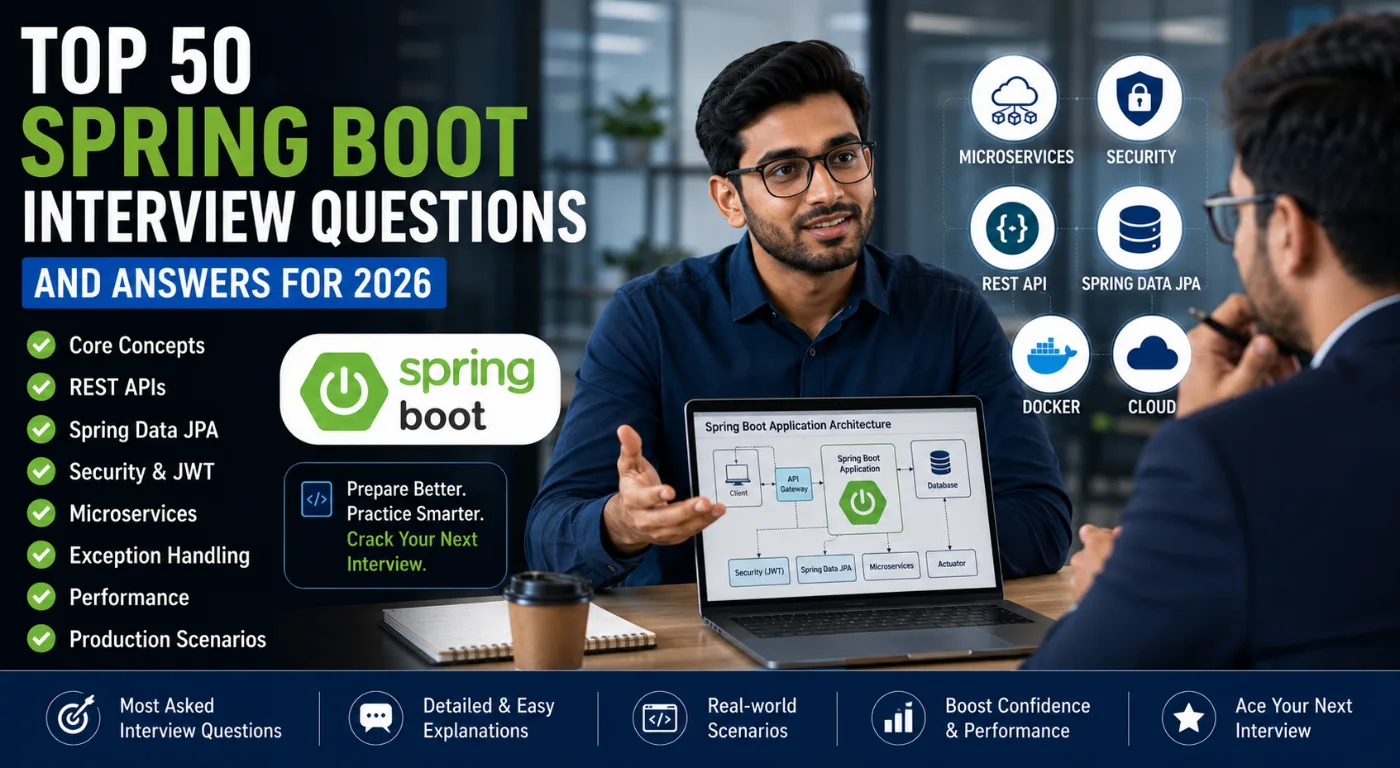
Top 50 Spring Boot Interview Questions and Answers for 2026
Spring Boot remains one of the most sought-after skills for Java developers. Whether you're a fresher or an experienced engineer, interviewers frequently ask Spring Boot questions ranging from basic concepts to production-level scenarios.
In this guide, we'll cover the most commonly asked Spring Boot interview questions.
1. What is Spring Boot?
Spring Boot is a framework built on top of Spring that simplifies application development by reducing configuration and setup requirements.
Benefits:
Faster development
Embedded servers
Production-ready features
Auto Configuration
2. What Problems Does Spring Boot Solve?
Traditional Spring applications required:
XML configuration
Manual dependency setup
Complex server deployment
Spring Boot simplifies all of these.
3. What is Auto Configuration?
Auto Configuration automatically configures beans based on dependencies available in the classpath.
For example:
If Spring Boot detects a database dependency, it automatically creates datasource configurations.
4. What is Starter Dependency?
Starter dependencies provide pre-configured libraries.
Examples:
spring-boot-starter-web
spring-boot-starter-data-jpa
spring-boot-starter-security
spring-boot-starter-test
5. What is @SpringBootApplication?
It combines:
@Configuration
@EnableAutoConfiguration
@ComponentScan
into a single annotation.
6. Difference Between @Component and @Bean?
@Component
Automatically detected during component scanning.
@Bean
Manually defined inside configuration classes.
7. What is Dependency Injection?
Dependency Injection allows Spring to create and manage object dependencies automatically.
Example:
@Service
public class UserService {

    private final UserRepository repository;

    public UserService(UserRepository repository){
        this.repository = repository;
    }
}
8. Constructor Injection vs Field Injection?
Constructor Injection is preferred because:
Better testability
Immutable dependencies
Easier maintenance
9. What is Bean Scope?
Common scopes:
Singleton
Prototype
Request
Session
Singleton is default.
10. What is Spring IoC Container?
IoC (Inversion of Control) container manages bean lifecycle and dependency injection.
11. What is REST API?
REST APIs expose application functionality through HTTP methods.
Methods:
GET
POST
PUT
DELETE
PATCH
12. Difference Between PUT and PATCH?
PUT
Updates entire resource.
PATCH
Updates partial resource.
13. What is ResponseEntity?
ResponseEntity allows customization of:
Status code
Headers
Response body
Example:
return ResponseEntity.ok(user);
14. What is Global Exception Handling?
Centralized exception handling using:
@RestControllerAdvice
Benefits:
Consistent responses
Cleaner code
Better maintainability
15. What is Spring Data JPA?
Spring Data JPA simplifies database operations by reducing boilerplate code.
16. Difference Between CrudRepository and JpaRepository?
JpaRepository provides:
Pagination
Sorting
Batch operations
in addition to CRUD operations.
17. What is Lazy Loading?
Associated data loads only when needed.
Improves performance.
18. What is Eager Loading?
Associated data loads immediately.
Useful when related data is always required.
19. What Causes N+1 Query Problem?
Occurs when fetching parent records and repeatedly querying child records.
Common JPA performance issue.
20. How Do You Solve N+1 Problem?
Solutions:
Fetch Join
Entity Graph
DTO Projection
21. What is Actuator?
Spring Boot Actuator provides production monitoring endpoints.
Examples:
/health
/metrics
/info
22. What is Spring Security?
Framework for:
Authentication
Authorization
Session management
23. What is JWT?
JSON Web Token is used for stateless authentication.
Structure:
Header
Payload
Signature
24. How Does JWT Authentication Work?
User logs in.
Server generates token.
Client stores token.
Token sent with every request.
Server validates token.
25. What is CORS?
Cross-Origin Resource Sharing allows frontend applications hosted on different domains to access APIs.
26. What is Microservice Architecture?
Architecture where applications are split into independent deployable services.
27. What is API Gateway?
API Gateway acts as a single entry point for all client requests.
Benefits:
Routing
Security
Rate limiting
28. What is Service Discovery?
Allows services to locate each other dynamically.
Popular tool:
Netflix Eureka.
29. What is Circuit Breaker?
Prevents repeated calls to failing services.
States:
Closed
Open
Half Open
30. What is Resilience4j?
Popular library for:
Circuit Breaker
Retry
Rate Limiter
Bulkhead
Production Questions Frequently Asked
31. How Do You Handle High Traffic APIs?
Caching
Load Balancing
Database Optimization
Horizontal Scaling
32. How Do You Improve API Performance?
Redis Cache
Pagination
Database Indexing
Async Processing
33. What Monitoring Tools Have You Used?
Examples:
Prometheus
Grafana
ELK Stack
Splunk
34. How Do You Secure Sensitive Configuration?
Use:
Environment Variables
Vault Solutions
Secret Managers
Never hardcode secrets.
35. Explain a Production Issue You Solved
Interviewers often focus heavily on:
Root cause analysis
Troubleshooting process
Preventive measures
Real-world examples carry significant weight during interviews.
Final Thoughts
Spring Boot interviews today focus on much more than annotations and theory.
Companies expect developers to understand:
Microservices
Security
Performance Optimization
Monitoring
Production Support
Cloud Deployments
Practicing these questions through realistic mock interviews can significantly improve your confidence and interview performance.
The more you practice explaining concepts verbally, the better prepared you'll be for real interviews.