Top 50 AWS Interview Questions and Answers for Experienced Developers (2026 Guide)
Prepare for your next AWS interview with the top 50 AWS interview questions and answers. Covers EC2, S3, Lambda, IAM, VPC, RDS, Auto Scaling, Load Balancers, CloudWatch,
Top 50 AWS Interview Questions and Answers for Experienced Developers (2026 Guide)
Introduction
Amazon Web Services (AWS) is the world's leading cloud platform, powering startups, enterprises, government organizations, and technology giants such as Netflix, Airbnb, Adobe, Samsung, and thousands of modern applications.
Because cloud computing has become a standard part of software development, AWS-related questions are now commonly asked in interviews for:
Software Engineers
Java Developers
Backend Developers
DevOps Engineers
Cloud Engineers
Solution Architects
Site Reliability Engineers (SREs)
Unlike traditional infrastructure interviews, AWS interviews focus on scalability, high availability, fault tolerance, security, cost optimization, and real-world architecture decisions.
This guide covers the top 50 AWS interview questions and answers frequently asked in technical interviews.
AWS Fundamentals
1. What is AWS?
Answer
Amazon Web Services (AWS) is a cloud computing platform that provides on-demand services such as:
Computing
Storage
Networking
Databases
Security
Analytics
Artificial Intelligence
AWS allows organizations to build and scale applications without managing physical infrastructure.
2. What are the advantages of AWS?
Answer
Major benefits include:
✅ Pay-as-you-go pricing
✅ Global infrastructure
✅ High availability
✅ Scalability
✅ Security
✅ Managed services
AWS helps organizations reduce operational overhead and focus on application development.
3. What is a Region in AWS?
Answer
A Region is a geographical location containing multiple AWS data centers.
Examples:
us-east-1
eu-west-1
ap-south-1 (Mumbai)
Each region operates independently.
4. What is an Availability Zone (AZ)?
Answer
An Availability Zone is an isolated data center within a region.
Each region contains multiple AZs.
Example:
Mumbai Region:
ap-south-1a
ap-south-1b
ap-south-1c
This improves fault tolerance and availability.
5. Difference Between Region and Availability Zone
Answer
Region | Availability Zone |
|---|---|
Geographic area | Individual data center |
Multiple AZs | Part of a region |
Independent location | Isolated infrastructure |
6. What is EC2?
Answer
EC2 (Elastic Compute Cloud) provides virtual servers in AWS.
Common uses:
Hosting applications
Running microservices
Processing workloads
Think of EC2 as a cloud-based virtual machine.
7. What is EBS?
Answer
Elastic Block Store (EBS) provides persistent storage for EC2 instances.
Features:
Durable
High-performance
Snapshot support
Used for operating systems and application data.
8. What is an AMI?
Answer
AMI (Amazon Machine Image) is a template used to launch EC2 instances.
Contains:
Operating System
Configuration
Installed software
9. What is Elastic IP?
Answer
Elastic IP is a static public IP address.
Benefits:
Remains constant
Can be reassigned to another instance
Useful during failovers.
10. What is IAM?
Answer
Identity and Access Management (IAM) controls access to AWS resources.
Capabilities:
Users
Roles
Groups
Permissions
IAM follows the principle of least privilege.
Compute Services
11. What are EC2 Instance Types?
Answer
Common categories:
General Purpose
Balanced CPU and memory.
Example:
t3, t4g
Compute Optimized
CPU-intensive workloads.
Example:
c5, c6
Memory Optimized
Large in-memory applications.
Example:
r5, r6
12. What is Auto Scaling?
Answer
Auto Scaling automatically adds or removes EC2 instances based on traffic.
Benefits:
Cost savings
High availability
Better performance
13. What is an Auto Scaling Group?
Answer
An Auto Scaling Group manages:
Minimum instances
Maximum instances
Desired instances
AWS automatically maintains the configured capacity.
14. What is AWS Lambda?
Answer
Lambda is a serverless compute service.
You upload code.
AWS manages:
Servers
Scaling
Infrastructure
You pay only for execution time.
15. Advantages of Lambda
Answer
Benefits:
No server management
Automatic scaling
Pay-per-use
Fast deployment
16. What is Serverless Architecture?
Answer
Serverless architecture allows applications to run without managing servers.
Common services:
Lambda
API Gateway
DynamoDB
17. What is ECS?
Answer
Elastic Container Service (ECS) is AWS's container orchestration service.
Used for running Docker containers.
18. What is EKS?
Answer
Elastic Kubernetes Service (EKS) is AWS's managed Kubernetes platform.
Used for containerized microservices.
19. Difference Between ECS and EKS
Answer
ECS | EKS |
|---|---|
AWS Native | Kubernetes |
Simpler | More flexible |
Easier setup | Higher complexity |
20. What is AWS Fargate?
Answer
Fargate allows containers to run without managing EC2 instances.
You focus on containers.
AWS manages infrastructure.
Storage & Database Services
21. What is Amazon S3?
Answer
Amazon S3 is object storage.
Common use cases:
Images
Videos
Backups
Static websites
22. What are S3 Storage Classes?
Answer
Popular classes:
Standard
Standard-IA
One Zone-IA
Glacier
Glacier Deep Archive
Used to optimize storage costs.
23. What is S3 Versioning?
Answer
Versioning keeps multiple versions of objects.
Benefits:
Accidental deletion recovery
Data protection
24. What is an S3 Lifecycle Policy?
Answer
Automatically moves files between storage classes.
Example:
After 30 days:
Standard → Glacier
Reduces costs.
25. What is RDS?
Answer
Relational Database Service (RDS) is AWS's managed SQL database service.
Supports:
MySQL
PostgreSQL
SQL Server
Oracle
MariaDB
26. What is Aurora?
Answer
Aurora is AWS's high-performance managed database.
Benefits:
Faster than standard MySQL
Better scalability
High availability
27. What is DynamoDB?
Answer
DynamoDB is a fully managed NoSQL database.
Features:
Serverless
Highly scalable
Millisecond latency
28. What is ElastiCache?
Answer
Managed caching service.
Supports:
Redis
Memcached
Used to improve application performance.
29. What is a Read Replica?
Answer
Read Replica handles read traffic separately.
Benefits:
Improved performance
Reduced database load
30. What is Multi-AZ Deployment?
Answer
AWS maintains a standby database in another Availability Zone.
Benefits:
High availability
Automatic failover
Networking Services
31. What is a VPC?
Answer
Virtual Private Cloud (VPC) is a private network inside AWS.
Allows complete control over:
IP addresses
Routing
Security
32. What is a Subnet?
Answer
A subnet is a segment of a VPC.
Types:
Public Subnet
Accessible from internet.
Private Subnet
Internal-only access.
33. What is an Internet Gateway?
Answer
Internet Gateway allows communication between a VPC and the internet.
Without it, public internet access is impossible.
34. What is a NAT Gateway?
Answer
Allows private subnet resources to access the internet.
Example:
Application server downloads updates.
External systems cannot directly access it.
35. What is a Route Table?
Answer
Defines network traffic routing inside a VPC.
Controls:
Internal routes
Internet routes
VPN routes
36. What is a Security Group?
Answer
Acts as a virtual firewall for instances.
Controls:
Inbound traffic
Outbound traffic
Stateful in nature.
37. What is a Network ACL?
Answer
Network Access Control List controls subnet-level traffic.
Unlike Security Groups:
Stateless
Operates at subnet level
38. What is an Application Load Balancer?
Answer
ALB distributes HTTP/HTTPS traffic.
Supports:
Path-based routing
Host-based routing
Commonly used with microservices.
39. What is Route 53?
Answer
AWS DNS service.
Functions:
Domain registration
DNS routing
Health checks
40. What is CloudFront?
Answer
CloudFront is AWS's Content Delivery Network (CDN).
Benefits:
Faster content delivery
Reduced latency
Global distribution
Real Production Scenario Questions
41. Your EC2 CPU Suddenly Reaches 100%. What Would You Investigate?
Answer
Check:
Application logs
Memory usage
Running processes
Traffic spikes
Auto Scaling metrics
CloudWatch is usually the first place to investigate.
42. Users Report Random Application Downtime. How Would You Troubleshoot?
Answer
Investigate:
Load balancer health checks
Application logs
EC2 health status
Auto Scaling events
Database connectivity
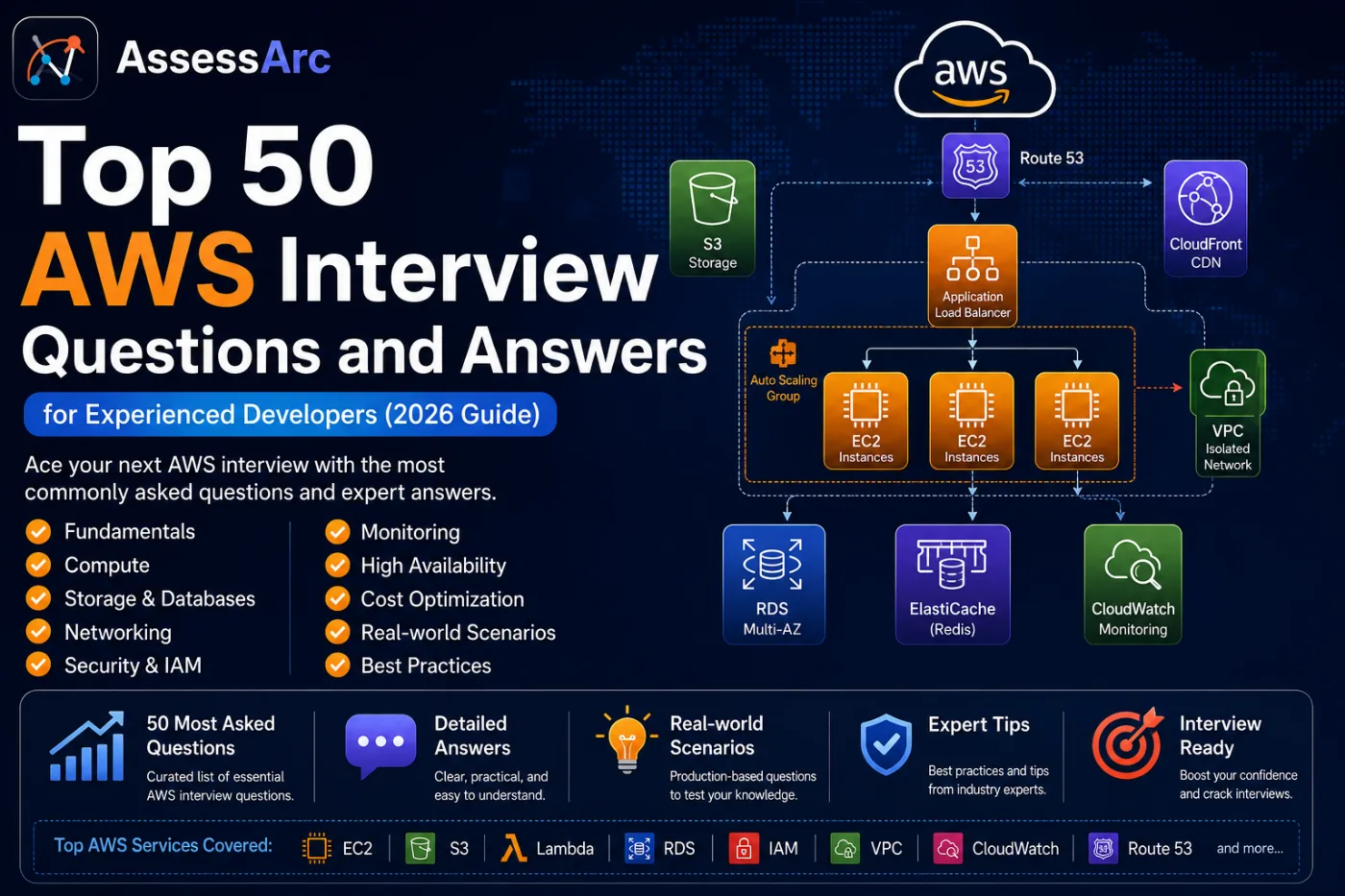
43. How Would You Deploy a Highly Available Spring Boot Application?
Answer
Architecture:
Multiple EC2 instances
Auto Scaling Group
Application Load Balancer
RDS Multi-AZ
CloudWatch Monitoring
This eliminates single points of failure.
44. How Would You Handle One Million Daily Users?
Answer
Use:
Auto Scaling
Load Balancers
Redis Cache
CDN
Read Replicas
Scale horizontally whenever possible.
45. RDS Performance Suddenly Drops. What Would You Check?
Answer
Investigate:
Slow queries
CPU utilization
Connections
Missing indexes
Storage bottlenecks
46. How Would You Design a Scalable E-Commerce Platform?
Answer
Components:
Route 53
CloudFront
ALB
EC2/EKS
Redis
RDS
S3
Architecture should support horizontal scaling.
47. How Would You Secure AWS Resources?
Answer
Best practices:
IAM Roles
MFA
Least Privilege Access
Encryption
Security Groups
48. What Are Common AWS Cost Optimization Techniques?
Answer
Methods:
Auto Scaling
Spot Instances
S3 Lifecycle Rules
Reserved Instances
Resource Monitoring
49. What AWS Services Should Developers Master?
Answer
Focus on:
EC2
S3
IAM
RDS
Lambda
VPC
CloudWatch
Auto Scaling
Load Balancers
These services appear most frequently in interviews.
50. What Are Interviewers Looking For in AWS Interviews?
Answer
Interviewers evaluate:
Cloud Fundamentals
Can you explain core services?
Architecture Thinking
Can you design scalable systems?
Security Knowledge
Can you secure cloud resources?
Cost Awareness
Can you optimize infrastructure costs?
Production Experience
Can you troubleshoot real-world issues?
Common AWS Interview Mistakes
❌ Memorizing services without understanding use cases
❌ Ignoring networking concepts
❌ Weak understanding of IAM
❌ Not knowing high-availability patterns
❌ No real-world architecture experience
❌ Not understanding Auto Scaling
❌ Ignoring security best practices
How AssessArc Helps You Prepare for AWS Interviews
AWS interviews are no longer limited to service definitions.
Interviewers expect candidates to explain:
Architecture decisions
Scalability approaches
Security considerations
Cost optimization strategies
Production troubleshooting
AssessArc helps candidates practice realistic AWS interview questions through AI-powered mock interviews and detailed feedback reports, helping improve both technical knowledge and communication skills before real interviews.
Conclusion
AWS has become one of the most important skills for modern software engineers.
Understanding EC2, S3, IAM, Lambda, VPC, RDS, CloudFront, Auto Scaling, and high-availability architecture can significantly improve your chances of success in cloud-focused interviews.
Master these AWS interview questions, understand the underlying concepts, and practice explaining real-world scenarios confidently to stand out in your next technical interview.