Top 50 Design Patterns Interview Questions and Answers for Experienced Developers (2026 Guide)
Prepare for design pattern interviews with 50 commonly asked questions covering Singleton, Factory, Builder, Strategy, Observer, SOLID principles, and real-world scenario
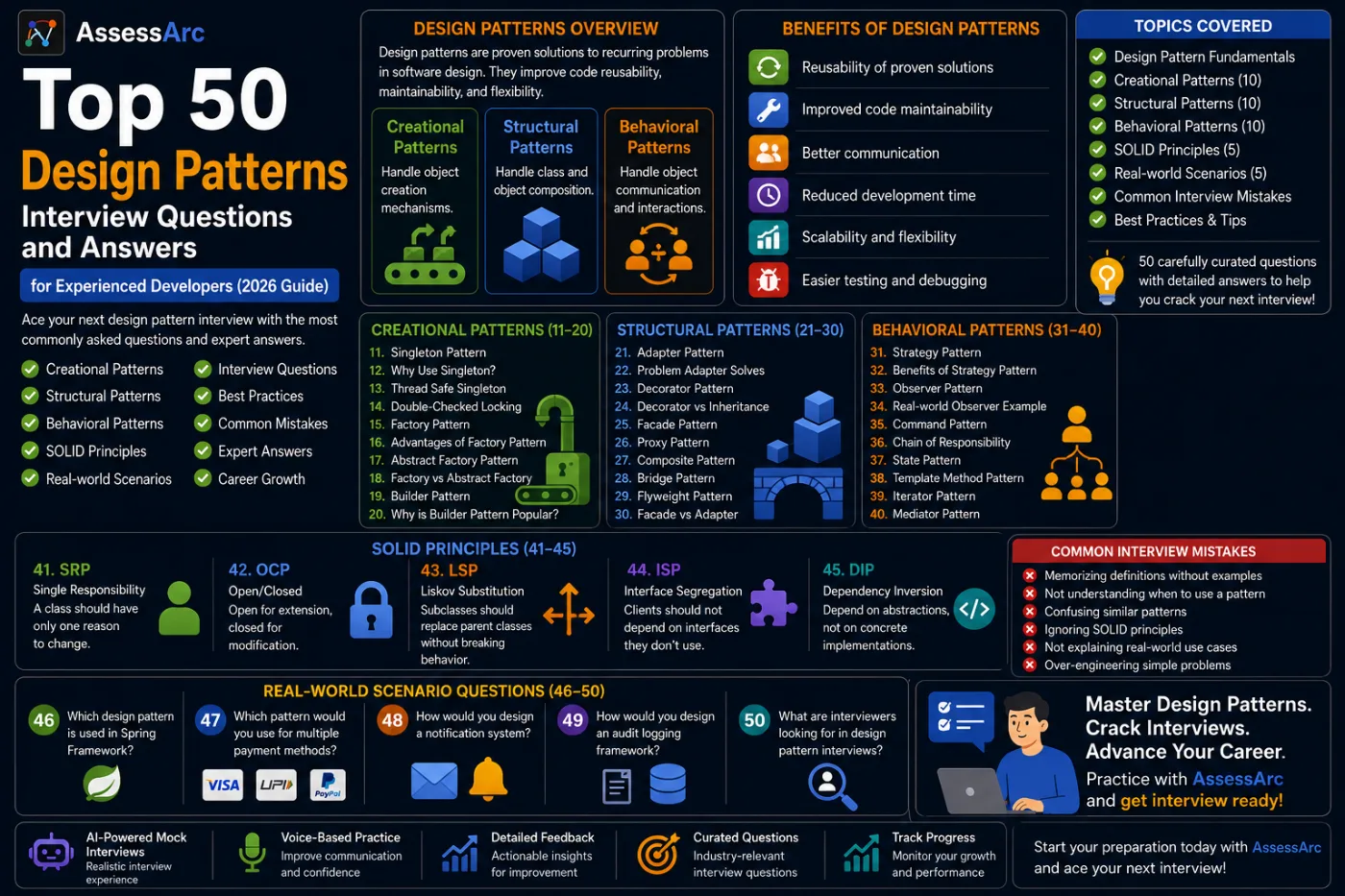
Top 50 Design Patterns Interview Questions and Answers for Experienced Developers (2026 Guide)
Table of Contents
Design Pattern Fundamentals
Creational Design Patterns
Structural Design Patterns
Behavioral Design Patterns
SOLID Principles
Real-World Design Pattern Scenarios
Common Interview Mistakes
How AssessArc Helps
Conclusion
Introduction
Design Patterns are proven solutions to recurring software design problems.
Companies use design pattern questions to evaluate:
Software design skills
Object-oriented programming knowledge
Code maintainability understanding
System architecture thinking
Design pattern questions are extremely common in interviews for:
Java Developers
Spring Boot Developers
Software Engineers
Backend Engineers
Tech Leads
Software Architects
This guide covers the top 50 Design Patterns interview questions and answers frequently asked in technical interviews.
Design Pattern Fundamentals
1. What is a Design Pattern?
Answer
A Design Pattern is a reusable solution to a commonly occurring software design problem.
Design patterns are not code but templates for solving problems.
Benefits:
✅ Reusability
✅ Maintainability
✅ Scalability
✅ Better communication among developers
2. Why Are Design Patterns Important?
Answer
Design patterns help developers:
Avoid reinventing solutions
Improve code quality
Follow industry best practices
Build scalable systems
3. What Are the Main Categories of Design Patterns?
Answer
Three major categories:
Creational Patterns
Object creation.
Structural Patterns
Class and object composition.
Behavioral Patterns
Communication between objects.
4. What is Gang of Four (GoF)?
Answer
The Gang of Four introduced 23 classic design patterns in their book:
Design Patterns: Elements of Reusable Object-Oriented Software
5. Difference Between Design Pattern and Framework
Answer
Design Pattern | Framework |
|---|---|
Concept | Implementation |
Flexible | Opinionated |
Reusable Solution | Ready-made Platform |
6. What is Loose Coupling?
Answer
Loose coupling means components depend minimally on each other.
Benefits:
Easier maintenance
Better testability
Higher flexibility
7. What is High Cohesion?
Answer
High cohesion means related functionality stays together.
Good software design aims for:
High Cohesion
Low Coupling
8. What Problem Do Design Patterns Solve?
Answer
They solve:
Code duplication
Tight coupling
Complex object creation
Difficult maintenance
9. Are Design Patterns Language Specific?
Answer
No.
Patterns are language-independent concepts.
They can be implemented in:
Java
Python
C#
JavaScript
10. When Should You Avoid Design Patterns?
Answer
Avoid patterns when:
Simpler solutions exist
Requirements are small
Pattern adds unnecessary complexity
Creational Design Patterns
11. What is the Singleton Pattern?
Answer
Singleton ensures only one instance of a class exists.
Examples:
Logger
Cache Manager
Configuration Manager
12. Why Use Singleton?
Answer
Benefits:
Controlled access
Memory efficiency
Shared state
13. How Do You Make Singleton Thread Safe?
Answer
Common approaches:
Synchronized method
Double-checked locking
Enum Singleton
14. What is Double-Checked Locking?
Answer
Reduces synchronization overhead while ensuring thread safety.
Common Java interview question.
15. What is Factory Pattern?
Answer
Factory Pattern creates objects without exposing creation logic.
Example:
Shape shape = ShapeFactory.getShape("Circle");
16. Advantages of Factory Pattern
Answer
Loose coupling
Easier maintenance
Better extensibility
17. What is Abstract Factory Pattern?
Answer
Creates families of related objects.
Example:
UI components for:
Windows
Mac
Linux
18. Factory vs Abstract Factory
Answer
Factory | Abstract Factory |
|---|---|
One Product | Family of Products |
Simpler | More Flexible |
19. What is Builder Pattern?
Answer
Builder Pattern constructs complex objects step by step.
Example:
User user = User.builder()
                .name("Ashish")
                .email("test@test.com")
                .build();
20. Why is Builder Popular in Java?
Answer
Benefits:
Readable code
Immutable objects
Optional fields support
Structural Design Patterns
21. What is Adapter Pattern?
Answer
Adapter allows incompatible interfaces to work together.
Real-world example:
Power adapter.
22. What Problem Does Adapter Solve?
Answer
Integrating legacy systems with new systems.
23. What is Decorator Pattern?
Answer
Decorator adds behavior dynamically without modifying the original class.
Example:
Java I/O Streams.
24. Decorator vs Inheritance
Answer
Decorator provides flexibility without deep inheritance hierarchies.
25. What is Facade Pattern?
Answer
Facade provides a simplified interface to complex subsystems.
Example:
Spring's JdbcTemplate.
26. What is Proxy Pattern?
Answer
Proxy acts as a placeholder for another object.
Common uses:
Security
Lazy loading
Logging
27. What is Composite Pattern?
Answer
Treats individual objects and groups uniformly.
Example:
File System:
File
Folder
28. What is Bridge Pattern?
Answer
Separates abstraction from implementation.
Allows both to evolve independently.
29. What is Flyweight Pattern?
Answer
Reduces memory usage by sharing common objects.
Example:
Text editors sharing character objects.
30. What is the Difference Between Facade and Adapter?
Answer
Facade | Adapter |
|---|---|
Simplifies Interface | Converts Interface |
Hides Complexity | Solves Compatibility |
Behavioral Design Patterns
31. What is Strategy Pattern?
Answer
Defines multiple algorithms and allows runtime selection.
Example:
Payment methods:
Credit Card
UPI
PayPal
32. Benefits of Strategy Pattern
Answer
Open for extension
Easy maintenance
Flexible behavior
33. What is Observer Pattern?
Answer
One-to-many dependency between objects.
When one object changes, all observers are notified.
34. Real-World Example of Observer Pattern
Answer
Examples:
Email notifications
Stock price alerts
Event listeners
35. What is Command Pattern?
Answer
Encapsulates requests as objects.
Examples:
Undo functionality
Task queues
36. What is Chain of Responsibility Pattern?
Answer
Request passes through multiple handlers.
Example:
Spring Security Filter Chain.
37. What is State Pattern?
Answer
Changes behavior based on internal state.
Example:
Order lifecycle.
38. What is Template Method Pattern?
Answer
Defines algorithm structure while allowing subclasses to customize steps.
39. What is Iterator Pattern?
Answer
Provides sequential access without exposing collection internals.
Example:
Java Iterator.
40. What is Mediator Pattern?
Answer
Reduces direct communication between objects.
Promotes loose coupling.
SOLID Principles
41. What is SRP?
Answer
Single Responsibility Principle.
A class should have only one reason to change.
42. What is OCP?
Answer
Open Closed Principle.
Open for extension.
Closed for modification.
43. What is LSP?
Answer
Liskov Substitution Principle.
Subclasses should replace parent classes without breaking behavior.
44. What is ISP?
Answer
Interface Segregation Principle.
Clients should not depend on unused methods.
45. What is DIP?
Answer
Dependency Inversion Principle.
Depend on abstractions, not implementations.
Real Production Scenario Questions
46. Which Design Pattern Is Used in Spring Framework?
Answer
Spring uses:
Singleton
Factory
Proxy
Template Method
Observer
47. Which Pattern Would You Use for Multiple Payment Methods?
Answer
Strategy Pattern.
Each payment type becomes a strategy.
48. How Would You Design a Notification System?
Answer
Observer Pattern.
Subscribers receive notifications automatically.
49. How Would You Design an Audit Logging Framework?
Answer
Decorator Pattern.
Allows adding logging behavior dynamically.
50. What Are Interviewers Looking For in Design Pattern Interviews?
Answer
Interviewers evaluate:
OOP Knowledge
Can you design maintainable code?
Pattern Understanding
Can you identify the correct pattern?
Real-world Experience
Have you used patterns in production?
Software Design Skills
Can you design scalable systems?
Common Design Pattern Interview Mistakes
❌ Memorizing definitions only
❌ Not knowing real-world examples
❌ Confusing Factory and Abstract Factory
❌ Confusing Strategy and State
❌ Ignoring SOLID principles
❌ Unable to explain production usage
How AssessArc Helps You Prepare for Design Pattern Interviews
Design pattern interviews often focus on practical scenarios rather than textbook definitions.
AssessArc helps developers practice:
Java Design Pattern Questions
Software Design Interviews
Object-Oriented Design Scenarios
Senior Developer Interviews
through AI-powered mock interviews, voice-based interactions, and detailed performance reports.
Conclusion
Design Patterns remain one of the most important topics for software engineers and backend developers.
Understanding Creational, Structural, Behavioral Patterns, and SOLID Principles helps developers write maintainable, scalable, and production-ready code.
Master these Design Pattern interview questions and practice explaining real-world use cases to confidently crack your next software engineering interview.