Top 50 Docker Interview Questions and Answers for Experienced Developers (2026 Guide)
Prepare for Docker interviews with the top 50 Docker interview questions and answers covering containers, images, networking, Docker Compose, and production scenarios.
Top 50 Docker Interview Questions and Answers for Experienced Developers (2026 Guide)
Introduction
Docker has become one of the most important technologies in modern software development.
Whether you're building microservices, deploying cloud-native applications, or working with DevOps pipelines, Docker is almost always part of the architecture.
As organizations increasingly adopt containerization, Docker-related interview questions are now common in interviews for:
Java Developers
Backend Developers
DevOps Engineers
Cloud Engineers
Platform Engineers
Software Engineers
Companies want candidates who understand not only Docker commands but also container architecture, networking, storage, security, and production deployment strategies.
In this guide, you'll learn the top 50 Docker interview questions and answers that frequently appear in technical interviews.
Docker Fundamentals
1. What is Docker?
Answer
Docker is an open-source containerization platform that allows applications and their dependencies to be packaged together and run consistently across environments.
Benefits:
Faster deployments
Environment consistency
Easy scalability
Better resource utilization
2. What is Containerization?
Answer
Containerization is the process of packaging an application along with all required dependencies into a lightweight container.
The container runs consistently across:
Developer machines
Testing environments
Production servers
3. Why is Docker Popular?
Answer
Docker provides:
✅ Faster deployments
✅ Lightweight containers
✅ Easy portability
✅ Improved scalability
✅ Better developer productivity
4. Docker vs Virtual Machine
Answer
Docker | Virtual Machine |
|---|---|
Shares Host OS | Separate OS |
Lightweight | Heavyweight |
Faster Startup | Slower Startup |
Lower Resource Usage | Higher Resource Usage |
Docker containers are much more efficient than traditional virtual machines.
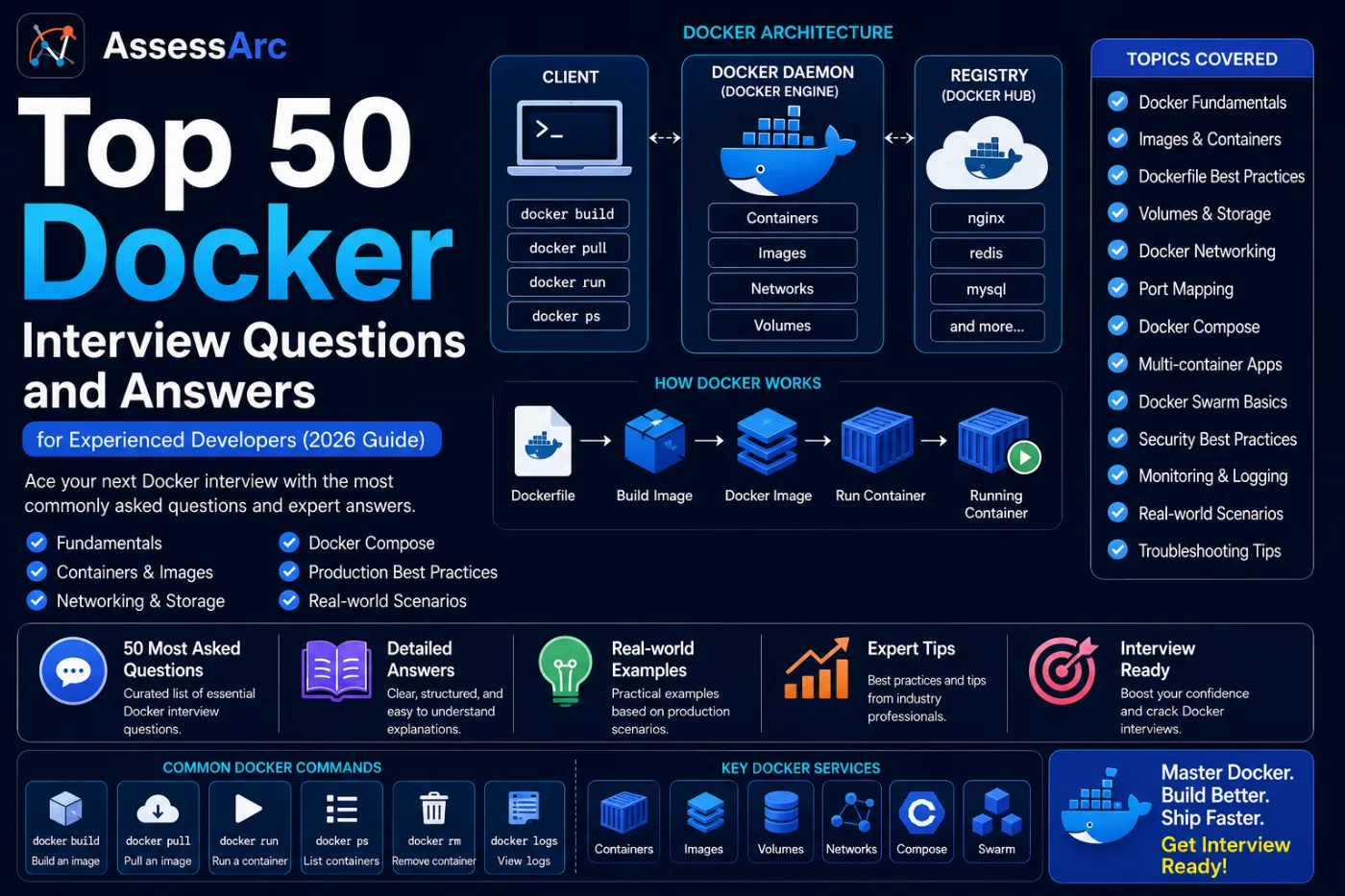
5. What is Docker Engine?
Answer
Docker Engine is the core runtime responsible for:
Building images
Running containers
Managing networks
Managing storage
6. What is Docker Daemon?
Answer
Docker Daemon (dockerd) is the background service responsible for managing Docker objects.
It handles:
Containers
Images
Volumes
Networks
7. What is Docker Client?
Answer
Docker Client is the command-line interface used to communicate with the Docker Daemon.
Example:
docker ps
docker images
docker run
8. What is Docker Hub?
Answer
Docker Hub is Docker's public image registry.
Developers can:
Upload images
Download images
Share images
Example:
docker pull nginx
9. What is a Docker Registry?
Answer
A Docker Registry stores Docker images.
Examples:
Docker Hub
AWS ECR
Google Artifact Registry
Azure Container Registry
10. What is a Docker Image?
Answer
A Docker Image is a read-only template used to create containers.
Contains:
Application code
Dependencies
Runtime
Configuration
Docker Images & Containers
11. What is a Docker Container?
Answer
A Container is a running instance of a Docker image.
Example:
Image → nginx
Container → Running nginx server
12. Difference Between Image and Container
Answer
Image | Container |
|---|---|
Template | Running Instance |
Read-only | Read-write |
Static | Dynamic |
13. What is a Dockerfile?
Answer
Dockerfile contains instructions to build Docker images.
Example:
FROM openjdk:21
COPY app.jar app.jar
ENTRYPOINT ["java","-jar","app.jar"]
14. What is the FROM Instruction?
Answer
Defines the base image.
Example:
FROM ubuntu
Every Dockerfile usually starts with FROM.
15. What is ENTRYPOINT?
Answer
Defines the main executable inside a container.
Example:
ENTRYPOINT ["java","-jar","app.jar"]
16. Difference Between CMD and ENTRYPOINT
Answer
CMD:
Provides default arguments.
ENTRYPOINT:
Defines the executable.
ENTRYPOINT is harder to override.
17. COPY vs ADD
Answer
COPY:
Simple file copy.
ADD:
Supports URLs and archive extraction.
Best practice:
Prefer COPY unless ADD features are required.
18. What are Docker Layers?
Answer
Each Dockerfile instruction creates a layer.
Benefits:
Faster builds
Layer caching
Reduced storage
19. What is Layer Caching?
Answer
Docker reuses unchanged layers during builds.
This significantly speeds up image creation.
20. What is a Multi-Stage Build?
Answer
Multi-stage builds reduce image size.
Example:
Build application in one stage.
Copy final artifact into a lightweight runtime image.
Docker Storage
21. What is a Docker Volume?
Answer
Volumes store persistent data outside containers.
Data remains even if containers are deleted.
22. Why Use Volumes?
Answer
Benefits:
Data persistence
Backup support
Better performance
23. What is a Bind Mount?
Answer
Maps host directories directly into containers.
Example:
docker run -v /host:/container
24. Volume vs Bind Mount
Answer
Volume | Bind Mount |
|---|---|
Docker Managed | Host Managed |
Portable | Less Portable |
Safer | More Flexible |
25. Can Container Data Survive Restart?
Answer
Yes.
If stored in volumes.
Otherwise container filesystem changes may be lost.
Docker Networking
26. What is Docker Networking?
Answer
Docker networking enables communication between:
Containers
Host systems
External services
27. What is Bridge Network?
Answer
Default Docker network.
Allows containers on the same host to communicate.
28. What is Host Network?
Answer
Container shares the host network stack.
Benefits:
Better performance
Disadvantage:
Reduced isolation
29. What is Overlay Network?
Answer
Overlay networks connect containers across multiple hosts.
Commonly used with:
Docker Swarm
Kubernetes
30. What is Port Mapping?
Answer
Maps container ports to host ports.
Example:
docker run -p 8080:8080 app
Docker Compose
31. What is Docker Compose?
Answer
Docker Compose manages multi-container applications.
Example:
Application
Database
Redis
can be started together.
32. What is docker-compose.yml?
Answer
Configuration file defining services.
Example:
services:
  app:
    image: app
  db:
    image: postgres
33. Why Use Docker Compose?
Answer
Benefits:
Simpler configuration
Easier development
Multi-container orchestration
34. How Do Containers Communicate in Compose?
Answer
Through service names.
Example:
db:5432
instead of IP addresses.
35. What is Service Discovery?
Answer
Automatic resolution of service names between containers.
Provided by Docker networking.
Production & Advanced Docker Questions
36. How Do You Reduce Docker Image Size?
Answer
Techniques:
Multi-stage builds
Alpine images
Remove unnecessary packages
37. How Do You Secure Docker Containers?
Answer
Best practices:
Use non-root users
Scan images
Update dependencies
Limit privileges
38. What is Docker Swarm?
Answer
Docker's native orchestration platform.
Supports:
Scaling
Service discovery
High availability
39. Docker Swarm vs Kubernetes
Answer
Docker Swarm | Kubernetes |
|---|---|
Easier Setup | More Features |
Simpler | More Complex |
Smaller Scale | Enterprise Scale |
40. What is Health Check?
Answer
Health checks verify application status.
Used to detect unhealthy containers.
41. What is Restart Policy?
Answer
Controls container restart behavior.
Examples:
always
unless-stopped
on-failure
42. How Do You Monitor Docker Containers?
Answer
Popular tools:
Prometheus
Grafana
Datadog
ELK Stack
43. What Causes Containers to Crash?
Answer
Common causes:
Memory limits
Application errors
Configuration issues
Dependency failures
44. How Do You Debug a Running Container?
Answer
Useful commands:
docker logs
docker exec
docker inspect
45. What is Docker Build Context?
Answer
Files sent to Docker daemon during image build.
Smaller contexts improve build speed.
Real Production Scenario Questions
46. A Container Keeps Restarting. How Would You Troubleshoot?
Answer
Check:
Logs
Memory limits
Environment variables
Startup commands
Start with:
docker logs <container-id>
47. Your Docker Image Is 3GB. How Would You Optimize It?
Answer
Use:
Multi-stage builds
Alpine images
Remove unnecessary dependencies
48. CPU Usage Suddenly Reaches 100%. What Would You Investigate?
Answer
Check:
Running processes
Traffic spikes
Application bugs
Infinite loops
49. How Would You Deploy a Spring Boot Application Using Docker?
Answer
Steps:
Create Dockerfile
Build image
Push to registry
Deploy container
Configure monitoring
50. Application Works Locally but Fails in Production. How Would You Debug?
Answer
Investigate:
Environment variables
Network configuration
Volume mounts
Resource limits
Container logs
Common Docker Interview Mistakes
❌ Memorizing commands without understanding architecture
❌ Weak understanding of networking
❌ No knowledge of volumes
❌ Ignoring image optimization
❌ No production troubleshooting experience
❌ Confusing containers and virtual machines
How AssessArc Helps You Prepare for Docker Interviews
Docker interviews often focus on practical scenarios rather than definitions.
Candidates must explain:
Container architecture
Deployment strategies
Networking
Storage
Troubleshooting
AssessArc helps developers practice Docker interview questions through realistic AI-powered mock interviews, voice-based discussions, and detailed feedback reports that improve technical depth and communication skills.
Conclusion
Docker has become a foundational skill for modern software engineers, DevOps professionals, and cloud engineers.
Understanding containerization, Docker images, networking, storage, Docker Compose, and production troubleshooting can significantly improve your interview performance.
Master these Docker interview questions, practice explaining concepts clearly, and you'll be well-prepared for your next Docker interview.