Top 50 Generative AI Interview Questions and Answers for Experienced Professionals (2026 Guide)
Prepare for Generative AI interviews with 50 commonly asked questions covering LLMs, RAG, embeddings, vector databases, prompt engineering, AI agents, and production AI
Top 50 Generative AI Interview Questions and Answers for Experienced Professionals (2026 Guide)
Table of Contents
Generative AI Fundamentals
Large Language Models (LLMs)
RAG & Vector Databases
Prompt Engineering
AI Agents & Tool Calling
Production AI Systems
Real-World GenAI Scenarios
Common Interview Mistakes
How AssessArc Helps
Conclusion
Introduction
Generative AI has become one of the fastest-growing areas in technology.
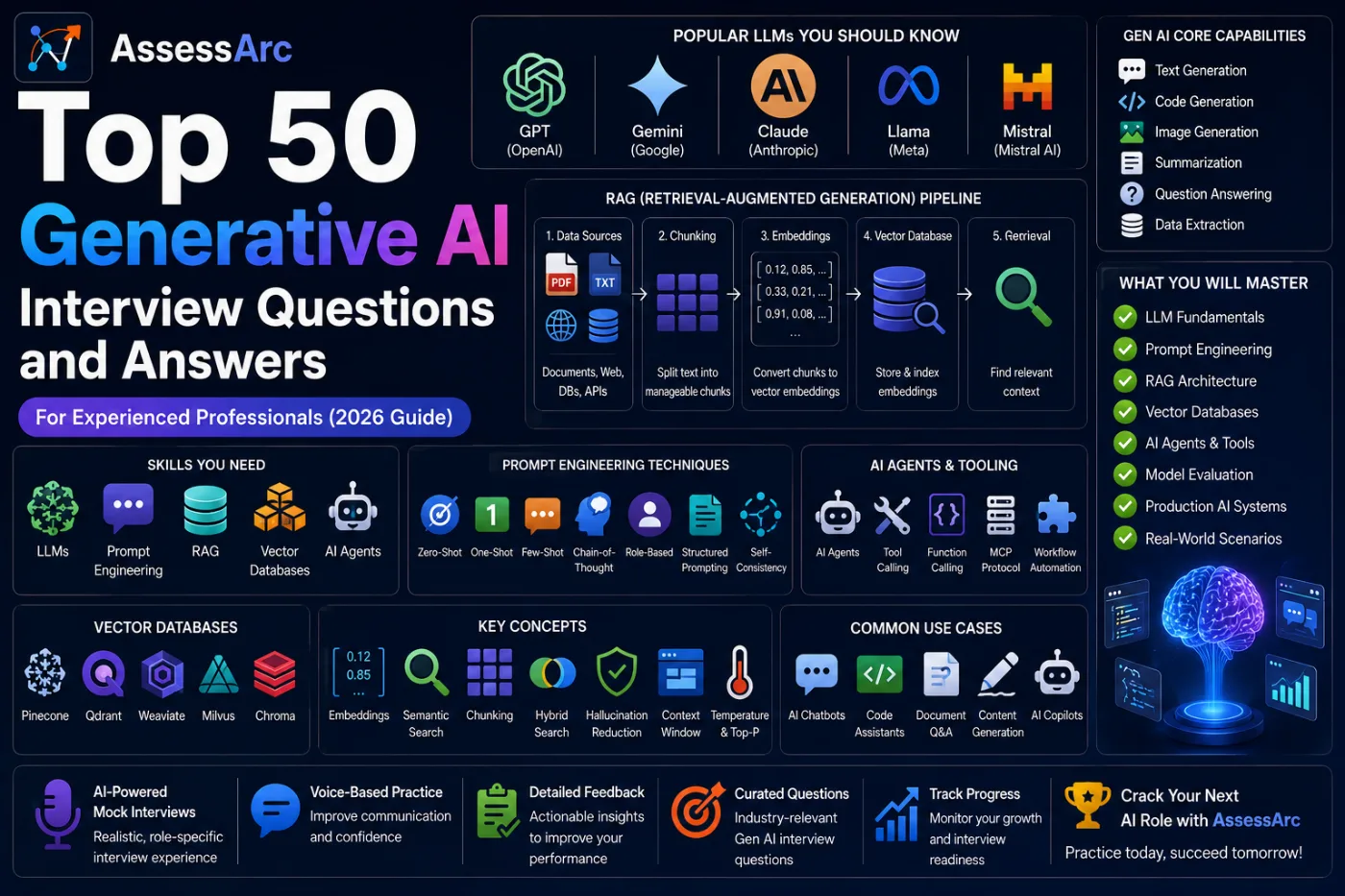
Organizations across industries are building AI-powered products using:
OpenAI GPT
Google Gemini
Anthropic Claude
Meta Llama
Mistral AI
As a result, companies are actively hiring:
Generative AI Engineers
AI Engineers
Prompt Engineers
ML Engineers
AI Product Developers
Unlike traditional machine learning interviews, Generative AI interviews focus heavily on:
LLMs
RAG Systems
Prompt Engineering
Vector Databases
AI Agents
Production AI Architecture
This guide covers the top 50 Generative AI interview questions and answers commonly asked in 2026.
Generative AI Fundamentals
1. What is Generative AI?
Answer
Generative AI refers to artificial intelligence systems capable of creating new content such as:
Text
Images
Audio
Video
Code
Examples:
ChatGPT
Gemini
Claude
Midjourney
2. How is Generative AI Different from Traditional AI?
Answer
Traditional AI | Generative AI |
|---|---|
Classification | Content Creation |
Prediction | Generation |
Analysis | Creation |
3. What Are Foundation Models?
Answer
Foundation Models are large pre-trained models trained on massive datasets.
Examples:
GPT-4
Gemini
Claude
Llama
4. What is an LLM?
Answer
LLM stands for Large Language Model.
These models understand and generate human language using deep learning techniques.
5. Examples of Popular LLMs
Answer
Common LLMs include:
GPT
Gemini
Claude
Llama
Mistral
6. Why Are LLMs Powerful?
Answer
They can:
Understand language
Generate content
Summarize documents
Write code
Answer questions
7. What Are Common Generative AI Applications?
Answer
Examples:
Chatbots
AI Assistants
Content Creation
Resume Analysis
Interview Platforms
Coding Assistants
8. What is Fine-Tuning?
Answer
Fine-tuning trains a pre-trained model on domain-specific data.
9. What is Transfer Learning?
Answer
Using knowledge learned from one task to improve performance on another.
10. What Skills Are Required for Generative AI Engineers?
Answer
Key skills:
Python
LLMs
Prompt Engineering
RAG
Vector Databases
AI Agents
Large Language Models (LLMs)
11. What is Tokenization?
Answer
Converting text into smaller units called tokens.
Example:
AssessArc is amazing
may become multiple tokens internally.
12. What is a Transformer?
Answer
Transformer is the neural network architecture powering modern LLMs.
13. What is Self-Attention?
Answer
Self-Attention allows models to understand relationships between words in context.
14. What is a Context Window?
Answer
Maximum amount of information a model can process in one request.
15. What is Temperature?
Answer
Controls output randomness.
Low Temperature:
More deterministic
High Temperature:
More creative
16. What is Top-P?
Answer
Probability-based token sampling technique.
Used to control output diversity.
17. What is Hallucination?
Answer
When an AI model generates false or fabricated information.
18. Why Do Hallucinations Occur?
Answer
Reasons:
Missing knowledge
Weak prompts
No grounding data
19. How Can Hallucinations Be Reduced?
Answer
Methods:
RAG
Better Prompts
Validation Layers
Human Review
20. GPT vs Gemini vs Claude
Answer
Model | Strength |
|---|---|
GPT | Coding & Reasoning |
Gemini | Multimodal Tasks |
Claude | Long Context |
Llama | Open Source |
RAG & Vector Databases
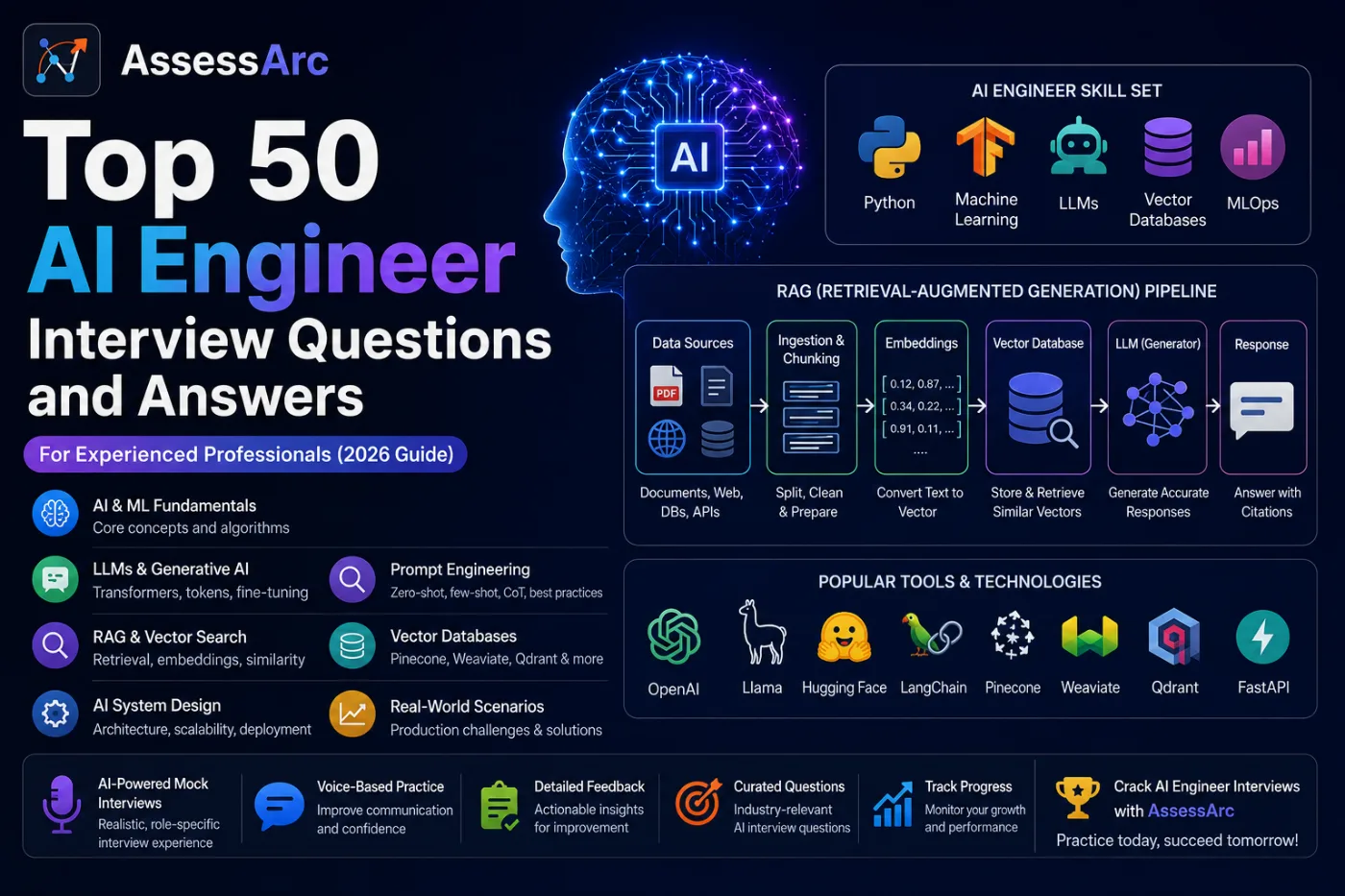
21. What is RAG?
Answer
RAG stands for Retrieval-Augmented Generation.
It combines:
Information Retrieval
LLM Generation
to improve accuracy.
22. Why Use RAG?
Answer
Benefits:
Reduces hallucinations
Uses private data
Improves reliability
23. What Are Embeddings?
Answer
Embeddings are numerical representations of text used for semantic understanding.
24. What is Semantic Search?
Answer
Searching based on meaning rather than exact keywords.
25. What is Chunking?
Answer
Breaking large documents into smaller sections before creating embeddings.
26. What is a Vector Database?
Answer
Database optimized for storing and searching embeddings.
Examples:
Pinecone
Qdrant
Weaviate
Milvus
Chroma
27. What is Similarity Search?
Answer
Finding the most relevant vectors based on semantic similarity.
28. What Metrics Are Used for Vector Search?
Answer
Common metrics:
Cosine Similarity
Dot Product
Euclidean Distance
29. What is Hybrid Search?
Answer
Combines:
Keyword Search
Semantic Search
for better retrieval accuracy.
30. What Are Common RAG Challenges?
Answer
Poor Chunking
Low Retrieval Accuracy
Hallucinations
Latency
Prompt Engineering
31. What is Prompt Engineering?
Answer
Designing prompts to improve AI outputs.
32. What Makes a Good Prompt?
Answer
A good prompt should be:
Clear
Specific
Structured
Context-rich
33. What is Zero-Shot Prompting?
Answer
Providing instructions without examples.
34. What is Few-Shot Prompting?
Answer
Providing examples before asking the model to perform a task.
35. What is Chain-of-Thought Prompting?
Answer
Encourages step-by-step reasoning.
36. What is Role-Based Prompting?
Answer
Assigning a role to the model.
Example:
Act as a Senior Software Architect.
37. What is Structured Prompting?
Answer
Using organized sections and instructions in prompts.
38. What is Self-Consistency Prompting?
Answer
Generating multiple reasoning paths and selecting the best result.
39. What is Tree-of-Thought Prompting?
Answer
Advanced reasoning strategy exploring multiple solution branches.
40. Why is Prompt Engineering Important?
Answer
It improves:
Accuracy
Consistency
Reliability
Cost Efficiency
AI Agents & Tool Calling
41. What is an AI Agent?
Answer
An AI Agent can:
Reason
Plan
Use Tools
Execute Tasks
autonomously.
42. What is Tool Calling?
Answer
Allows AI models to interact with external APIs and systems.
43. What is Function Calling?
Answer
Structured mechanism enabling AI models to invoke predefined functions.
44. What is MCP (Model Context Protocol)?
Answer
MCP is a protocol that enables AI models to securely interact with tools, databases, files, and external systems.
45. Why Are AI Agents Important?
Answer
Agents can automate workflows that go beyond simple text generation.
Production AI Systems
46. How Would You Build an AI Mock Interview Platform Like AssessArc?
Answer
Architecture:
Resume Upload
Role Selection
Question Generation
Voice Interview
AI Evaluation
Feedback Report
47. How Would You Reduce AI Inference Costs?
Answer
Methods:
Caching
Prompt Optimization
Smaller Models
Context Compression
48. How Would You Monitor AI Application Quality?
Answer
Track:
Latency
Accuracy
Hallucination Rate
User Satisfaction
49. How Would You Secure a Generative AI Application?
Answer
Implement:
Authentication
Rate Limiting
Prompt Injection Protection
Data Privacy Controls
50. What Are Interviewers Looking for in Generative AI Interviews?
Answer
Interviewers evaluate:
LLM Understanding
Can you explain modern AI systems?
RAG Knowledge
Can you build retrieval-based applications?
Prompt Engineering
Can you improve model outputs?
AI Architecture
Can you design scalable AI solutions?
Production Experience
Have you deployed real-world AI systems?
Common Generative AI Interview Mistakes
❌ Memorizing AI buzzwords
❌ Weak understanding of RAG
❌ No vector database knowledge
❌ Ignoring production architecture
❌ No cost optimization strategy
❌ Poor understanding of hallucination prevention
How AssessArc Helps You Prepare for Generative AI Interviews
AssessArc helps candidates practice:
AI Engineer Interviews
Generative AI Interviews
Prompt Engineering Interviews
RAG Architecture Discussions
AI Agent Scenarios
through AI-powered voice interviews, intelligent follow-up questions, personalized feedback, and detailed performance reports.
Conclusion
Generative AI is transforming how software is built and how businesses operate.
Understanding LLMs, Prompt Engineering, RAG Systems, Vector Databases, AI Agents, and Production AI Architectures is essential for succeeding in modern AI interviews.
Master these Generative AI interview questions, practice explaining concepts clearly, and you'll be well-prepared for your next AI engineering role.