Top 50 Hibernate Interview Questions and Answers for Experienced Developers (2026 Guide)
Prepare for Hibernate interviews with 50 commonly asked questions covering ORM, caching, mappings, fetching, JPA, transactions, and real-world scenarios.
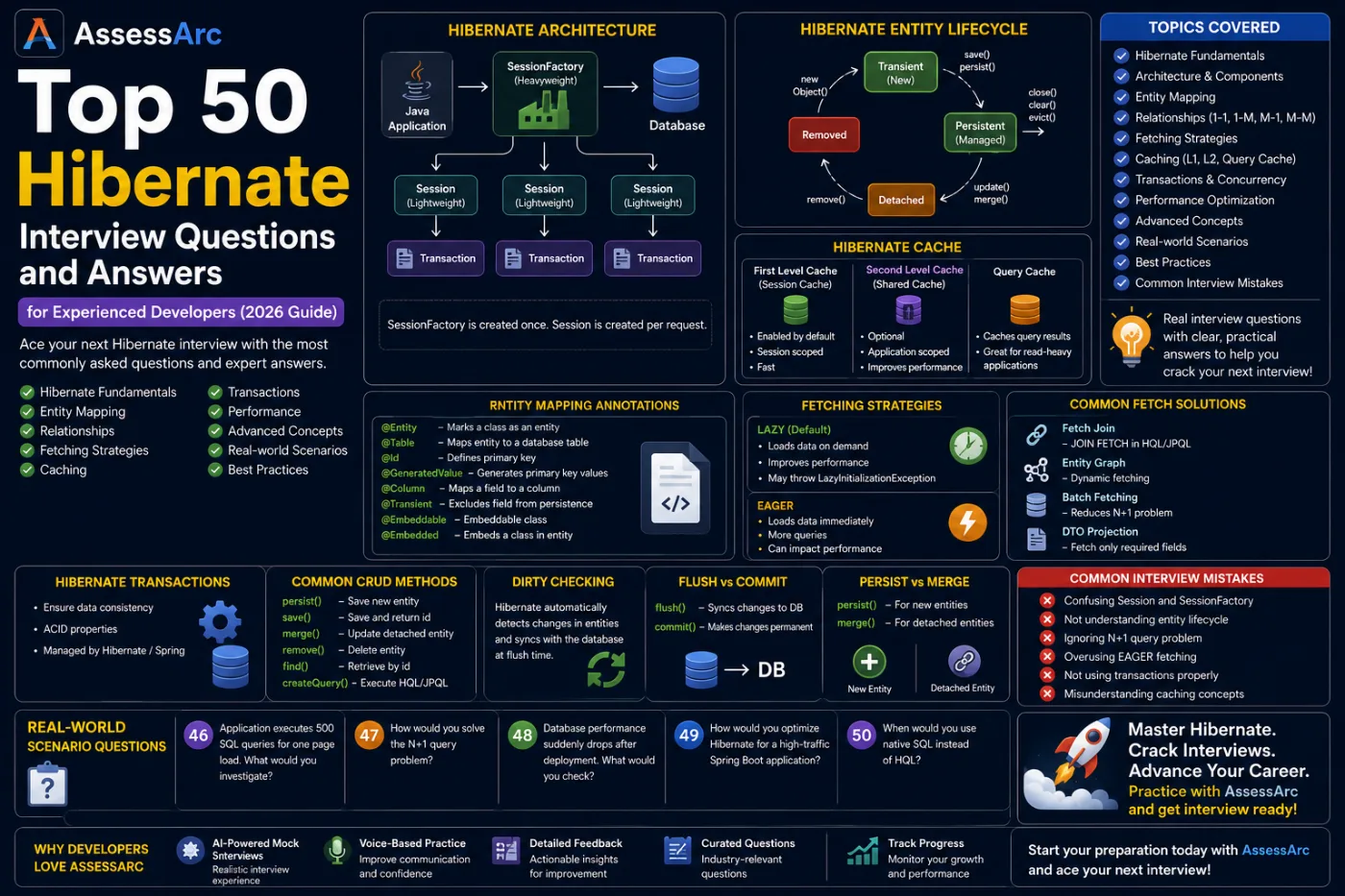
Top 50 Hibernate Interview Questions and Answers for Experienced Developers (2026 Guide)
Table of Contents
Hibernate Fundamentals
Hibernate Architecture
Entity Mapping
Relationships Mapping
Fetching Strategies
Hibernate Caching
Transactions & Performance
Real-World Scenario Questions
Common Hibernate Interview Mistakes
How AssessArc Helps
Conclusion
Introduction
Hibernate is one of the most widely used ORM (Object Relational Mapping) frameworks in Java development.
Almost every enterprise application built using:
Spring Boot
Microservices
Java EE
Banking Systems
E-Commerce Platforms
uses Hibernate or JPA internally.
Because Hibernate sits between Java applications and relational databases, interviewers frequently ask Hibernate questions to evaluate:
Database knowledge
ORM concepts
Performance optimization skills
Real-world troubleshooting experience
This guide covers the top 50 Hibernate interview questions and answers that experienced developers should know before attending technical interviews.
Hibernate Fundamentals
1. What is Hibernate?
Answer
Hibernate is an open-source ORM framework that simplifies database interaction in Java applications.
It maps:
Java Objects ↔ Database Tables
This eliminates the need to write large amounts of JDBC code.
2. What is ORM?
Answer
ORM stands for Object Relational Mapping.
It is a technique that maps:
Java | Database |
|---|---|
Class | Table |
Object | Row |
Field | Column |
ORM allows developers to work with objects instead of SQL statements.
3. Why Use Hibernate?
Answer
Benefits include:
✅ Reduced JDBC boilerplate
✅ Automatic table mapping
✅ Better maintainability
✅ Database independence
✅ Caching support
✅ Transaction management
4. What Are the Main Components of Hibernate?
Answer
Core components:
Configuration
SessionFactory
Session
Transaction
Query
Entity
5. What is SessionFactory?
Answer
SessionFactory is a heavyweight object responsible for creating Sessions.
Characteristics:
Thread-safe
Created once per application
Expensive to create
6. What is Session?
Answer
Session represents a connection between the application and database.
Responsibilities:
CRUD operations
Entity management
Query execution
7. Difference Between SessionFactory and Session
Answer
SessionFactory | Session |
|---|---|
Heavyweight | Lightweight |
Thread-safe | Not thread-safe |
Created once | Created per request |
8. What is a Transaction?
Answer
A transaction ensures data consistency.
Example:
Money Transfer
Debit Account A
Credit Account B
Both operations must succeed together.
9. What is Configuration Object?
Answer
Configuration loads Hibernate settings and mappings.
Example:
Configuration configuration = new Configuration();
10. What is Hibernate Lifecycle?
Answer
Entity lifecycle states:
Transient
Persistent
Detached
Removed
Understanding these states is important for interviews.
Entity Mapping
11. What is @Entity?
Answer
Marks a class as a Hibernate entity.
Example:
@Entity
public class User {
}
12. What is @Table?
Answer
Maps an entity to a database table.
Example:
@Table(name="users")
13. What is @Id?
Answer
Defines the primary key.
Example:
@Id
private Long id;
14. What is @GeneratedValue?
Answer
Automatically generates primary keys.
Example:
@GeneratedValue(strategy = GenerationType.IDENTITY)
15. What Generation Strategies Are Available?
Answer
Common strategies:
AUTO
IDENTITY
SEQUENCE
TABLE
16. What is @Column?
Answer
Maps a field to a database column.
Example:
@Column(name="email")
17. What is @Transient?
Answer
Marks fields that should not be persisted.
Example:
@Transient
private String tempData;
18. What is an Embedded Object?
Answer
Used when multiple fields belong together.
Example:
@Embeddable
public class Address
19. What is a Composite Key?
Answer
Primary key composed of multiple columns.
Implemented using:
@EmbeddedId
@IdClass
20. What is Inheritance Mapping?
Answer
Hibernate supports:
Single Table
Joined Table
Table Per Class
inheritance strategies.
Relationships Mapping
21. What is One-to-One Mapping?
Answer
One record relates to exactly one record.
Example:
User ↔ Passport
Annotation:
@OneToOne
22. What is One-to-Many Mapping?
Answer
One parent has multiple children.
Example:
Department → Employees
23. What is Many-to-One Mapping?
Answer
Many records belong to one parent.
Example:
Employees → Department
24. What is Many-to-Many Mapping?
Answer
Many records relate to many records.
Example:
Students ↔ Courses
25. What is mappedBy?
Answer
Defines the owning side of a relationship.
Helps avoid duplicate mapping.
26. What is Cascade?
Answer
Cascade propagates operations to child entities.
Examples:
Persist
Remove
Merge
27. Common Cascade Types?
Answer
PERSIST
MERGE
REMOVE
REFRESH
DETACH
ALL
28. What is Orphan Removal?
Answer
Automatically removes child entities when disconnected from parent.
29. What is Bidirectional Mapping?
Answer
Both entities reference each other.
Example:
Department ↔ Employee
30. What is Unidirectional Mapping?
Answer
Only one entity references the other.
Simpler but less flexible.
Fetching Strategies
31. What is Lazy Loading?
Answer
Data loads only when required.
Example:
fetch = FetchType.LAZY
Benefits:
Better performance
Reduced queries
32. What is Eager Loading?
Answer
Related data loads immediately.
Example:
fetch = FetchType.EAGER
33. Lazy vs Eager Loading
Answer
Lazy | Eager |
|---|---|
Loads on demand | Loads immediately |
Better performance | Can cause overhead |
34. What is the N+1 Query Problem?
Answer
One query loads parents.
N additional queries load children.
Example:
1 query for Departments
100 queries for Employees
Total:
101 queries
35. How Do You Solve N+1 Problems?
Answer
Common solutions:
Fetch Join
Entity Graph
Batch Fetching
36. What is Fetch Join?
Answer
Loads related entities using a single query.
Example:
SELECT d
FROM Department d
JOIN FETCH d.employees
37. What is Batch Fetching?
Answer
Loads related entities in batches.
Reduces database round trips.
38. What is EntityGraph?
Answer
Controls fetching dynamically.
Improves performance.
39. What Causes LazyInitializationException?
Answer
Accessing lazy-loaded data after Session is closed.
Very common interview question.
40. How Do You Prevent LazyInitializationException?
Answer
Methods:
Fetch Join
EntityGraph
Open Session in View
DTO Projection
Hibernate Caching
41. What is First-Level Cache?
Answer
Built into Hibernate Session.
Enabled by default.
Scope:
One Session.
42. What is Second-Level Cache?
Answer
Shared across Sessions.
Improves performance significantly.
Popular providers:
EhCache
Hazelcast
Infinispan
43. What is Query Cache?
Answer
Caches query results.
Useful for frequently executed queries.
44. Difference Between First and Second Level Cache
Answer
First Level | Second Level |
|---|---|
Session Scope | Application Scope |
Default Enabled | Optional |
Faster Access | Shared Access |
45. When Should Caching Be Used?
Answer
Use caching for:
Frequently read data
Reference data
Product catalogs
User profiles
Transactions & Performance
46. Difference Between persist() and merge()
Answer
persist():
Creates new entity.
merge():
Updates detached entity.
47. Difference Between save() and persist()
Answer
save():
Returns generated ID.
persist():
JPA standard method.
48. What is Dirty Checking?
Answer
Hibernate automatically detects changes to entities.
No explicit update call required.
49. What is Flush?
Answer
Synchronizes Session state with database.
Does not commit transaction.
50. What Are Interviewers Looking For in Hibernate Interviews?
Answer
Interviewers evaluate:
ORM Understanding
Can you explain object-relational mapping?
Relationship Mapping
Can you model real-world entities?
Performance Optimization
Can you solve N+1 issues?
Caching Knowledge
Can you improve performance?
Production Experience
Can you troubleshoot Hibernate problems?
Real Production Scenario Questions
Scenario 1
Application executes 500 SQL queries for one page load. What would you investigate?
Answer
Check:
N+1 query problems
Lazy loading
Fetch joins
Entity relationships
Scenario 2
Database performance drops after deployment. What would you check?
Answer
Investigate:
Generated SQL
Missing indexes
Query plans
Fetch strategies
Scenario 3
How would you optimize Hibernate for a high-traffic Spring Boot application?
Answer
Use:
Second-level cache
Query optimization
DTO projections
Batch processing
Scenario 4
When would you use native SQL instead of HQL?
Answer
Use native SQL when:
Complex reporting queries
Database-specific features
Performance-critical operations
Scenario 5
How would you solve a LazyInitializationException in production?
Answer
Preferred solutions:
Fetch Join
DTO Projection
EntityGraph
Avoid blindly switching everything to EAGER loading.
Common Hibernate Interview Mistakes
❌ Confusing Session and SessionFactory
❌ Weak understanding of entity lifecycle
❌ Not knowing N+1 query problems
❌ Poor caching knowledge
❌ Confusing persist() and merge()
❌ Overusing EAGER fetching
How AssessArc Helps You Prepare for Hibernate Interviews
Hibernate interviews often focus on practical scenarios rather than definitions.
AssessArc helps developers practice:
Hibernate Questions
JPA Questions
Spring Boot Interviews
Backend Architecture Discussions
Production Troubleshooting Scenarios
through AI-powered mock interviews, voice-based interactions, and detailed performance reports.
Conclusion
Hibernate remains one of the most important technologies in Java backend development.
Understanding ORM concepts, entity mapping, relationships, fetching strategies, caching, transactions, and performance optimization can significantly improve your interview success rate.
Master these Hibernate interview questions, practice explaining concepts clearly, and you'll be well-prepared for your next Java or Spring Boot interview.