Top 50 Java 8 Interview Questions and Answers for Experienced Developers (2026 Guide)
Prepare for Java 8 interviews with 50 commonly asked questions covering Streams, Lambda Expressions, Functional Interfaces, Optional, Date API, and real-world scenarios.
Top 50 Java 8 Interview Questions and Answers for Experienced Developers (2026 Guide)
Table of Contents
Java 8 Fundamentals
Lambda Expressions
Functional Interfaces
Stream API
Optional Class
Date & Time API
Method References
Real-World Scenario Questions
Common Interview Mistakes
How AssessArc Helps
Introduction
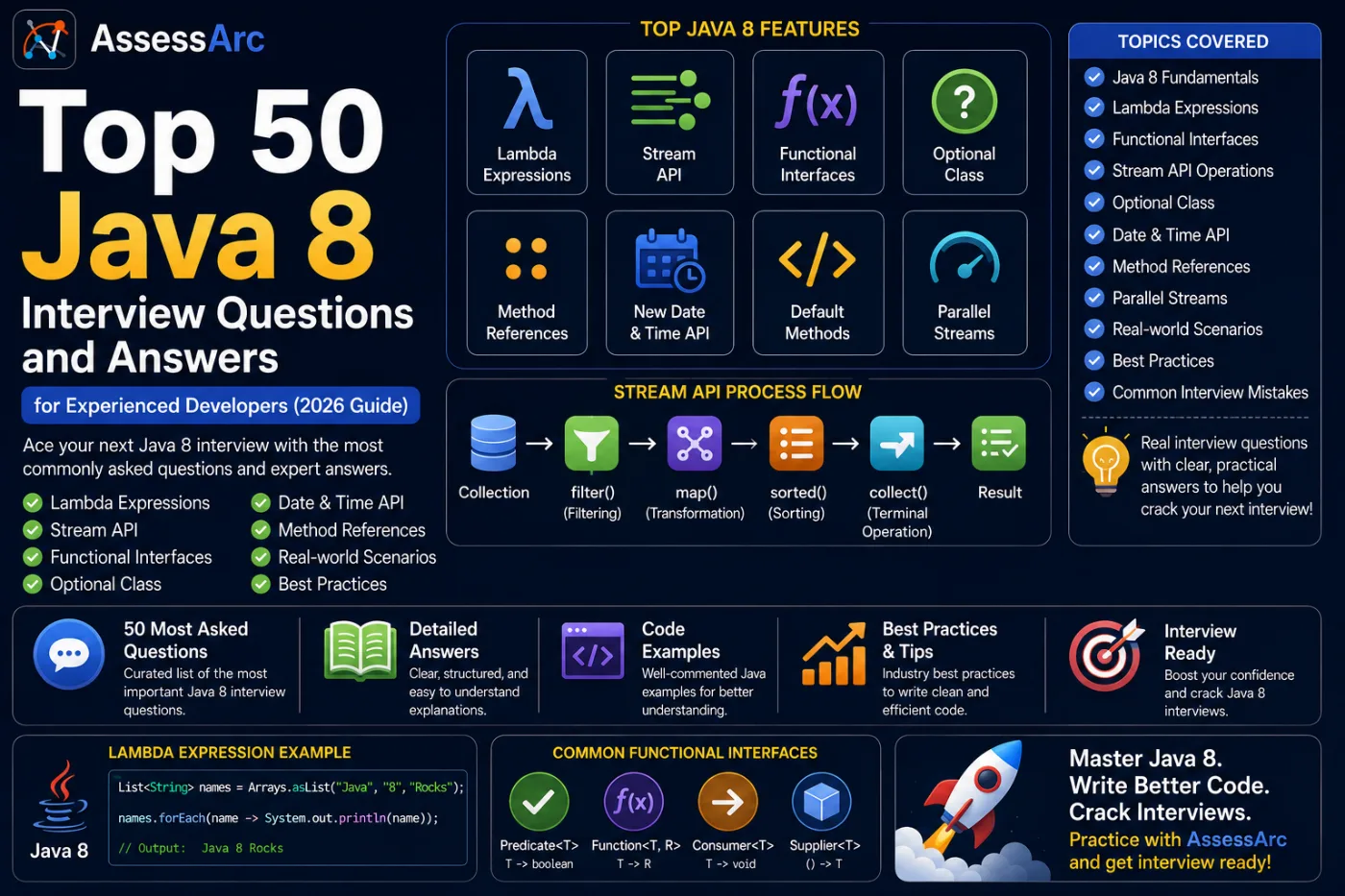
Java 8 was one of the most important releases in Java history.
It introduced powerful features such as:
Lambda Expressions
Stream API
Functional Interfaces
Optional
Method References
New Date & Time API
These features transformed Java into a more modern, concise, and functional programming language.
As a result, Java 8 questions frequently appear in interviews for:
Java Developers
Spring Boot Developers
Backend Engineers
Microservices Developers
Software Engineers
This guide covers the top 50 Java 8 interview questions and answers that are commonly asked in technical interviews.
Java 8 Fundamentals
1. What are the major features introduced in Java 8?
Answer
Java 8 introduced:
Lambda Expressions
Stream API
Functional Interfaces
Method References
Optional Class
New Date & Time API
Default Methods
Parallel Streams
These features improved readability and productivity.
2. Why was Java 8 considered a revolutionary release?
Answer
Before Java 8, developers wrote a lot of boilerplate code.
Java 8 introduced functional programming concepts that made code:
Cleaner
Shorter
Easier to maintain
3. What is Functional Programming?
Answer
Functional Programming focuses on:
Functions as first-class citizens
Immutability
Declarative programming
Java 8 introduced many functional programming concepts.
4. What is a Lambda Expression?
Answer
A Lambda Expression is an anonymous function.
Example:
(x, y) -> x + y
Benefits:
Less boilerplate code
Better readability
5. What are the parts of a Lambda Expression?
Answer
Components:
Parameters
Arrow Operator (->)
Body
Example:
name -> System.out.println(name)
6. Can Lambda Expressions Access Local Variables?
Answer
Yes.
But variables must be:
Final
orEffectively Final
7. What is the "Effectively Final" Concept?
Answer
A variable is effectively final if its value is not modified after initialization.
8. Why Do Lambda Expressions Improve Readability?
Answer
They eliminate unnecessary anonymous class syntax.
Before Java 8:
Much more verbose.
After Java 8:
More concise and expressive.
9. Can Lambda Expressions Throw Exceptions?
Answer
Yes.
Handled similarly to normal methods.
Checked exceptions require explicit handling.
10. What are Common Lambda Use Cases?
Answer
Sorting
Filtering
Mapping
Event Handling
Stream Processing
Functional Interfaces
11. What is a Functional Interface?
Answer
A Functional Interface contains exactly one abstract method.
Example:
@FunctionalInterface
interface Calculator {
    int add(int a, int b);
}
12. What is the @FunctionalInterface Annotation?
Answer
Ensures an interface contains only one abstract method.
Compiler validates this rule.
13. What are Common Functional Interfaces?
Answer
Java provides:
Predicate
Function
Consumer
Supplier
14. What is Predicate?
Answer
Represents a condition.
Predicate<Integer> even =
n -> n % 2 == 0;
Returns:
true
false
15. What is Function?
Answer
Accepts one input and returns one output.
Function<String,Integer> length =
String::length;
16. What is Consumer?
Answer
Consumes data without returning a result.
Consumer<String> print =
System.out::println;
17. What is Supplier?
Answer
Supplies data without accepting input.
Supplier<String> message =
() -> "Hello";
18. Difference Between Predicate and Function
Answer
Predicate | Function |
|---|---|
Returns boolean | Returns value |
Used for filtering | Used for transformation |
19. Can Functional Interfaces Have Default Methods?
Answer
Yes.
Only one abstract method restriction applies.
Default methods are allowed.
20. Why Are Functional Interfaces Important?
Answer
They enable:
Lambda Expressions
Stream Processing
Functional Programming
Stream API
21. What is Stream API?
Answer
Stream API processes collections declaratively.
Example:
users.stream()
22. Benefits of Stream API
Answer
Cleaner code
Better readability
Parallel processing support
23. Difference Between Collection and Stream
Answer
Collection | Stream |
|---|---|
Stores data | Processes data |
Mutable | Functional style |
24. What is filter()?
Answer
Filters data based on conditions.
Example:
users.stream()
     .filter(u -> u.isActive());
25. What is map()?
Answer
Transforms data.
Example:
users.stream()
     .map(User::getName);
26. What is flatMap()?
Answer
Flattens nested structures.
Useful for nested collections.
27. What is sorted()?
Answer
Sorts stream elements.
Example:
numbers.stream()
       .sorted();
28. What is distinct()?
Answer
Removes duplicate elements.
29. What is collect()?
Answer
Terminal operation converting stream into:
List
Set
Map
30. What is forEach()?
Answer
Processes each element.
Example:
users.forEach(System.out::println);
31. What is reduce()?
Answer
Combines stream elements into a single result.
Example:
sum = numbers.stream()
             .reduce(0, Integer::sum);
32. What is Stream Lazy Evaluation?
Answer
Intermediate operations execute only when a terminal operation is invoked.
Improves efficiency.
33. What is Parallel Stream?
Answer
Processes data using multiple threads.
Example:
list.parallelStream()
34. When Should Parallel Streams Be Avoided?
Answer
Avoid when:
Small datasets
Thread contention
Order-sensitive operations
35. What are Intermediate Operations?
Answer
Examples:
filter()
map()
sorted()
They return a Stream.
36. What are Terminal Operations?
Answer
Examples:
collect()
count()
reduce()
forEach()
They produce final results.
Optional Class
37. What is Optional?
Answer
Optional helps avoid NullPointerException.
Example:
Optional<User> user;
38. Why Was Optional Introduced?
Answer
To represent absence of values safely.
39. What is of()?
Answer
Creates Optional with non-null value.
Optional.of("Java")
40. What is ofNullable()?
Answer
Handles nullable values safely.
Optional.ofNullable(value)
41. What is orElse()?
Answer
Provides default value.
optional.orElse("Default")
42. What is orElseGet()?
Answer
Lazily computes default value.
More efficient in many cases.
Date & Time API
43. Why Was New Date API Introduced?
Answer
Old Date API had:
Mutability issues
Thread-safety issues
Poor design
44. What is LocalDate?
Answer
Represents date only.
Example:
LocalDate.now()
45. What is LocalDateTime?
Answer
Represents date and time.
Example:
LocalDateTime.now()
46. What is ZonedDateTime?
Answer
Represents date and time with timezone information.
47. What is Method Reference?
Answer
Shorthand for Lambda Expressions.
Example:
System.out::println
Real Interview Scenario Questions
48. How Would You Find Duplicate Elements Using Streams?
Answer
Common approach:
Use Set
Filter duplicates
Frequently asked in interviews.
49. How Would You Sort Employees by Salary Using Streams?
Answer
Use:
sorted(Comparator.comparing(Employee::getSalary))
50. What Are Interviewers Looking For in Java 8 Interviews?
Answer
Interviewers evaluate:
Lambda Understanding
Stream API Knowledge
Functional Interfaces
Optional Usage
Real-world Coding Experience
Common Java 8 Interview Mistakes
❌ Memorizing Streams without understanding
❌ Confusing map() and flatMap()
❌ Weak Optional knowledge
❌ Not knowing Functional Interfaces
❌ No practical examples
How AssessArc Helps You Prepare
Java interviews increasingly focus on Java 8 concepts.
AssessArc helps candidates practice:
Stream Questions
Lambda Questions
Scenario-Based Questions
Java Backend Interviews
through AI-powered mock interviews and detailed feedback reports.
Conclusion
Java 8 remains one of the most important versions of Java and is still heavily used in enterprise applications.
Mastering Streams, Lambdas, Functional Interfaces, Optional, and Date APIs can significantly improve your interview performance.
Practice these Java 8 interview questions regularly and confidently explain concepts during interviews to maximize your chances of success.