Top 50 Kafka Interview Questions and Answers for Experienced Developers (2026 Guide)
Prepare for your next Apache Kafka interview with the top 50 Kafka interview questions and answers. Covers Kafka architecture, partitions, offsets, consumer groups, repli
Top 50 Kafka Interview Questions and Answers for Experienced Developers (2026 Guide)
Introduction
Apache Kafka has become one of the most widely used distributed event-streaming platforms in modern software systems.
Companies such as Netflix, LinkedIn, Uber, Amazon, Airbnb, and thousands of startups use Kafka to handle millions of events every second.
As organizations increasingly adopt Microservices, Event-Driven Architecture, and Real-Time Data Processing, Kafka skills have become highly valuable for Software Engineers, Java Developers, Backend Engineers, Data Engineers, and Solution Architects.
Because of this demand, Kafka-related interview questions frequently appear in technical interviews.
In this guide, you'll learn the most commonly asked Kafka interview questions along with detailed answers that help you prepare for real-world interviews.
Kafka Fundamentals
1. What is Apache Kafka?
Answer
Apache Kafka is a distributed event-streaming platform used for:
Real-time data streaming
Event-driven architectures
Asynchronous communication
Log aggregation
Data integration
Kafka enables systems to publish, store, and consume streams of events at massive scale.
Real-World Example
When a customer places an order:
Order Service publishes an event.
Payment Service consumes it.
Notification Service consumes it.
Analytics Service consumes it.
All services work independently.
2. Why is Kafka so popular?
Answer
Kafka offers:
✅ High Throughput
✅ Horizontal Scalability
✅ Fault Tolerance
✅ Durability
✅ Distributed Architecture
✅ Real-Time Processing
It can process millions of messages per second while maintaining reliability.
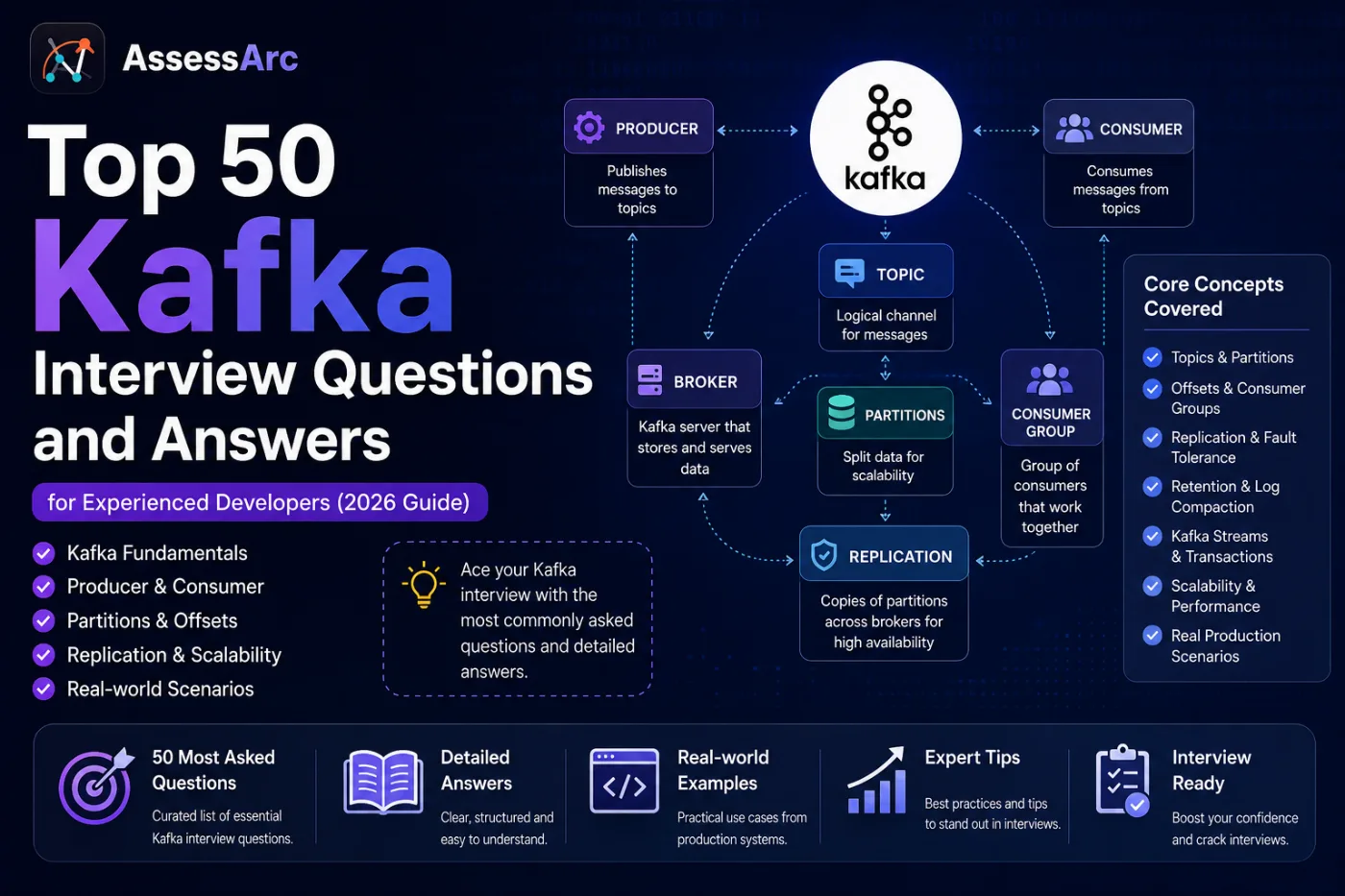
3. What are the main components of Kafka?
Answer
Kafka consists of:
Producer
Publishes messages.
Consumer
Reads messages.
Topic
Logical category of messages.
Partition
Subdivision of a topic.
Broker
Kafka server storing data.
Consumer Group
Group of consumers processing messages together.
ZooKeeper (Legacy)
Used for cluster coordination.
KRaft
Modern Kafka metadata management replacing ZooKeeper.
4. What is a Topic?
Answer
A Topic is a logical channel where messages are stored.
Example:
payment-events
order-events
notification-events
Applications publish and consume data through topics.
5. What is a Partition?
Answer
Partitions divide a topic into smaller units.
Benefits:
Scalability
Parallel processing
Load distribution
Example
Topic:
order-events
Partitions:
Partition 0
Partition 1
Partition 2
Messages are distributed across partitions.
6. Why are Partitions important?
Answer
Partitions enable:
Horizontal scaling
Parallel consumption
High throughput
Without partitions, Kafka could not scale efficiently.
7. What is a Kafka Broker?
Answer
A Broker is a Kafka server responsible for:
Storing messages
Serving consumers
Handling producers
Replicating data
A Kafka cluster usually contains multiple brokers.
8. What is Replication in Kafka?
Answer
Replication creates copies of data across brokers.
Benefits:
High Availability
Fault Tolerance
Data Protection
9. What is a Replica?
Answer
Replica is a copy of a partition.
Example:
Partition 0
Stored on:
Broker 1
Broker 2
Broker 3
This prevents data loss if a broker crashes.
10. What is a Leader Replica?
Answer
Each partition has one leader.
All:
Reads
Writes
Go through the leader replica.
Followers replicate the leader.
Producer Interview Questions
11. What is a Kafka Producer?
Answer
A Producer publishes records to Kafka topics.
Example:
Order Service publishes:
{
  "orderId": "123",
  "amount": 500
}
to order-events topic.
12. How does Kafka determine the target partition?
Answer
Kafka uses:
Key-Based Routing
Same key → Same partition
Round Robin
If no key is provided.
13. What is Producer Acknowledgement (acks)?
Answer
Controls durability guarantees.
acks=0
No confirmation.
Fastest but risky.
acks=1
Leader confirms.
acks=all
All replicas confirm.
Most reliable.
14. What is Idempotent Producer?
Answer
Prevents duplicate messages caused by retries.
Useful for:
Payments
Banking
Financial transactions
15. What is Compression in Kafka?
Answer
Compression reduces network traffic.
Supported formats:
GZIP
Snappy
LZ4
ZSTD
Benefits:
Faster transmission
Lower storage usage
Consumer Interview Questions
16. What is a Kafka Consumer?
Answer
Consumers read data from Kafka topics.
Example:
Notification Service consumes:
order-created events.
17. What is a Consumer Group?
Answer
Multiple consumers working together.
Benefits:
Scalability
Parallel processing
Each partition is assigned to only one consumer within a group.
18. What happens if consumers are greater than partitions?
Answer
Extra consumers remain idle.
Example:
3 partitions
5 consumers
Only 3 consumers receive messages.
19. What happens if partitions are greater than consumers?
Answer
Some consumers handle multiple partitions.
Example:
10 partitions
5 consumers
Each consumer processes approximately 2 partitions.
20. What is an Offset?
Answer
Offset is a unique sequence number for each message.
Kafka tracks offsets to know which messages were consumed.
21. What is Offset Commit?
Answer
Offset Commit records consumption progress.
Kafka uses it to resume processing after failures.
22. Auto Commit vs Manual Commit?
Auto Commit
Simple
May lose messages
Manual Commit
More reliable
Preferred in production systems
23. What is Consumer Lag?
Answer
Difference between:
Latest Offset
and
Consumed Offset
High lag indicates consumers are slower than producers.
24. How do you monitor Consumer Lag?
Answer
Tools:
Burrow
Prometheus
Grafana
Confluent Control Center
25. How do you reduce Consumer Lag?
Answer
Methods:
Increase partitions
Add consumers
Optimize processing
Improve hardware
Advanced Kafka Interview Questions
26. What is Kafka Retention Policy?
Answer
Defines how long messages remain stored.
Retention can be based on:
Time
Size
Example:
7 days retention.
27. What is Log Compaction?
Answer
Retains only the latest value for a key.
Useful for:
User Profiles
Configuration Data
28. What is Exactly Once Semantics?
Answer
Ensures messages are processed exactly once.
Achieved using:
Idempotent Producer
Transactions
29. What is At-Least-Once Delivery?
Answer
Messages may be duplicated but never lost.
Most common production strategy.
30. What is At-Most-Once Delivery?
Answer
Messages may be lost but never duplicated.
Rarely used.
Real-World Kafka Scenario Questions
31. Kafka broker crashes. What happens?
Answer
Leader election occurs.
A follower becomes leader.
Consumers continue processing.
32. How would you design a high-throughput Kafka system?
Answer
Use:
Multiple partitions
Multiple brokers
Compression
Batch processing
33. How do you handle duplicate messages?
Answer
Use:
Idempotency
Unique transaction IDs
Deduplication tables
34. Why is Kafka preferred over RabbitMQ for streaming?
Answer
Kafka provides:
Higher throughput
Better scalability
Event replay
Long-term retention
35. When would RabbitMQ be a better choice?
Answer
For:
Complex routing
Request-response patterns
Smaller workloads
Production Experience Questions
36. How many partitions should a topic have?
Answer
Depends on:
Throughput
Consumer count
Scalability needs
No fixed number exists.
37. Can partition count be increased?
Answer
Yes.
However message ordering may change.
38. Can partition count be decreased?
Answer
No.
Kafka does not support decreasing partitions.
39. How do you ensure message ordering?
Answer
Use:
Same key
Same partition
Kafka guarantees ordering within a partition.
40. How do you secure Kafka?
Answer
Use:
SSL/TLS
SASL Authentication
ACL Authorization
Frequently Asked Kafka Scenario Questions
41. Why is my consumer not receiving messages?
Answer
Possible causes:
Wrong topic
Wrong group ID
Offset issue
Network issue
42. Why are messages delayed?
Answer
Potential reasons:
Consumer lag
Network latency
Slow processing
43. Why are messages duplicated?
Answer
Common causes:
Retries
Auto commits
Consumer crashes
44. What happens if all brokers fail?
Answer
Cluster becomes unavailable.
Replication minimizes this risk.
45. How do you scale Kafka?
Answer
Add:
More brokers
More partitions
More consumers
46. What is Dead Letter Queue (DLQ)?
Answer
Stores failed messages.
Allows investigation without blocking processing.
47. What is Kafka Streams?
Answer
Java library for stream processing.
Supports:
Filtering
Aggregation
Joins
48. What is Event-Driven Architecture?
Answer
Systems communicate through events rather than direct API calls.
Kafka is widely used to implement Event-Driven Architecture.
49. What are the biggest challenges in Kafka?
Answer
Consumer lag
Monitoring
Schema evolution
Data consistency
Partition strategy
50. What Kafka topics should experienced developers master?
Answer
Before interviews, focus on:
Partitions
Offsets
Consumer Groups
Replication
Retention
Kafka Streams
Transactions
Exactly Once Processing
Scaling Strategies
Real Production Scenarios
Final Thoughts
Kafka interviews today focus less on definitions and more on production experience.
Interviewers want to understand:
How you scale Kafka
How you troubleshoot lag
How you handle failures
How you guarantee reliability
How Kafka integrates with Microservices
The best way to prepare is not only reading questions but also practicing how you explain concepts aloud.
Platforms like AssessArc help candidates practice realistic Kafka interview questions through AI-powered mock interviews, enabling developers to improve confidence, communication, and technical depth before actual interviews.