Top 50 Kubernetes Interview Questions and Answers for Experienced Developers (2026 Guide)
Prepare for Kubernetes interviews with the top 50 Kubernetes interview questions and answers covering Pods, Deployments, Services, Ingress, ConfigMaps, Helm, and
Top 50 Kubernetes Interview Questions and Answers for Experienced Developers (2026 Guide)
Introduction
Kubernetes (K8s) has become the industry standard for container orchestration.
While Docker revolutionized containerization, Kubernetes solved the challenge of managing containers at scale.
Today, companies such as Google, Netflix, Amazon, Uber, Spotify, Airbnb, and thousands of startups rely on Kubernetes to deploy, scale, monitor, and manage applications in production.
As a result, Kubernetes questions frequently appear in interviews for:
Software Engineers
Java Developers
Backend Engineers
DevOps Engineers
Cloud Engineers
Platform Engineers
Site Reliability Engineers (SREs)
Modern Kubernetes interviews focus not only on concepts but also on troubleshooting, scalability, networking, and real-world production scenarios.
This guide covers the top 50 Kubernetes interview questions and answers that experienced developers should know before attending technical interviews.
Kubernetes Fundamentals
1. What is Kubernetes?
Answer
Kubernetes is an open-source container orchestration platform used to automate:
Deployment
Scaling
Management
Monitoring
of containerized applications.
It was originally developed by Google and is now maintained by the Cloud Native Computing Foundation (CNCF).
2. Why Do We Need Kubernetes?
Answer
Managing hundreds of containers manually is difficult.
Kubernetes provides:
✅ Auto Scaling
✅ Self Healing
✅ Load Balancing
✅ Service Discovery
✅ Rolling Updates
✅ High Availability
3. What Problems Does Kubernetes Solve?
Answer
Without Kubernetes:
Manual deployments
Difficult scaling
No self-healing
Complex networking
With Kubernetes:
Automated deployments
Automatic recovery
Centralized management
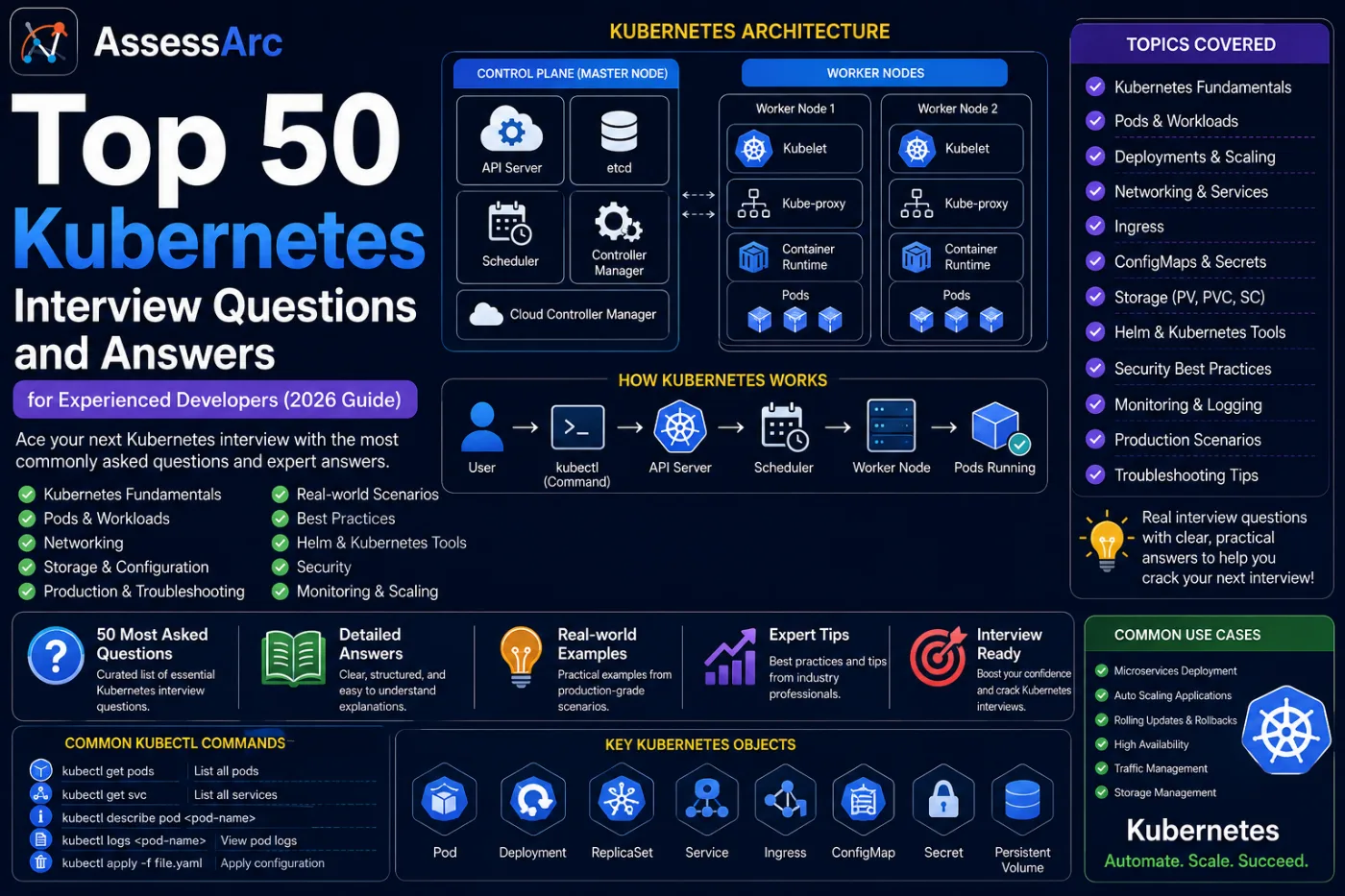
4. What is a Kubernetes Cluster?
Answer
A Kubernetes Cluster is a group of machines working together to run containerized applications.
It consists of:
Control Plane (Master)
Worker Nodes
5. What is a Control Plane?
Answer
The Control Plane manages the entire cluster.
Responsibilities:
Scheduling
Monitoring
API management
Cluster state management
6. What is a Worker Node?
Answer
Worker Nodes run application workloads.
Each worker node contains:
Kubelet
Container Runtime
Kube Proxy
7. What is Kubelet?
Answer
Kubelet is an agent running on every worker node.
Responsibilities:
Starts containers
Monitors pods
Reports status to control plane
8. What is kube-proxy?
Answer
kube-proxy manages networking and traffic routing inside the cluster.
It enables communication between services and pods.
9. What is etcd?
Answer
etcd is Kubernetes' distributed key-value database.
Stores:
Cluster configuration
Secrets
Metadata
Current cluster state
10. What is the API Server?
Answer
API Server is the central entry point for Kubernetes.
All operations go through it:
kubectl get pods
kubectl apply
kubectl delete
Pods & Workloads
11. What is a Pod?
Answer
A Pod is the smallest deployable unit in Kubernetes.
A pod can contain:
One container
Multiple containers
that share storage and networking.
12. Why Does Kubernetes Use Pods Instead of Containers?
Answer
Pods provide:
Shared networking
Shared storage
Lifecycle management
Kubernetes manages pods, not individual containers.
13. What is a Deployment?
Answer
Deployment manages application releases.
Responsibilities:
Rolling updates
Rollbacks
Scaling
Example:
apiVersion: apps/v1
kind: Deployment
14. What is a ReplicaSet?
Answer
ReplicaSet ensures a specified number of pod replicas are always running.
Example:
Desired replicas = 3
If one pod crashes:
Kubernetes automatically creates another.
15. Difference Between Deployment and ReplicaSet
Answer
Deployment | ReplicaSet |
|---|---|
Manages ReplicaSets | Manages Pods |
Supports Rollback | No Rollback |
Recommended | Usually Managed by Deployment |
16. What is a StatefulSet?
Answer
StatefulSet manages stateful applications.
Examples:
PostgreSQL
MongoDB
Cassandra
Provides stable identities.
17. What is a DaemonSet?
Answer
DaemonSet ensures one pod runs on every node.
Common use cases:
Monitoring agents
Log collectors
Examples:
Fluentd
Prometheus Node Exporter
18. What is a Job?
Answer
A Job executes a task once and exits.
Examples:
Data migration
Batch processing
19. What is a CronJob?
Answer
CronJob executes Jobs on a schedule.
Example:
Daily backup at midnight.
20. What is Horizontal Pod Autoscaler (HPA)?
Answer
Automatically scales pods based on:
CPU utilization
Memory usage
Custom metrics
Kubernetes Networking
21. What is a Service?
Answer
A Service provides a stable endpoint for pods.
Without Services:
Pod IPs constantly change.
22. What is ClusterIP?
Answer
Default Kubernetes Service type.
Accessible only within the cluster.
23. What is NodePort?
Answer
Exposes an application through a port on each node.
Example:
NodeIP:30080
24. What is LoadBalancer Service?
Answer
Creates a cloud load balancer.
Commonly used in:
AWS
Azure
GCP
25. What is Ingress?
Answer
Ingress manages external HTTP/HTTPS traffic.
Benefits:
SSL termination
Path-based routing
Host-based routing
26. Why Use Ingress Instead of Multiple Load Balancers?
Answer
Ingress:
Reduces costs
Simplifies routing
Centralizes traffic management
27. What is Kubernetes DNS?
Answer
Provides service discovery.
Example:
user-service.default.svc.cluster.local
28. What is Service Discovery?
Answer
Allows applications to find each other automatically.
No hardcoded IP addresses required.
29. What is a Network Policy?
Answer
Controls pod-to-pod communication.
Functions like a firewall.
30. How Do Pods Communicate?
Answer
Through:
Services
Cluster networking
DNS resolution
Storage & Configuration
31. What is a ConfigMap?
Answer
Stores non-sensitive configuration.
Examples:
URLs
Feature flags
Application settings
32. What is a Secret?
Answer
Stores sensitive data.
Examples:
Passwords
Tokens
API keys
33. ConfigMap vs Secret
Answer
ConfigMap | Secret |
|---|---|
Non-sensitive | Sensitive |
Plain Text | Base64 Encoded |
34. What is a Persistent Volume (PV)?
Answer
Persistent Volume represents storage inside Kubernetes.
Independent of pod lifecycle.
35. What is a Persistent Volume Claim (PVC)?
Answer
PVC requests storage from available Persistent Volumes.
Applications use PVC instead of directly accessing PVs.
36. What is a Storage Class?
Answer
Storage Class enables dynamic volume provisioning.
Benefits:
Automatic storage allocation
Cloud integration
37. What is Helm?
Answer
Helm is the package manager for Kubernetes.
Benefits:
Reusable templates
Simplified deployments
Easier upgrades
38. What is a Helm Chart?
Answer
A Helm Chart is a package containing Kubernetes resources.
Examples:
Deployment
Service
ConfigMap
39. Why is Helm Popular?
Answer
Helm simplifies:
Deployments
Configuration management
Version control
40. What is Namespace?
Answer
Namespaces logically separate resources.
Example:
production
staging
development
Production & Troubleshooting Questions
41. What Causes a Pod to Crash?
Answer
Common reasons:
Application errors
Memory issues
Configuration mistakes
Missing dependencies
42. How Do You Debug a Failing Pod?
Answer
Useful commands:
kubectl logs pod-name

kubectl describe pod pod-name

kubectl get events
43. What is CrashLoopBackOff?
Answer
Pod repeatedly starts and crashes.
Common causes:
Application failures
Incorrect configuration
Missing environment variables
44. How Do You Perform Zero-Downtime Deployment?
Answer
Use:
Rolling Updates
Multiple replicas
Readiness probes
Users experience no downtime.
45. What is a Readiness Probe?
Answer
Determines whether a pod can receive traffic.
Unhealthy pods are removed from load balancing.
Real Production Scenario Questions
46. A Pod Keeps Restarting. How Would You Troubleshoot?
Answer
Check:
Pod logs
Events
Resource limits
Environment variables
Application startup process
47. Application Is Down But Pods Are Running. What Would You Check?
Answer
Investigate:
Service configuration
Ingress configuration
DNS
Network policies
Readiness probes
48. How Would You Deploy a Spring Boot Application with Zero Downtime?
Answer
Use:
Deployment
Multiple replicas
Rolling updates
Readiness probes
Load balancing
49. How Would You Scale Kubernetes for One Million Users?
Answer
Use:
Horizontal Pod Autoscaler
Cluster Autoscaler
Load Balancers
Caching
CDN
Scale both applications and infrastructure.
50. High Memory Usage Is Impacting the Cluster. How Would You Investigate?
Answer
Check:
Resource metrics
Memory leaks
Pod limits
Heap usage
Application profiling
Use:
kubectl top pods
kubectl top nodes
Common Kubernetes Interview Mistakes
❌ Memorizing kubectl commands only
❌ Weak understanding of networking
❌ Not understanding Services and Ingress
❌ No troubleshooting knowledge
❌ Confusing Deployments and ReplicaSets
❌ Lack of production examples
How AssessArc Helps You Prepare for Kubernetes Interviews
Kubernetes interviews often focus on real-world scenarios rather than definitions.
Interviewers expect candidates to explain:
Pod architecture
Networking
Deployments
Scaling
Monitoring
Troubleshooting
AssessArc helps developers practice Kubernetes interview questions through AI-powered mock interviews, voice-based discussions, and detailed feedback reports that improve both technical expertise and communication skills.
Conclusion
Kubernetes has become a core technology for modern software engineering and cloud-native development.
Understanding Pods, Deployments, Services, Ingress, Storage, Helm, Scaling, and Troubleshooting can significantly improve your chances of success in technical interviews.
Master these Kubernetes interview questions, practice explaining concepts clearly, and you'll be ready to confidently tackle Kubernetes interviews in 2026 and beyond.