Top 50 Machine Learning Interview Questions and Answers for Experienced Professionals (2026 Guide)
Prepare for Machine Learning interviews with 50 commonly asked questions covering supervised learning, deep learning, model evaluation, feature engineering, and MLOps.
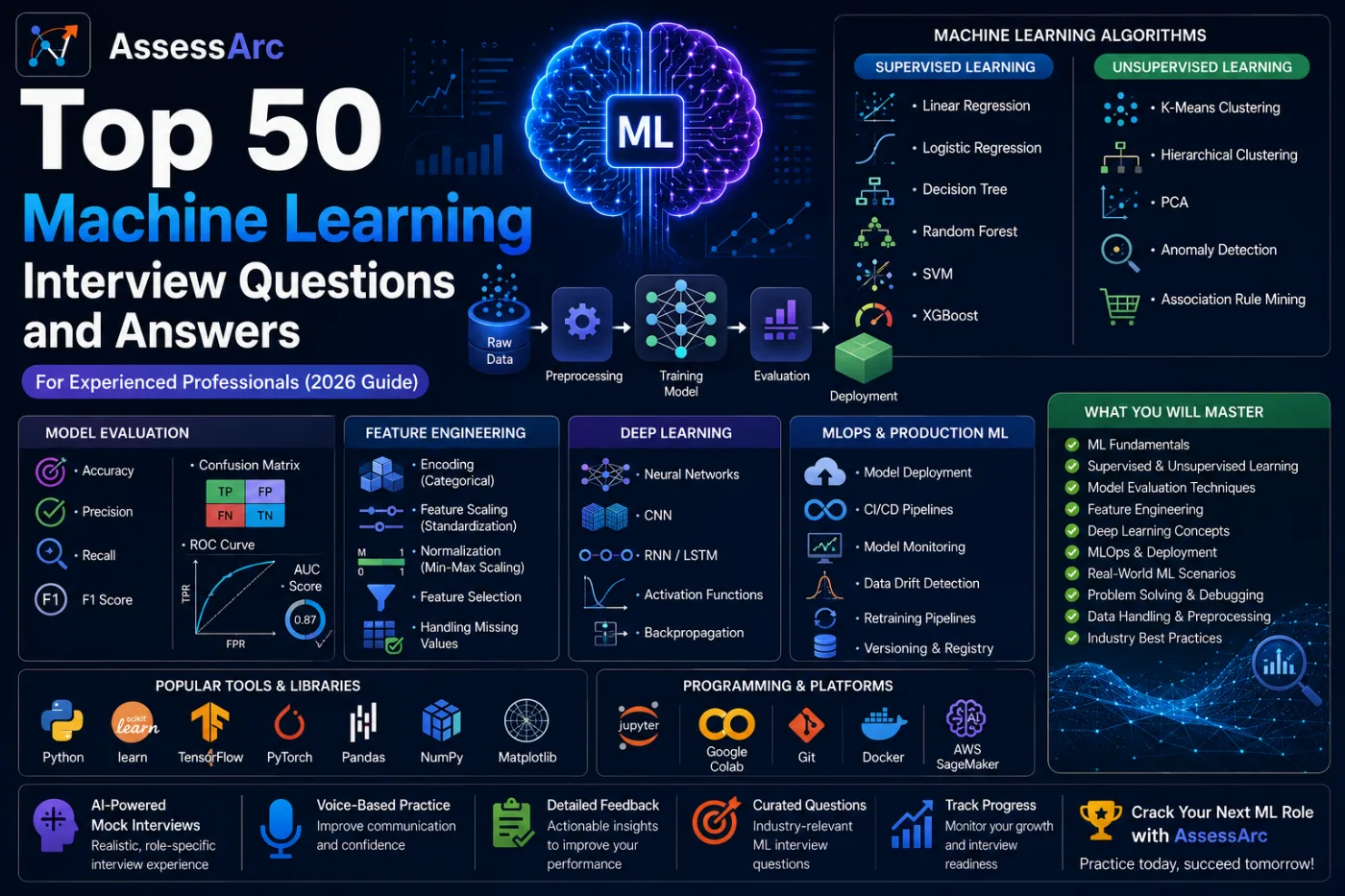
Top 50 Machine Learning Interview Questions and Answers for Experienced Professionals (2026 Guide)
Table of Contents
Machine Learning Fundamentals
Supervised Learning Questions
Unsupervised Learning Questions
Model Evaluation Questions
Feature Engineering Questions
Deep Learning Questions
MLOps & Production ML Questions
Real-World Machine Learning Scenarios
Common Interview Mistakes
How AssessArc Helps
Conclusion
Introduction
Machine Learning Engineers are among the most in-demand professionals in today's technology landscape.
Organizations use Machine Learning for:
Recommendation Systems
Fraud Detection
Customer Analytics
NLP Applications
Computer Vision
Predictive Analytics
As a result, Machine Learning interviews evaluate both theoretical concepts and practical implementation skills.
Interviewers typically focus on:
ML Algorithms
Statistics
Model Evaluation
Feature Engineering
Deep Learning
Production Deployment
MLOps
This guide covers the top 50 Machine Learning interview questions and answers frequently asked in 2026.
Machine Learning Fundamentals
1. What is Machine Learning?
Answer
Machine Learning is a subset of Artificial Intelligence that enables systems to learn patterns from data and improve performance without explicit programming.
Examples:
Spam Detection
Product Recommendations
Credit Scoring
2. Types of Machine Learning
Answer
Main categories:
Supervised Learning
Uses labeled data.
Unsupervised Learning
Uses unlabeled data.
Reinforcement Learning
Learns through rewards and penalties.
3. What is a Training Dataset?
Answer
Dataset used to train machine learning models.
The model learns patterns from this data.
4. What is a Test Dataset?
Answer
Used to evaluate model performance on unseen data.
5. What is Overfitting?
Answer
Overfitting occurs when a model performs well on training data but poorly on new data.
6. What is Underfitting?
Answer
Underfitting occurs when a model fails to learn important patterns from data.
7. What is Bias?
Answer
Bias refers to errors caused by overly simplistic assumptions.
8. What is Variance?
Answer
Variance refers to model sensitivity to training data variations.
9. What is the Bias-Variance Tradeoff?
Answer
Goal:
Balance bias and variance to maximize generalization.
10. What is Cross Validation?
Answer
Technique used to evaluate model performance using multiple train-test splits.
Common approach:
K-Fold Cross Validation.
Supervised Learning Questions
11. What is Supervised Learning?
Answer
Machine learning approach using labeled data.
Examples:
Classification
Regression
12. What is Classification?
Answer
Predicting categories.
Examples:
Spam Detection
Fraud Detection
13. What is Regression?
Answer
Predicting continuous values.
Examples:
House Prices
Sales Forecasting
14. What is Linear Regression?
Answer
Algorithm used to predict continuous values using a linear relationship.
15. What is Logistic Regression?
Answer
Classification algorithm used for binary outcomes.
Example:
Spam vs Not Spam.
16. What is Decision Tree?
Answer
Tree-based algorithm that splits data into decision nodes.
17. What is Random Forest?
Answer
Ensemble algorithm consisting of multiple decision trees.
Benefits:
Higher accuracy
Reduced overfitting
18. What is XGBoost?
Answer
Popular gradient boosting algorithm known for high predictive performance.
19. What is Support Vector Machine (SVM)?
Answer
Algorithm that finds the optimal boundary separating classes.
20. When Would You Use Random Forest Instead of Logistic Regression?
Answer
Use Random Forest when:
Relationships are nonlinear
Feature interactions are complex
Unsupervised Learning Questions
21. What is Unsupervised Learning?
Answer
Learning from data without labels.
22. What is Clustering?
Answer
Grouping similar data points together.
23. What is K-Means Clustering?
Answer
Popular clustering algorithm that groups data into K clusters.
24. What is Hierarchical Clustering?
Answer
Builds nested clusters using a tree structure.
25. What is Dimensionality Reduction?
Answer
Reducing the number of features while preserving information.
26. What is PCA?
Answer
Principal Component Analysis.
Technique used for dimensionality reduction.
27. Why Use PCA?
Answer
Benefits:
Faster Training
Reduced Noise
Better Visualization
28. What is Anomaly Detection?
Answer
Identifying unusual observations in data.
Examples:
Fraud Detection
Network Security
29. What is Association Rule Mining?
Answer
Discovering relationships between items.
Example:
Market Basket Analysis.
30. What Are Common Clustering Use Cases?
Answer
Examples:
Customer Segmentation
Recommendation Systems
Behavioral Analysis
Model Evaluation Questions
31. What is Accuracy?
Answer
Percentage of correct predictions.
32. What is Precision?
Answer
Measures correctness of positive predictions.
33. What is Recall?
Answer
Measures ability to identify actual positives.
34. What is F1 Score?
Answer
Harmonic mean of Precision and Recall.
35. What is a Confusion Matrix?
Answer
Evaluation table containing:
True Positive
False Positive
True Negative
False Negative
36. What is ROC Curve?
Answer
Graph showing model performance across classification thresholds.
37. What is AUC?
Answer
Area Under ROC Curve.
Measures classifier performance.
38. What is Mean Squared Error (MSE)?
Answer
Measures average squared prediction errors.
39. What is RMSE?
Answer
Root Mean Squared Error.
Common regression metric.
40. Why Is Accuracy Sometimes Misleading?
Answer
For imbalanced datasets accuracy can appear high despite poor model performance.
Feature Engineering Questions
41. What is Feature Engineering?
Answer
Process of creating meaningful features from raw data.
42. Why Is Feature Engineering Important?
Answer
Good features often improve model performance more than algorithm selection.
43. What is Feature Scaling?
Answer
Transforming feature values to a common range.
44. What is Standardization?
Answer
Transforms data to:
Mean = 0
Standard Deviation = 1
45. What is Normalization?
Answer
Scales data to a fixed range such as:
0 to 1
Deep Learning & MLOps Questions
46. What is Deep Learning?
Answer
Subset of machine learning using neural networks with multiple layers.
47. What is a Neural Network?
Answer
Computational model inspired by the human brain.
Consists of:
Input Layer
Hidden Layers
Output Layer
48. What is MLOps?
Answer
MLOps combines:
Machine Learning
DevOps
Automation
to deploy and manage ML systems.
49. How Would You Deploy a Machine Learning Model?
Answer
Typical approach:
Train Model
Save Model
Build API
Containerize
Deploy
Monitor
50. What Are Interviewers Looking for in Machine Learning Interviews?
Answer
Interviewers evaluate:
ML Fundamentals
Can you explain core concepts?
Statistics Knowledge
Do you understand data behavior?
Model Evaluation
Can you measure performance correctly?
Production Experience
Can you deploy and monitor models?
Problem Solving
Can you apply ML to real business challenges?
Real-World Machine Learning Scenario Questions
Scenario 1
Your model performs 99% accuracy in training but 70% in production. What would you investigate?
Answer
Check:
Overfitting
Data Drift
Feature Leakage
Training Data Quality
Scenario 2
How would you handle missing values in a dataset?
Answer
Methods:
Remove Records
Mean Imputation
Median Imputation
Model-Based Imputation
Scenario 3
How would you improve a recommendation system?
Answer
Use:
Better Features
Collaborative Filtering
User Behavior Signals
Hybrid Models
Scenario 4
How would you monitor a deployed ML model?
Answer
Track:
Accuracy
Latency
Drift
Business Metrics
Scenario 5
How would you explain an ML prediction to business stakeholders?
Answer
Use:
Simple Language
Visualizations
Explainability Tools
Common Machine Learning Interview Mistakes
❌ Memorizing algorithms without understanding
❌ Weak statistics knowledge
❌ Ignoring feature engineering
❌ Not understanding model evaluation
❌ No deployment experience
❌ Unable to explain business impact
How AssessArc Helps You Prepare for Machine Learning Interviews
AssessArc helps candidates practice:
Machine Learning Interviews
AI Engineer Interviews
Data Science Interviews
ML System Design Questions
Real-World Production Scenarios
through AI-powered voice interviews, intelligent follow-up questions, personalized feedback, and detailed performance reports.
Conclusion
Machine Learning continues to be one of the most valuable skills in modern technology.
Understanding supervised learning, unsupervised learning, feature engineering, model evaluation, deep learning, and MLOps can significantly improve your interview performance.
Master these Machine Learning interview questions, practice explaining concepts clearly, and confidently prepare for your next Machine Learning Engineer role.