Top 50 Prompt Engineering Interview Questions and Answers for Experienced Professionals (2026 Guide)
Prepare for Prompt Engineering interviews with 50 commonly asked questions covering LLMs, prompting techniques, RAG, AI agents, evaluation methods, and real-world AI
Top 50 Prompt Engineering Interview Questions and Answers for Experienced Professionals (2026 Guide)
Table of Contents
Prompt Engineering Fundamentals
LLM Concepts
Prompting Techniques
RAG & Knowledge Retrieval
AI Agents & Tool Calling
Prompt Evaluation & Optimization
Real-World Prompt Engineering Scenarios
Common Interview Mistakes
How AssessArc Helps
Conclusion
Introduction
Prompt Engineering has emerged as one of the most important skills in the Generative AI era.
Organizations building AI applications using:
ChatGPT
Gemini
Claude
Llama
Mistral
need professionals who can design prompts that improve AI performance, reduce hallucinations, increase accuracy, and deliver reliable outputs.
Prompt Engineers work on:
LLM Applications
AI Assistants
RAG Systems
AI Agents
Content Generation
Customer Support Automation
As AI adoption continues to accelerate, Prompt Engineering interviews have become increasingly common.
This guide covers the top 50 Prompt Engineering interview questions and answers frequently asked in 2026.
Prompt Engineering Fundamentals
1. What is Prompt Engineering?
Answer
Prompt Engineering is the process of designing and optimizing prompts to guide AI models toward desired outputs.
The goal is to improve:
Accuracy
Consistency
Relevance
Reliability
2. Why is Prompt Engineering Important?
Answer
Prompt quality directly impacts AI performance.
A poorly written prompt can produce:
Incorrect answers
Hallucinations
Irrelevant responses
A well-structured prompt significantly improves output quality.
3. What is a Prompt?
Answer
A prompt is the input provided to an AI model.
Example:
Explain microservices architecture with real-world examples.
4. What Makes a Good Prompt?
Answer
Good prompts are:
✅ Clear
✅ Specific
✅ Context-rich
✅ Goal-oriented
5. What Are the Responsibilities of a Prompt Engineer?
Answer
Responsibilities include:
Prompt Design
AI Testing
Response Evaluation
Prompt Optimization
RAG Integration
Agent Workflows
6. What is Context in Prompt Engineering?
Answer
Context provides background information that helps the model generate better responses.
7. Why Does Context Matter?
Answer
Without context:
AI may generate generic answers.
With context:
AI generates more relevant responses.
8. What is Prompt Optimization?
Answer
Improving prompts to achieve better accuracy and consistency.
9. What is Prompt Chaining?
Answer
Breaking complex tasks into multiple prompts.
Example:
Summarize document
Extract key points
Generate report
10. What Are Common Prompt Engineering Use Cases?
Answer
Examples:
AI Chatbots
Resume Analysis
Interview Platforms
Document Search
AI Agents
LLM Concepts
11. What is an LLM?
Answer
LLM stands for Large Language Model.
Examples:
GPT
Gemini
Claude
Llama
12. What is Tokenization?
Answer
Converting text into tokens that AI models can process.
13. What is a Context Window?
Answer
Maximum amount of information an LLM can process in a single request.
14. What is Temperature?
Answer
Controls randomness.
Low temperature:
Predictable output
High temperature:
Creative output
15. What is Top-P Sampling?
Answer
Technique used to control token selection probability.
16. What is Hallucination?
Answer
When an AI model generates false or fabricated information.
17. Why Do Hallucinations Occur?
Answer
Common reasons:
Missing knowledge
Ambiguous prompts
Weak retrieval systems
18. How Can Hallucinations Be Reduced?
Answer
Methods:
RAG
Better Prompt Design
Validation Systems
Grounded Context
19. What is Fine-Tuning?
Answer
Training an existing model on specialized data.
20. Prompt Engineering vs Fine-Tuning
Answer
Prompt Engineering | Fine-Tuning |
|---|---|
Faster | More Expensive |
No Training Required | Requires Training |
Easy Iteration | Longer Development |
Prompting Techniques
21. What is Zero-Shot Prompting?
Answer
The model receives instructions without examples.
Example:
Summarize this article.
22. What is One-Shot Prompting?
Answer
Prompt contains one example.
23. What is Few-Shot Prompting?
Answer
Prompt includes multiple examples before the actual task.
24. Why is Few-Shot Prompting Powerful?
Answer
It helps the model understand:
Format
Style
Expectations
25. What is Chain-of-Thought Prompting?
Answer
Encourages the model to reason step-by-step.
26. What is Role-Based Prompting?
Answer
Assigning a role to the model.
Example:
Act as a senior software architect.
27. What is Structured Prompting?
Answer
Providing clearly defined sections and instructions.
28. What is Delimiter-Based Prompting?
Answer
Using markers to separate instructions and content.
Example:
###
Document
###
29. What is Self-Consistency Prompting?
Answer
Generating multiple reasoning paths and selecting the best answer.
30. What is Tree-of-Thought Prompting?
Answer
Advanced reasoning technique exploring multiple solution paths.
RAG & Knowledge Retrieval
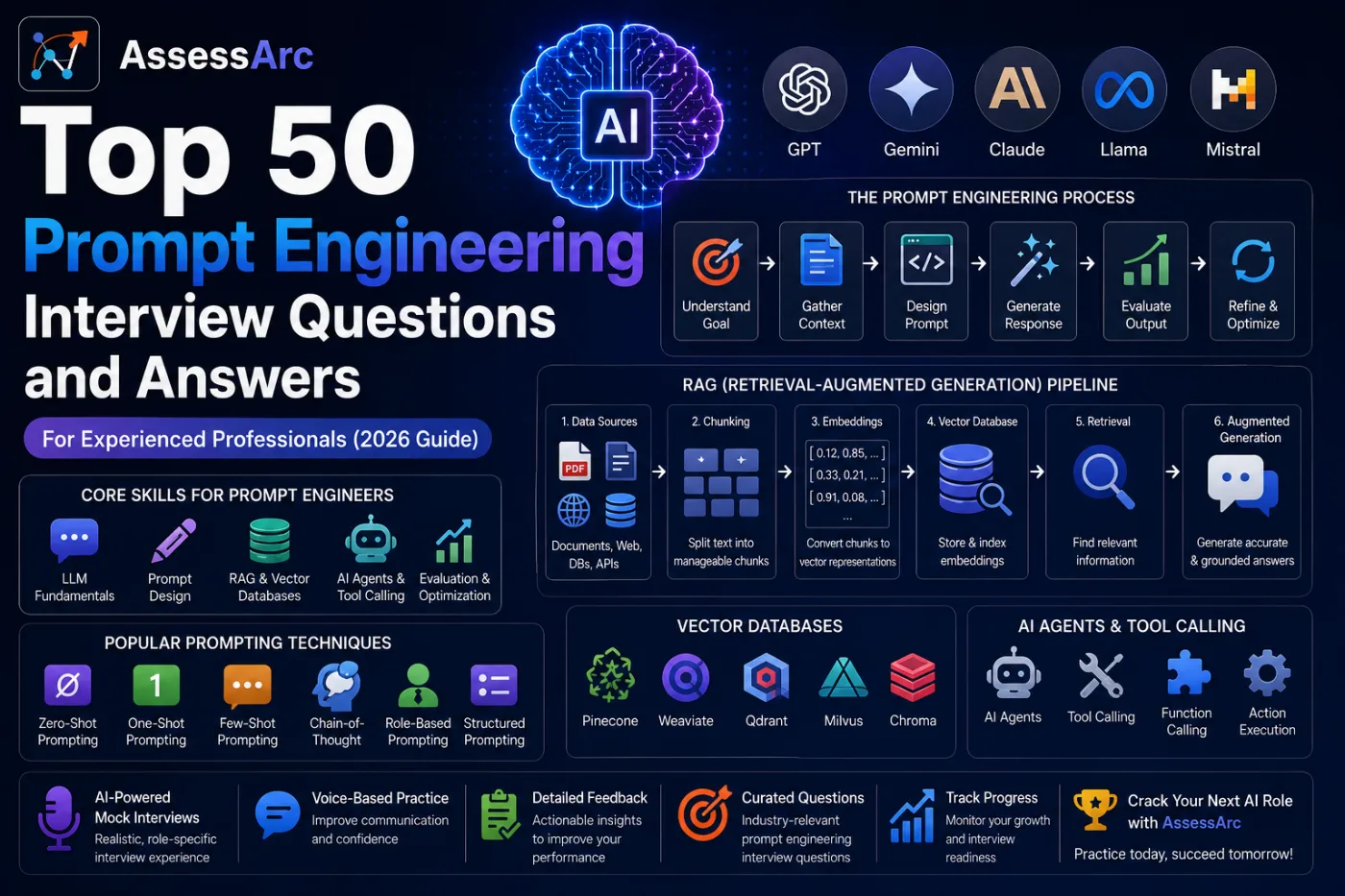
31. What is RAG?
Answer
Retrieval-Augmented Generation combines:
Information Retrieval
Large Language Models
to provide grounded responses.
32. Why is RAG Important?
Answer
Benefits:
Reduces Hallucinations
Improves Accuracy
Uses External Knowledge
33. What Are Embeddings?
Answer
Numerical representations of text used for semantic search.
34. What is Semantic Search?
Answer
Searching based on meaning instead of exact keywords.
35. What is Chunking?
Answer
Splitting large documents into smaller searchable sections.
36. What is a Vector Database?
Answer
Database optimized for storing embeddings.
Examples:
Pinecone
Weaviate
Qdrant
Milvus
37. What is Hybrid Search?
Answer
Combines:
Keyword Search
Vector Search
for better retrieval quality.
38. What Are Common RAG Challenges?
Answer
Poor Chunking
Weak Retrieval
Hallucinations
Latency
39. How Would You Improve Retrieval Quality?
Answer
Methods:
Better Chunking
Metadata Filtering
Re-ranking Models
40. What Role Does Prompt Engineering Play in RAG?
Answer
Prompts determine how retrieved information is used and interpreted.
AI Agents & Tool Calling
41. What is an AI Agent?
Answer
An AI Agent can:
Reason
Plan
Use Tools
Execute Actions
to complete tasks.
42. What is Tool Calling?
Answer
Allows AI models to interact with external systems and APIs.
43. What is Function Calling?
Answer
Structured mechanism enabling AI models to invoke functions.
44. Why Are AI Agents Becoming Popular?
Answer
Agents can automate complex workflows beyond simple conversations.
45. What Challenges Exist in AI Agents?
Answer
Common challenges:
Reliability
Cost
Latency
Tool Selection
Real-World Prompt Engineering Scenarios
46. How Would You Build a Resume Analysis Prompt?
Answer
Include:
Candidate Resume
Evaluation Criteria
Desired Output Format
Scoring Instructions
47. How Would You Improve AI Interview Feedback Accuracy?
Answer
Provide:
Evaluation Rubrics
Sample Responses
Scoring Guidelines
Structured Feedback Format
48. How Would You Reduce AI Response Costs?
Answer
Use:
Shorter Prompts
Context Optimization
Caching
Smaller Models
49. How Would You Evaluate Prompt Quality?
Answer
Metrics:
Accuracy
Relevance
Consistency
Hallucination Rate
50. What Are Interviewers Looking for in Prompt Engineering Interviews?
Answer
Interviewers evaluate:
LLM Understanding
Do you understand how models work?
Prompt Design
Can you design effective prompts?
RAG Knowledge
Can you improve AI accuracy?
AI Systems Thinking
Can you build production-ready AI applications?
Optimization Skills
Can you improve quality while reducing cost?
Common Prompt Engineering Interview Mistakes
❌ Memorizing prompting techniques without understanding
❌ Weak knowledge of RAG
❌ Ignoring hallucination prevention
❌ No understanding of AI agents
❌ Poor prompt evaluation methodology
❌ Focusing only on ChatGPT usage
How AssessArc Helps You Prepare for Prompt Engineering Interviews
AssessArc helps candidates practice:
Prompt Engineering Interviews
Generative AI Interviews
LLM Discussions
RAG System Design Questions
AI Agent Scenarios
through AI-powered voice interviews, intelligent follow-up questions, personalized feedback, and detailed performance reports.
Conclusion
Prompt Engineering is rapidly becoming a core skill for AI professionals.
Understanding prompting techniques, LLM behavior, RAG systems, vector databases, AI agents, and evaluation frameworks can significantly improve your interview performance.
Practice these Prompt Engineering interview questions regularly and confidently explain real-world use cases to maximize your chances of landing your next AI role.