Top 50 RAG Interview Questions and Answers for Experienced Professionals (2026 Guide)
Prepare for RAG interviews with 50 commonly asked questions covering Retrieval-Augmented Generation, embeddings, vector databases, semantic search, chunking
Top 50 RAG Interview Questions and Answers for Experienced Professionals (2026 Guide)
Table of Contents
RAG Fundamentals
Embeddings & Semantic Search
Vector Databases
Retrieval Techniques
Chunking Strategies
Hybrid Search & Re-ranking
Production RAG Systems
Real-World RAG Scenarios
Common Interview Mistakes
How AssessArc Helps
Conclusion
Introduction
Retrieval-Augmented Generation (RAG) has become one of the most important concepts in modern AI applications.
Organizations are building RAG-powered systems for:
Enterprise Search
AI Chatbots
Document Q&A
Knowledge Assistants
Customer Support
AI Interview Platforms
While Large Language Models (LLMs) are powerful, they often suffer from:
❌ Hallucinations
❌ Outdated Knowledge
❌ Missing Company-Specific Information
RAG solves these challenges by combining:
Information Retrieval
Vector Search
Large Language Models
As a result, RAG-related interview questions are becoming extremely common for:
AI Engineers
Generative AI Engineers
Machine Learning Engineers
Prompt Engineers
AI Architects
This guide covers the top 50 RAG interview questions and answers frequently asked in 2026.
RAG Fundamentals
1. What is RAG?
Answer
RAG stands for Retrieval-Augmented Generation.
It combines:
Information Retrieval
Large Language Models
to generate more accurate and context-aware responses.
2. Why Do We Need RAG?
Answer
LLMs have limitations:
Hallucinations
Knowledge Cutoff
No Access to Private Data
RAG addresses these issues by retrieving relevant information before generating responses.
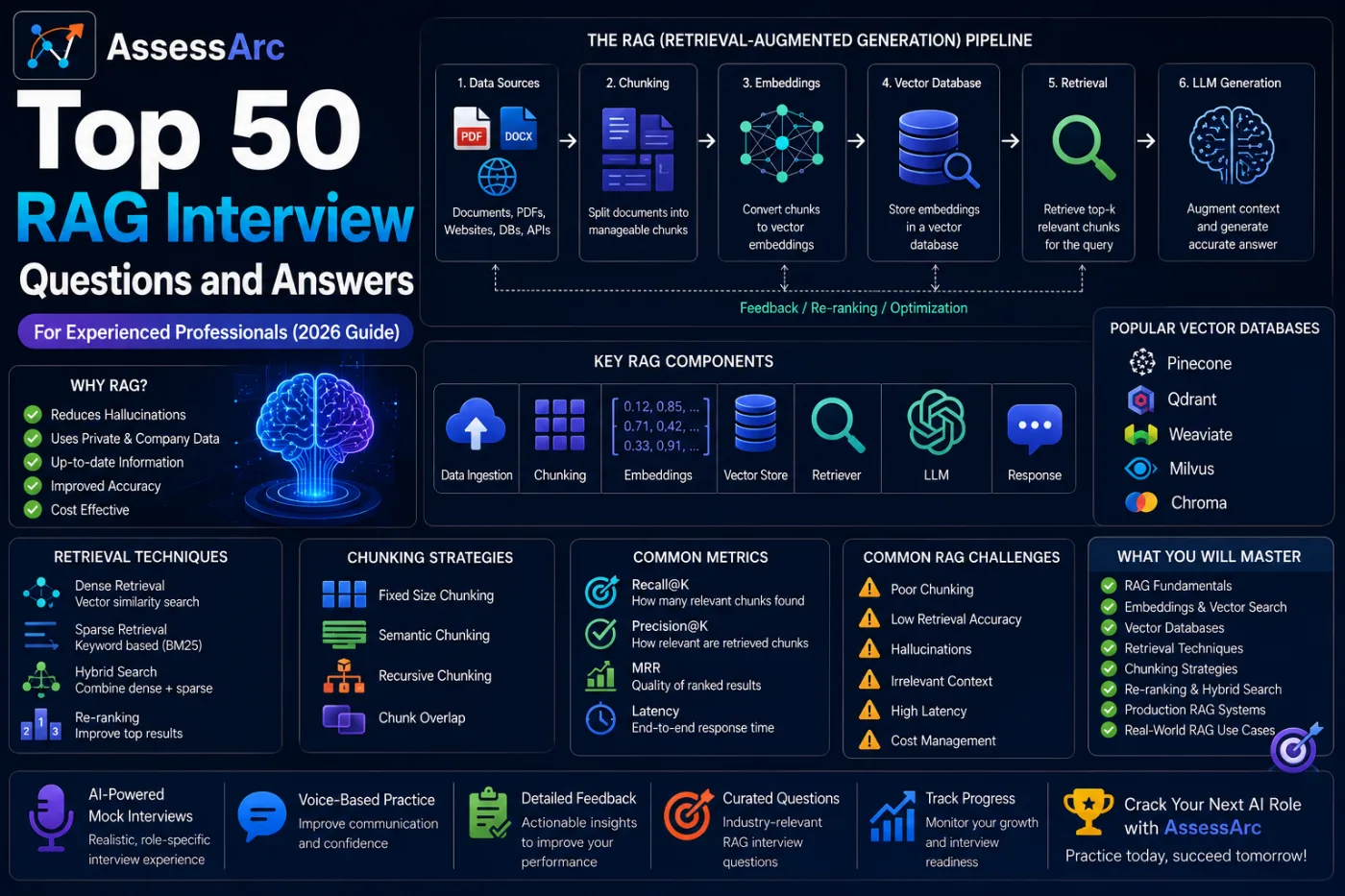
3. What Are the Main Components of a RAG System?
Answer
A typical RAG system includes:
Data Source
Chunking
Embeddings
Vector Database
Retriever
LLM
Response Generator
4. How Does RAG Work?
Answer
Workflow:
User Query
Query Embedding
Vector Search
Retrieve Relevant Chunks
Send Context to LLM
Generate Answer
5. What Problems Does RAG Solve?
Answer
RAG helps:
Reduce hallucinations
Use private company data
Improve answer accuracy
Keep information current
6. RAG vs Fine-Tuning
Answer
RAG | Fine-Tuning |
|---|---|
Uses External Data | Changes Model Weights |
Easier Updates | Retraining Required |
Lower Cost | Higher Cost |
7. What Types of Applications Use RAG?
Answer
Examples:
Customer Support Bots
Internal Knowledge Assistants
Legal Document Search
HR Chatbots
Interview Preparation Platforms
8. Why Is RAG Popular?
Answer
Benefits:
Better Accuracy
Lower Cost
Faster Updates
Enterprise Adoption
9. What Is Context Augmentation?
Answer
Providing retrieved information to an LLM before answer generation.
10. What Are Common Challenges in RAG Systems?
Answer
Poor Retrieval
Weak Chunking
Hallucinations
High Latency
Irrelevant Context
Embeddings & Semantic Search
11. What Are Embeddings?
Answer
Embeddings are numerical vector representations of text.
They capture semantic meaning.
12. Why Are Embeddings Important?
Answer
Embeddings enable:
Semantic Search
Similarity Search
Retrieval
13. What Is Semantic Search?
Answer
Semantic Search retrieves information based on meaning rather than exact keywords.
14. Keyword Search vs Semantic Search
Answer
Keyword Search | Semantic Search |
|---|---|
Exact Match | Meaning Based |
Limited Understanding | Context Aware |
15. What Are Embedding Models?
Answer
Examples:
OpenAI Embeddings
Gemini Embeddings
BGE
E5
Instructor XL
16. What Is Vector Similarity?
Answer
Measure of closeness between embeddings.
17. What Is Cosine Similarity?
Answer
Most common similarity metric used in vector search.
Measures angle between vectors.
18. What Is Euclidean Distance?
Answer
Measures straight-line distance between vectors.
19. What Is Dot Product Similarity?
Answer
Measures similarity using vector multiplication.
20. Why Do Similar Documents Have Similar Embeddings?
Answer
Embedding models learn semantic relationships between words and concepts.
Vector Databases
21. What Is a Vector Database?
Answer
A database optimized for storing and searching embeddings.
22. Why Not Use Traditional SQL Databases?
Answer
Traditional databases are not optimized for high-dimensional vector similarity search.
23. Popular Vector Databases
Answer
Examples:
Pinecone
Qdrant
Weaviate
Milvus
Chroma
24. What Is ANN Search?
Answer
Approximate Nearest Neighbor search.
Used for efficient vector retrieval.
25. Why Is ANN Important?
Answer
Allows fast retrieval from millions of vectors.
26. What Is Indexing in Vector Databases?
Answer
Technique for optimizing similarity searches.
27. What Is HNSW?
Answer
Hierarchical Navigable Small World.
Popular vector indexing algorithm.
28. What Is Metadata Filtering?
Answer
Filtering retrieved results using metadata.
Examples:
Department
Date
Category
29. Why Use Metadata Filtering?
Answer
Improves retrieval precision.
30. What Is Multi-Tenant RAG?
Answer
Supporting multiple organizations with isolated data.
Retrieval Techniques
31. What Is a Retriever?
Answer
Component responsible for finding relevant information.
32. What Is Top-K Retrieval?
Answer
Returning the top K most relevant documents.
33. What Is Dense Retrieval?
Answer
Uses embeddings and vector search.
34. What Is Sparse Retrieval?
Answer
Uses keyword-based methods like BM25.
35. What Is Hybrid Search?
Answer
Combines:
Dense Retrieval
Sparse Retrieval
for better accuracy.
36. Why Is Hybrid Search Better?
Answer
Captures both:
Semantic Meaning
Exact Keywords
37. What Is Re-ranking?
Answer
Improving retrieval results after initial search.
38. Why Use Re-ranking Models?
Answer
They improve answer quality by selecting the most relevant chunks.
39. What Is Query Expansion?
Answer
Adding related terms to improve retrieval performance.
40. What Is Retrieval Recall?
Answer
Measures how many relevant documents were successfully retrieved.
Chunking Strategies
41. What Is Chunking?
Answer
Splitting documents into smaller pieces before embedding.
42. Why Is Chunking Important?
Answer
Poor chunking can significantly reduce retrieval accuracy.
43. Fixed-Size Chunking vs Semantic Chunking
Answer
Fixed Size | Semantic |
|---|---|
Simple | Context Aware |
Faster | More Accurate |
44. What Is Chunk Overlap?
Answer
Sharing content between adjacent chunks.
45. Why Use Chunk Overlap?
Answer
Preserves context across chunk boundaries.
Real-World RAG Scenario Questions
46. How Would You Build a Company Knowledge Assistant?
Answer
Architecture:
Document Upload
Chunking
Embedding Generation
Vector Database
Retrieval Layer
LLM Response Generation
47. How Would You Reduce Hallucinations in a RAG System?
Answer
Use:
Better Retrieval
Re-ranking
Grounded Prompts
Citation-Based Responses
48. How Would You Improve Retrieval Accuracy?
Answer
Methods:
Better Embeddings
Hybrid Search
Metadata Filtering
Re-ranking Models
49. How Would You Optimize RAG Latency?
Answer
Techniques:
Smaller Embedding Models
Efficient Indexing
Caching
Query Optimization
50. What Are Interviewers Looking for in RAG Interviews?
Answer
Interviewers evaluate:
RAG Architecture Knowledge
Can you explain end-to-end workflows?
Retrieval Understanding
Do you understand embeddings and search?
Production Experience
Can you build scalable RAG systems?
Optimization Skills
Can you improve retrieval quality and performance?
Real-World Problem Solving
Can you design enterprise AI applications?
Common RAG Interview Mistakes
❌ Thinking RAG is only vector search
❌ Weak understanding of embeddings
❌ Ignoring chunking strategies
❌ Not knowing hybrid search
❌ No knowledge of re-ranking
❌ Ignoring production scalability concerns
How AssessArc Helps You Prepare for RAG Interviews
AssessArc helps candidates practice:
RAG Architecture Interviews
Generative AI Interviews
AI Engineer Interviews
Vector Database Questions
Production AI Scenarios
through AI-powered voice interviews, intelligent follow-up questions, personalized feedback, and detailed performance reports.
Conclusion
RAG has become a foundational technology for enterprise AI applications.
Understanding embeddings, vector databases, retrieval techniques, chunking strategies, hybrid search, and production deployment patterns is essential for modern AI roles.
Master these RAG interview questions and confidently explain real-world architectures to maximize your chances of succeeding in your next AI interview.