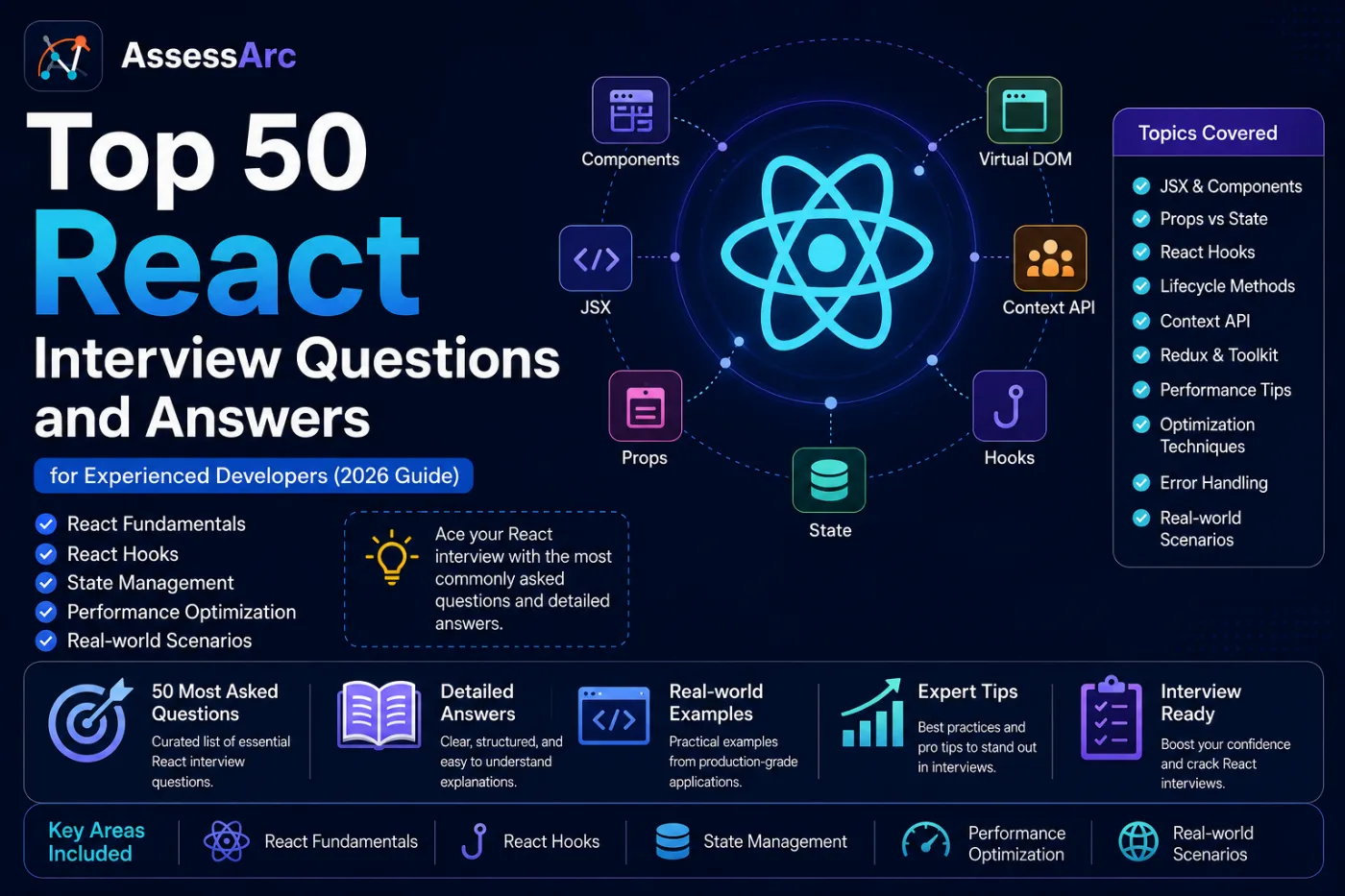
Top 50 React Interview Questions and Answers for Experienced Developers (2026 Guide)
Prepare for your next React interview with the top 50 React interview questions and answers. Covers React Hooks, Virtual DOM, State Management, Redux, Context API
Top 50 React Interview Questions and Answers for Experienced Developers (2026 Guide)
Introduction
React remains one of the most popular frontend libraries in the world.
Companies such as Google, Meta, Netflix, Airbnb, Uber, Amazon, Microsoft, and thousands of startups use React to build scalable, fast, and interactive web applications.
Because of its popularity, React interview questions are commonly asked in interviews for:
Frontend Developers
React Developers
Full Stack Developers
Software Engineers
UI Engineers
Modern React interviews focus not only on React fundamentals but also on Hooks, Performance Optimization, State Management, Component Design, and Real-World Problem Solving.
In this guide, you'll learn the top 50 React interview questions and answers frequently asked in technical interviews.
React Fundamentals
1. What is React?
Answer
React is an open-source JavaScript library developed by Meta for building user interfaces.
React helps developers create:
Single Page Applications (SPAs)
Reusable Components
Fast User Interfaces
React follows a component-based architecture.
2. Why is React Popular?
Answer
React offers:
✅ Component Reusability
✅ Virtual DOM
✅ Strong Community
✅ Fast Rendering
✅ Easy Learning Curve
✅ Large Ecosystem
These features make React a preferred choice for modern frontend development.
3. What is Virtual DOM?
Answer
Virtual DOM is a lightweight copy of the actual DOM.
React updates the Virtual DOM first.
Then React compares:
Old Virtual DOM
vs
New Virtual DOM
and updates only changed elements.
This process improves performance significantly.
4. Difference Between DOM and Virtual DOM
Answer
DOM | Virtual DOM |
|---|---|
Actual browser DOM | In-memory copy |
Slower updates | Faster updates |
Direct manipulation | Diffing mechanism |
Higher cost | Optimized rendering |
5. What is JSX?
Answer
JSX stands for JavaScript XML.
It allows developers to write HTML-like syntax inside JavaScript.
Example:
function App() {
  return <h1>Hello React</h1>;
}
JSX improves readability and developer productivity.
6. What is a Component?
Answer
A Component is a reusable UI building block.
Examples:
Navbar
Login Form
Dashboard
User Profile
React applications are built using components.
7. What are Functional Components?
Answer
Functional Components are JavaScript functions that return JSX.
Example:
function Welcome() {
  return <h1>Welcome</h1>;
}
Modern React primarily uses functional components.
8. What are Class Components?
Answer
Class Components are older React components based on ES6 classes.
Example:
class Welcome extends React.Component {
  render() {
    return <h1>Welcome</h1>;
  }
}
Hooks have largely replaced class components.
9. What are Props?
Answer
Props (Properties) allow data to be passed from parent to child components.
Example:
<User name="John" />
Props are read-only.
10. What is State?
Answer
State stores data that can change over time.
Example:
const [count, setCount] = useState(0);
Updating state triggers re-rendering.
11. Difference Between Props and State
Answer
Props | State |
|---|---|
Passed by parent | Managed internally |
Read-only | Mutable |
External data | Component data |
12. What is One-Way Data Binding?
Answer
React follows one-way data flow.
Data moves:
Parent → Child
This makes applications predictable and easier to debug.
13. What is Reconciliation?
Answer
Reconciliation is React's process of comparing Virtual DOM versions and updating only changed elements.
This minimizes expensive DOM operations.
14. What is a Key in React?
Answer
Keys help React identify list items uniquely.
Example:
users.map(user => (
  <li key={user.id}>{user.name}</li>
))
Keys improve rendering performance.
15. Why Should We Avoid Using Array Index as Key?
Answer
Indexes can cause:
Incorrect UI updates
Rendering bugs
Performance issues
Prefer unique IDs whenever possible.
React Hooks
16. What is a Hook?
Answer
Hooks allow functional components to use React features such as:
State
Lifecycle methods
Context
without class components.
17. What is useState?
Answer
useState manages component state.
Example:
const [count, setCount] = useState(0);
18. What is useEffect?
Answer
useEffect handles side effects such as:
API Calls
Event Listeners
Timers
Example:
useEffect(() => {
  fetchUsers();
}, []);
19. What Does an Empty Dependency Array Mean?
Answer
useEffect(() => {
  loadData();
}, []);
Runs only once after component mount.
20. What is useRef?
Answer
useRef creates mutable references.
Common uses:
DOM Access
Persisting Values
Example:
const inputRef = useRef();
21. What is useMemo?
Answer
useMemo memoizes expensive calculations.
Example:
const total = useMemo(
  () => calculateTotal(),
  [items]
);
Improves performance.
22. What is useCallback?
Answer
useCallback memoizes functions.
Example:
const handleClick = useCallback(() => {
  saveData();
}, []);
Useful for preventing unnecessary re-renders.
23. Difference Between useMemo and useCallback
Answer
useMemo | useCallback |
|---|---|
Memoizes values | Memoizes functions |
Returns value | Returns function |
24. What is useContext?
Answer
useContext allows components to consume shared data without prop drilling.
Example:
const theme = useContext(ThemeContext);
25. What is a Custom Hook?
Answer
Custom Hooks allow reusable stateful logic.
Example:
function useFetch(url) {
   ...
}
26. Rules of Hooks
Answer
Hooks must:
✅ Be called at top level
✅ Be called inside React functions
❌ Not be called conditionally
27. What Happens if Dependency Array is Missing?
Answer
useEffect runs after every render.
Can cause:
Performance issues
Infinite loops
28. What is Cleanup Function in useEffect?
Answer
Used for cleanup operations.
Example:
useEffect(() => {
  const timer = setInterval(...);

  return () => clearInterval(timer);
}, []);
29. What Causes Infinite Re-renders?
Answer
Common causes:
Incorrect state updates
Missing dependencies
Recursive effects
30. What are Hook Dependencies?
Answer
Dependencies determine when React re-executes a hook.
Correct dependency management is essential.
State Management
31. What is Context API?
Answer
Context API shares data across components without passing props manually.
Useful for:
Themes
Authentication
User Settings
32. What is Redux?
Answer
Redux is a predictable state management library.
Used for:
Global state
Large applications
33. What Problems Does Redux Solve?
Answer
Redux helps manage:
Shared state
Complex data flow
State consistency
34. What is Redux Toolkit?
Answer
Redux Toolkit simplifies Redux development.
Benefits:
Less boilerplate
Better structure
Easier maintenance
35. Context API vs Redux
Answer
Context API | Redux |
|---|---|
Simpler | More powerful |
Small apps | Large apps |
Less setup | More features |
36. What is Prop Drilling?
Answer
Passing props through multiple layers unnecessarily.
Example:
App → Dashboard → UserCard → UserProfile
Context API helps solve this.
37. What is Zustand?
Answer
Zustand is a lightweight state management library.
Benefits:
Simpler than Redux
Minimal boilerplate
38. When Should You Use Global State?
Answer
For shared data:
User authentication
Shopping cart
Application settings
39. When Should You Use Local State?
Answer
For component-specific data:
Modal visibility
Form inputs
Dropdown state
40. What is State Lifting?
Answer
Moving state to a common parent component.
Allows multiple child components to share data.
React Performance Optimization
41. What is React.memo?
Answer
React.memo prevents unnecessary re-renders.
Example:
export default React.memo(UserCard);
42. What is Lazy Loading?
Answer
Loads components only when needed.
Example:
const Dashboard =
React.lazy(() => import("./Dashboard"));
Improves initial load time.
43. What is Code Splitting?
Answer
Breaks application into smaller bundles.
Benefits:
Faster loading
Better performance
44. How Do You Prevent Unnecessary Re-renders?
Answer
Techniques:
React.memo
useMemo
useCallback
Proper state design
45. What is Debouncing?
Answer
Delays function execution.
Common use:
Search inputs.
Reduces API calls.
Real Production Scenario Questions
46. A React Page Takes 8 Seconds to Load. How Would You Optimize It?
Answer
Investigate:
Bundle size
Lazy loading
Images
API calls
Code splitting
47. Users Report Excessive API Calls. How Would You Debug?
Answer
Check:
useEffect dependencies
Duplicate requests
Component re-renders
Event listeners
48. How Would You Manage State Across 50+ Components?
Answer
Use:
Context API
Redux Toolkit
Zustand
Avoid excessive prop drilling.
49. How Would You Build a Scalable React Application?
Answer
Best practices:
Modular architecture
Reusable components
Feature-based folders
State management
Lazy loading
50. What Are Interviewers Looking For in React Interviews?
Answer
Interviewers evaluate:
React Fundamentals
Can you explain core concepts?
Hooks
Do you understand modern React?
State Management
Can you manage application state effectively?
Performance
Can you optimize large applications?
Real-World Experience
Can you solve production problems?
Common React Interview Mistakes
❌ Memorizing Hooks without understanding them
❌ Weak understanding of Virtual DOM
❌ Not knowing useEffect behavior
❌ Poor state management knowledge
❌ No performance optimization experience
❌ Lack of real-world examples
How AssessArc Helps You Prepare for React Interviews
React interviews require more than memorizing concepts.
Candidates must confidently explain:
Hooks
Component Design
State Management
Performance Optimization
Real-world Scenarios
AssessArc helps developers practice realistic React interview questions through AI-powered mock interviews, voice-based interactions, and detailed feedback reports that improve both technical depth and communication skills.
Conclusion
React continues to dominate modern frontend development, making React interview preparation essential for software engineers and frontend developers.
Mastering React fundamentals, Hooks, Context API, Redux, performance optimization techniques, and production troubleshooting scenarios can significantly improve your interview performance.
Use these 50 React Interview Questions and Answers as your preparation roadmap and practice explaining concepts clearly to stand out in your next interview.