Top 50 Redis Interview Questions and Answers for Experienced Developers (2026 Guide)
Prepare for Redis interviews with 50 commonly asked questions covering caching, persistence, Pub/Sub, replication, clustering, and real-world scenarios.
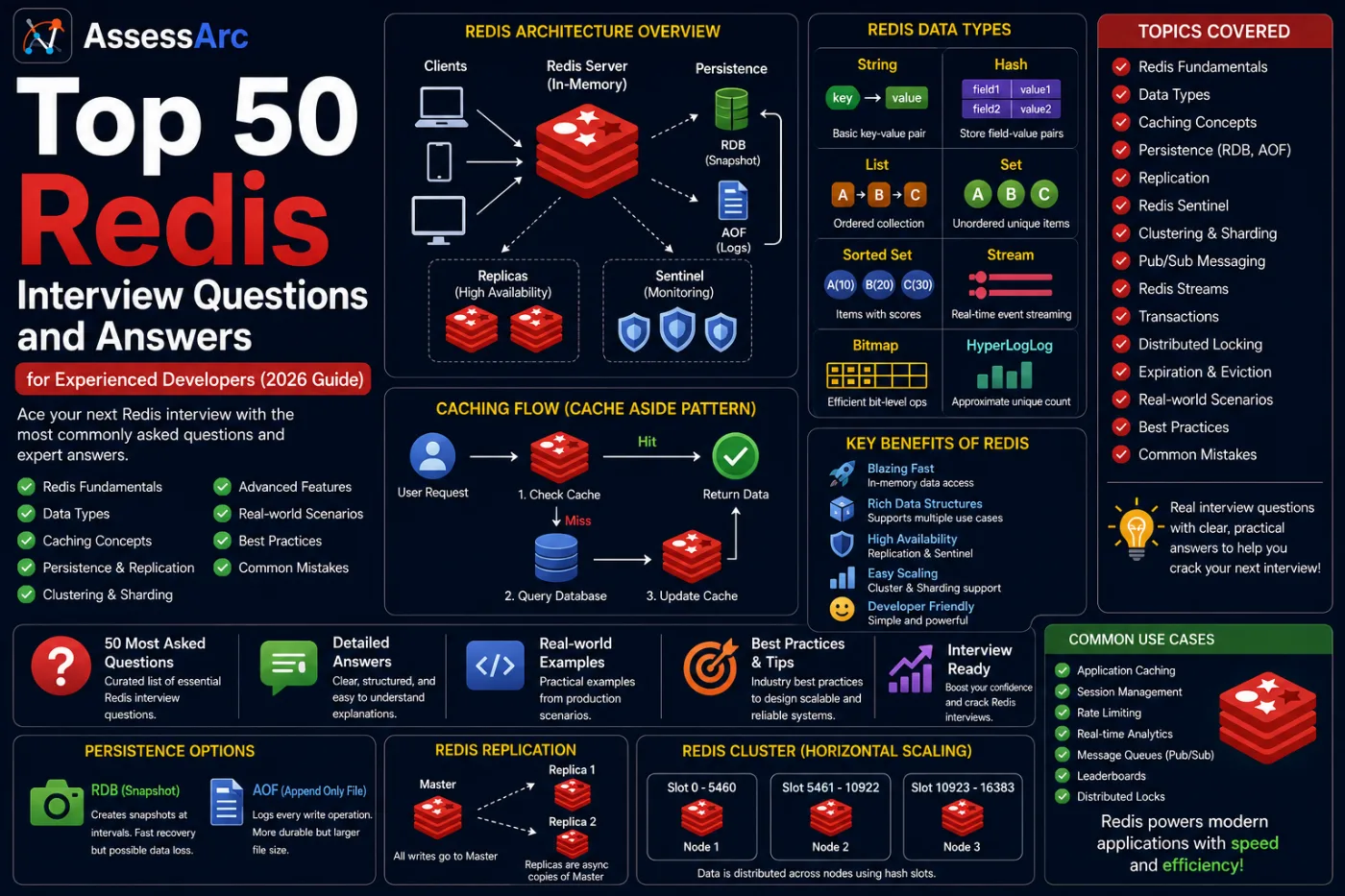
Top 50 Redis Interview Questions and Answers for Experienced Developers (2026 Guide)
Table of Contents
Redis Fundamentals
Redis Data Types
Caching Concepts
Persistence & Replication
Redis Clustering
Advanced Redis Features
Production Scenario Questions
Common Redis Interview Mistakes
How AssessArc Helps
Conclusion
Introduction
Redis is one of the most popular in-memory data stores used in modern software architectures.
Companies such as Netflix, Amazon, Uber, Airbnb, LinkedIn, Spotify, and thousands of startups use Redis for:
Caching
Session Management
Real-Time Analytics
Message Queues
Distributed Locking
Rate Limiting
Because Redis is widely used in high-performance systems, interviewers frequently ask Redis-related questions during interviews for:
Java Developers
Spring Boot Developers
Backend Engineers
Microservices Developers
Software Architects
DevOps Engineers
This guide covers the top 50 Redis interview questions and answers that experienced developers should know.
Redis Fundamentals
1. What is Redis?
Answer
Redis (Remote Dictionary Server) is an open-source, in-memory data structure store.
It is commonly used for:
Caching
Databases
Session storage
Message brokers
Redis stores data primarily in memory, making it extremely fast.
2. Why is Redis So Fast?
Answer
Redis is fast because:
✅ Data is stored in memory
✅ Single-threaded architecture
✅ Efficient data structures
✅ Minimal disk access
Typical response times are measured in microseconds.
3. What Are Common Redis Use Cases?
Answer
Redis is commonly used for:
Application caching
Session management
Rate limiting
Real-time leaderboards
Pub/Sub messaging
Distributed locks
4. Is Redis a Database?
Answer
Yes.
Redis can function as a NoSQL database.
However, it is most commonly used as a cache layer in front of traditional databases.
5. Redis vs Traditional Database
Answer
Redis | Relational Database |
|---|---|
In-memory | Disk-based |
Extremely Fast | Slower |
Key-Value Store | Relational |
Millisecond/Microsecond Access | Higher Latency |
6. What Is an In-Memory Database?
Answer
An in-memory database stores data in RAM rather than on disk.
Benefits:
Faster access
Lower latency
Better performance
7. What Is a Redis Key?
Answer
Redis stores data using:
key → value
Example:
user:101 → Ashish
8. What Is a Redis Value?
Answer
The value associated with a Redis key.
Can be:
String
Hash
List
Set
Sorted Set
9. What Is Redis Architecture?
Answer
Redis follows:
Client-Server Architecture
Single Thread Event Loop
Clients connect to Redis servers and execute commands.
10. What Are the Advantages of Redis?
Answer
Benefits:
✅ Extremely Fast
✅ Easy Scaling
✅ Rich Data Structures
✅ High Availability
✅ Replication Support
Redis Data Types
11. What Are Redis Data Types?
Answer
Redis supports:
String
Hash
List
Set
Sorted Set
Bitmap
HyperLogLog
Stream
12. What Is a String in Redis?
Answer
Most basic Redis data type.
Example:
SET username Ashish
13. What Is a Hash?
Answer
Stores field-value pairs.
Example:
HSET user:1 name Ashish age 28
Useful for user profiles.
14. What Is a List?
Answer
Ordered collection of elements.
Example:
LPUSH tasks "task1"
Useful for queues.
15. What Is a Set?
Answer
Unordered collection of unique elements.
Example:
SADD skills Java Kafka Redis
Duplicates are not allowed.
16. What Is a Sorted Set?
Answer
Stores values with scores.
Example:
ZADD leaderboard 100 user1
Used for rankings and leaderboards.
17. Difference Between Set and Sorted Set
Answer
Set | Sorted Set |
|---|---|
Unique Elements | Unique Elements |
No Ordering | Ordered by Score |
18. What Is HyperLogLog?
Answer
Used for approximate counting of unique elements.
Useful for:
Website visitors
Analytics
Consumes very little memory.
19. What Is a Redis Stream?
Answer
Data structure designed for event streaming.
Useful for:
Event-driven systems
Message processing
20. What Is a Bitmap?
Answer
Efficient storage for binary states.
Common use cases:
Daily active users
Feature flags
Redis Caching Concepts
21. What Is Caching?
Answer
Caching stores frequently accessed data in memory.
Benefits:
Faster responses
Reduced database load
22. Why Is Redis Commonly Used for Caching?
Answer
Redis provides:
Low latency
High throughput
TTL support
Easy integration
23. What Is Cache Aside Pattern?
Answer
Most common caching strategy.
Flow:
Check cache
If miss → query database
Store result in cache
Return data
24. What Is Read Through Cache?
Answer
Cache automatically loads data from database when missing.
Application interacts only with cache.
25. What Is Write Through Cache?
Answer
Data is written to:
Cache
Database
simultaneously.
26. What Is Write Behind Cache?
Answer
Data is written to cache first.
Database update occurs later asynchronously.
Improves write performance.
27. What Is Cache Miss?
Answer
Occurs when requested data is not found in cache.
Application must fetch data from database.
28. What Is Cache Hit?
Answer
Occurs when requested data is available in cache.
Provides very fast responses.
29. What Is Cache Eviction?
Answer
Removing entries when memory becomes full.
30. Common Cache Eviction Policies?
Answer
Redis supports:
LRU (Least Recently Used)
LFU (Least Frequently Used)
Random
TTL Based
Persistence & Replication
31. Does Redis Store Data Permanently?
Answer
By default Redis stores data in memory.
Persistence mechanisms prevent data loss.
32. What Is RDB Persistence?
Answer
RDB creates point-in-time snapshots.
Advantages:
Fast recovery
Smaller files
33. What Is AOF Persistence?
Answer
AOF (Append Only File) logs write operations.
Benefits:
Better durability
Lower data loss risk
34. RDB vs AOF
Answer
RDB | AOF |
|---|---|
Snapshot Based | Log Based |
Faster | More Durable |
Smaller Files | Larger Files |
35. What Is Redis Replication?
Answer
Redis supports:
Master → Replica architecture
Replicas receive data from the master.
36. Benefits of Replication
Answer
High Availability
Read Scaling
Backup Support
37. What Is Redis Sentinel?
Answer
Sentinel provides:
Monitoring
Automatic Failover
Master Discovery
38. What Happens If Master Fails?
Answer
Sentinel promotes a replica to become the new master.
This minimizes downtime.
39. What Is Failover?
Answer
Automatic switching from failed master to healthy replica.
40. Why Use Redis Sentinel?
Answer
Sentinel improves:
Availability
Reliability
Recovery speed
Redis Clustering
41. What Is Redis Cluster?
Answer
Redis Cluster enables horizontal scaling.
Data is distributed across multiple nodes.
42. What Is Sharding?
Answer
Sharding splits data across multiple servers.
Benefits:
Better scalability
Higher throughput
43. What Are Redis Hash Slots?
Answer
Redis Cluster uses:
16384 hash slots
Keys are distributed among these slots.
44. What Is Consistent Hashing?
Answer
Technique used to distribute data evenly across servers.
Minimizes data movement when nodes change.
45. Benefits of Redis Cluster
Answer
✅ Horizontal Scaling
✅ Fault Tolerance
✅ High Availability
Advanced Redis Features
46. What Is Redis Pub/Sub?
Answer
Publish-Subscribe messaging pattern.
Example:
Publisher sends messages.
Subscribers receive messages instantly.
47. What Is Distributed Locking?
Answer
Prevents multiple processes from executing the same task simultaneously.
Common implementation:
SETNX
or
RedLock Algorithm.
48. What Is Rate Limiting Using Redis?
Answer
Redis tracks request counts.
Useful for:
API Protection
Preventing abuse
Real Production Scenario Questions
49. Redis Memory Usage Suddenly Reaches 100%. What Would You Investigate?
Answer
Check:
Key sizes
Eviction policies
Memory leaks
Expired keys
Application caching strategy
Useful commands:
INFO MEMORY
MEMORY USAGE
50. How Would You Handle Cache Stampede During a Flash Sale?
Answer
Techniques:
Cache Warming
Distributed Locking
Request Coalescing
Longer TTLs
Background Refresh
This is one of the most frequently asked Redis scenario questions.
Common Redis Interview Mistakes
❌ Thinking Redis is only a cache
❌ Not understanding persistence
❌ Weak knowledge of replication
❌ Confusing Redis Cluster and Sentinel
❌ No understanding of cache stampede
❌ Ignoring distributed locking concepts
How AssessArc Helps You Prepare for Redis Interviews
Redis interviews increasingly focus on production scenarios rather than simple definitions.
AssessArc helps candidates practice:
Redis Architecture Questions
Cache Design Questions
Distributed System Scenarios
Backend Developer Interviews
through AI-powered mock interviews, voice-based practice sessions, and detailed feedback reports.
Conclusion
Redis is one of the most important technologies in modern backend development.
Whether you're preparing for Java, Spring Boot, Microservices, Cloud, or Backend Engineer interviews, understanding Redis caching, persistence, clustering, replication, and distributed locking can significantly improve your interview performance.
Master these Redis interview questions, practice explaining concepts clearly, and you'll be well prepared for your next technical interview.