Top 50 REST API Interview Questions and Answers for Experienced Developers (2026 Guide)
Prepare for REST API interviews with 50 commonly asked questions covering REST principles, HTTP methods, status codes, security, versioning, and best practices.
Top 50 REST API Interview Questions and Answers for Experienced Developers (2026 Guide)
Table of Contents
REST API Fundamentals
HTTP Methods
HTTP Status Codes
API Design Best Practices
Security & Authentication
Advanced REST Concepts
Production Scenario Questions
Common Interview Mistakes
How AssessArc Helps
Conclusion
Introduction
REST APIs are the backbone of modern software applications.
Whether you're building:
Spring Boot Applications
Microservices
Mobile Applications
Frontend Applications
Cloud-Native Systems
REST APIs are almost always involved.
Because of this, REST API interview questions are among the most commonly asked topics in interviews for:
Java Developers
Spring Boot Developers
Backend Engineers
Full Stack Developers
Software Architects
Interviewers expect candidates to understand not only REST concepts but also API design, security, scalability, versioning, and real-world production challenges.
This guide covers the top 50 REST API interview questions and answers frequently asked in technical interviews.
REST API Fundamentals
1. What is REST?
Answer
REST (Representational State Transfer) is an architectural style for designing networked applications.
It was introduced by Roy Fielding in his doctoral dissertation.
REST defines a set of constraints for building scalable web services.
2. What is a REST API?
Answer
A REST API is an API that follows REST architectural principles.
It allows clients and servers to communicate using HTTP.
Example:
GET /users/101
3. What are REST Constraints?
Answer
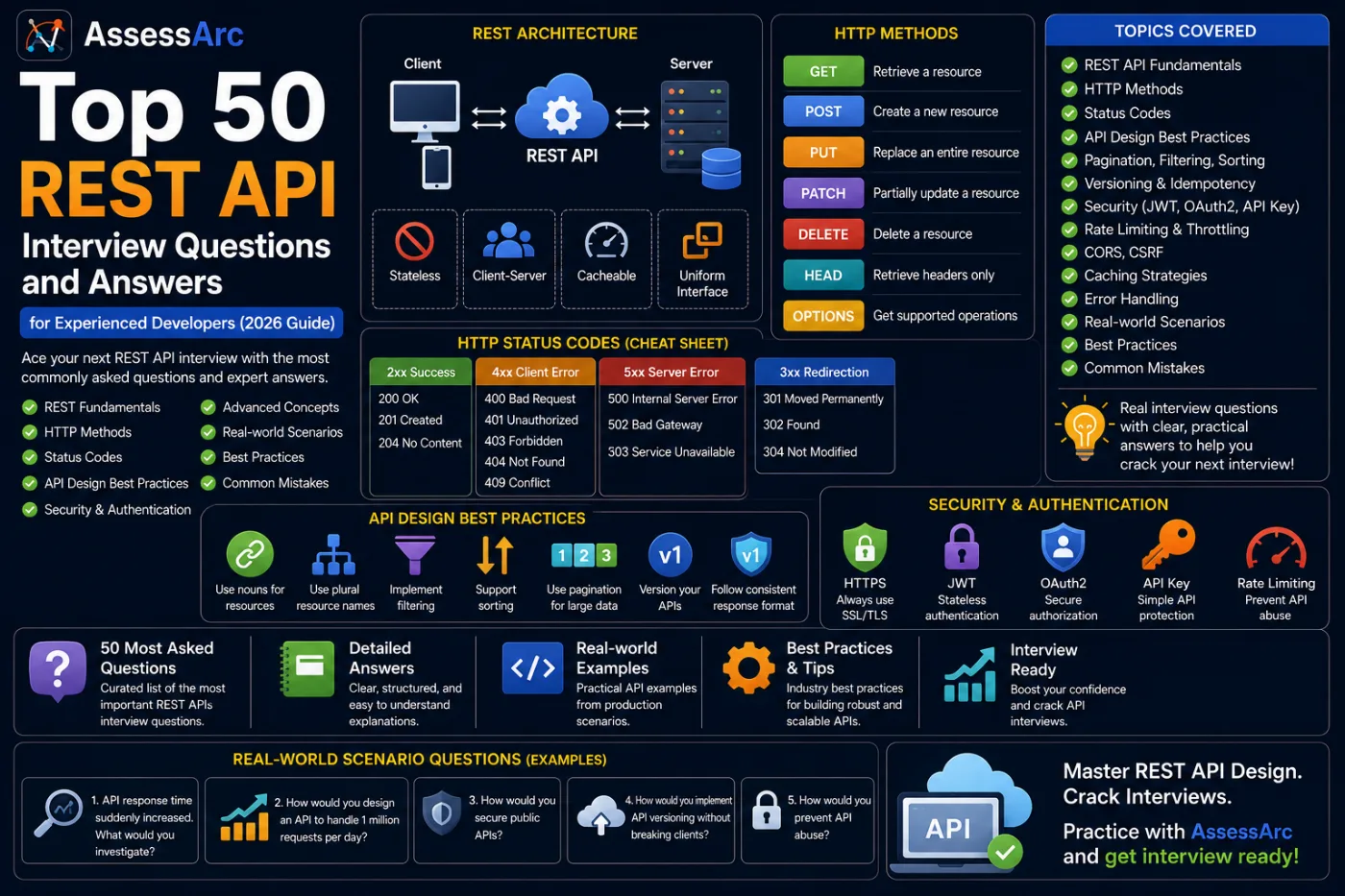
REST defines six constraints:
Client-Server
Stateless
Cacheable
Uniform Interface
Layered System
Code on Demand (optional)
4. What is the Client-Server Architecture?
Answer
Client and server are independent.
Client:
Requests data
Server:
Processes requests
Returns responses
This separation improves scalability.
5. What Does Stateless Mean?
Answer
Each request contains all information needed to process it.
The server does not store client session state between requests.
Benefits:
Better scalability
Easier load balancing
6. Why Are REST APIs Stateless?
Answer
Stateless systems are:
Simpler
More scalable
Easier to distribute
7. What is a Resource in REST?
Answer
A resource is any object exposed through an API.
Examples:
/users
/orders
/products
8. What is a URI?
Answer
URI (Uniform Resource Identifier) uniquely identifies a resource.
Example:
/api/users/101
9. What is Representation in REST?
Answer
Resources can be represented as:
JSON
XML
HTML
JSON is the most commonly used format.
10. Why is JSON Preferred?
Answer
JSON is:
✅ Lightweight
✅ Human-readable
✅ Easy to parse
✅ Widely supported
HTTP Methods
11. What is GET?
Answer
GET retrieves data.
Example:
GET /users
Characteristics:
Safe
Idempotent
12. What is POST?
Answer
POST creates a new resource.
Example:
POST /users
13. What is PUT?
Answer
PUT updates an entire resource.
Example:
PUT /users/101
14. What is PATCH?
Answer
PATCH partially updates a resource.
Example:
Update only email field.
15. Difference Between PUT and PATCH
Answer
PUT | PATCH |
|---|---|
Full Update | Partial Update |
Replaces Resource | Modifies Resource |
16. What is DELETE?
Answer
DELETE removes a resource.
Example:
DELETE /users/101
17. Which HTTP Methods Are Idempotent?
Answer
Idempotent methods:
GET
PUT
DELETE
HEAD
Multiple calls produce the same result.
18. Which HTTP Method Is Not Idempotent?
Answer
POST is generally not idempotent.
Multiple POST requests may create multiple resources.
19. What is HEAD?
Answer
HEAD returns headers only.
No response body is returned.
20. What is OPTIONS?
Answer
Returns supported operations for a resource.
Often used during CORS preflight requests.
HTTP Status Codes
21. What is HTTP Status Code 200?
Answer
Success.
Request processed successfully.
22. What is 201 Created?
Answer
Resource successfully created.
Commonly returned after POST requests.
23. What is 204 No Content?
Answer
Request succeeded but no response body is returned.
24. What is 400 Bad Request?
Answer
Client sent invalid data.
Examples:
Missing fields
Validation failures
25. What is 401 Unauthorized?
Answer
Authentication required.
User is not authenticated.
26. What is 403 Forbidden?
Answer
User is authenticated but lacks permission.
27. What is 404 Not Found?
Answer
Requested resource does not exist.
28. What is 405 Method Not Allowed?
Answer
HTTP method is not supported for the resource.
29. What is 409 Conflict?
Answer
Request conflicts with current resource state.
Example:
Duplicate username.
30. What is 500 Internal Server Error?
Answer
Unexpected server-side error.
Usually indicates application failure.
API Design Best Practices
31. How Should REST API URLs Be Designed?
Answer
Use nouns instead of verbs.
Good:
/users
/orders
Bad:
/getUsers
/createOrder
32. Why Use Plural Resource Names?
Answer
Improves consistency.
Example:
/users
/products
/orders
33. What is API Versioning?
Answer
Allows API evolution without breaking clients.
Example:
/api/v1/users
/api/v2/users
34. Why Is Versioning Important?
Answer
Allows:
New features
Backward compatibility
Safe migrations
35. What is Pagination?
Answer
Limits returned data.
Example:
/users?page=1&size=20
Improves performance.
36. What is Filtering?
Answer
Returns specific results.
Example:
/users?status=active
37. What is Sorting?
Answer
Controls result ordering.
Example:
/users?sort=name
38. What is Idempotency?
Answer
Repeated requests produce the same outcome.
Important for reliable APIs.
39. What is HATEOAS?
Answer
Hypermedia As The Engine Of Application State.
Responses include links to related resources.
Example:
{
  "id":101,
  "links":[
     {
       "rel":"orders",
       "href":"/users/101/orders"
     }
  ]
}
40. Should APIs Return Consistent Response Structures?
Answer
Yes.
Consistency improves:
Developer experience
Maintenance
Client integration
Security & Authentication
41. How Do You Secure REST APIs?
Answer
Use:
HTTPS
JWT
OAuth2
Rate Limiting
Input Validation
42. Why Use HTTPS?
Answer
Encrypts communication.
Protects:
Passwords
Tokens
Sensitive information
43. What is JWT Authentication?
Answer
JWT provides stateless authentication.
Structure:
Header.Payload.Signature
44. What is OAuth2?
Answer
OAuth2 is an authorization framework.
Commonly used for:
Google Login
GitHub Login
LinkedIn Login
45. What is Rate Limiting?
Answer
Restricts the number of requests.
Benefits:
Prevent abuse
Improve stability
Protect APIs
Production Scenario Questions
46. API Response Time Suddenly Increases from 200ms to 5 Seconds. What Would You Check?
Answer
Investigate:
Database queries
External services
Network latency
Application logs
Resource utilization
47. How Would You Design an API Handling One Million Requests Per Day?
Answer
Use:
Load Balancers
Caching
Database Optimization
Horizontal Scaling
CDN
48. How Would You Prevent API Abuse?
Answer
Implement:
Rate Limiting
API Keys
OAuth2
Monitoring
49. How Would You Introduce a Breaking API Change?
Answer
Create a new API version.
Example:
/v1/users
/v2/users
Maintain backward compatibility.
50. What Are Interviewers Looking For in REST API Interviews?
Answer
Interviewers evaluate:
REST Principles
Can you explain REST constraints?
HTTP Knowledge
Do you understand methods and status codes?
API Design
Can you design clean APIs?
Security
Can you secure APIs properly?
Production Experience
Can you solve real-world problems?
Common REST API Interview Mistakes
❌ Confusing PUT and PATCH
❌ Incorrect status code usage
❌ Weak understanding of statelessness
❌ Ignoring security concepts
❌ Poor API design practices
❌ No real-world examples
How AssessArc Helps You Prepare for REST API Interviews
REST API interviews often include architecture and scenario-based discussions.
AssessArc helps candidates practice:
REST API Questions
Spring Boot API Questions
Backend Engineering Interviews
Production Scenarios
through AI-powered mock interviews, voice-based interactions, and detailed performance feedback.
Conclusion
REST APIs remain a foundational skill for modern software engineers.
Understanding REST principles, HTTP methods, status codes, security, versioning, pagination, and API design best practices can significantly improve your interview performance.
Master these REST API interview questions and practice explaining concepts clearly to confidently succeed in your next backend or software engineering interview.