Top 50 Spring Security Interview Questions and Answers for Experienced Developers (2026 Guide)
Prepare for Spring Security interviews with 50 commonly asked questions covering JWT, OAuth2, authentication, authorization, CSRF, and security best practices.
Top 50 Spring Security Interview Questions and Answers for Experienced Developers (2026 Guide)
Table of Contents
Spring Security Fundamentals
Authentication & Authorization
JWT Security
OAuth2 & OAuth
CSRF & CORS
Security Best Practices
Production Scenarios
Common Interview Mistakes
How AssessArc Helps
Introduction
Spring Security is the most widely used security framework in Java applications.
Almost every Spring Boot application requires:
Authentication
Authorization
JWT Security
OAuth2 Integration
Role-Based Access Control
API Protection
As a result, Spring Security questions are extremely common in interviews for:
Java Developers
Spring Boot Developers
Backend Engineers
Microservices Developers
Full Stack Developers
This guide covers the top 50 Spring Security interview questions and answers frequently asked in technical interviews.
Spring Security Fundamentals
1. What is Spring Security?
Answer
Spring Security is a framework that provides authentication, authorization, and protection against common security vulnerabilities.
It helps secure:
REST APIs
Web Applications
Microservices
2. Why Do We Need Spring Security?
Answer
Without security:
Anyone can access APIs
Sensitive data is exposed
Applications become vulnerable
Spring Security protects applications through multiple security layers.
3. What Features Does Spring Security Provide?
Answer
Spring Security offers:
✅ Authentication
✅ Authorization
✅ Password Encryption
✅ CSRF Protection
✅ Session Management
✅ OAuth2 Support
✅ JWT Integration
4. What is Authentication?
Answer
Authentication verifies user identity.
Example:
User enters:
Username
Password
System verifies credentials.
Question:
"Who are you?"
5. What is Authorization?
Answer
Authorization determines what an authenticated user can access.
Example:
Admin can:
Create Users
Delete Users
Regular user cannot.
Question:
"What are you allowed to do?"
6. Difference Between Authentication and Authorization
Authentication | Authorization |
|---|---|
Identity Verification | Access Control |
Happens First | Happens After |
Login Process | Permission Check |
7. What is SecurityContext?
Answer
SecurityContext stores authentication details of the currently logged-in user.
Accessible through:
SecurityContextHolder.getContext()
8. What is UserDetailsService?
Answer
Interface used to load user information.
Commonly fetches users from:
Database
LDAP
External systems
9. What is PasswordEncoder?
Answer
Used to securely store passwords.
Never store plain-text passwords.
Example:
BCryptPasswordEncoder
10. Why is BCrypt Recommended?
Answer
Benefits:
Salted Hashing
Strong Security
Resistant to brute-force attacks
Authentication Questions
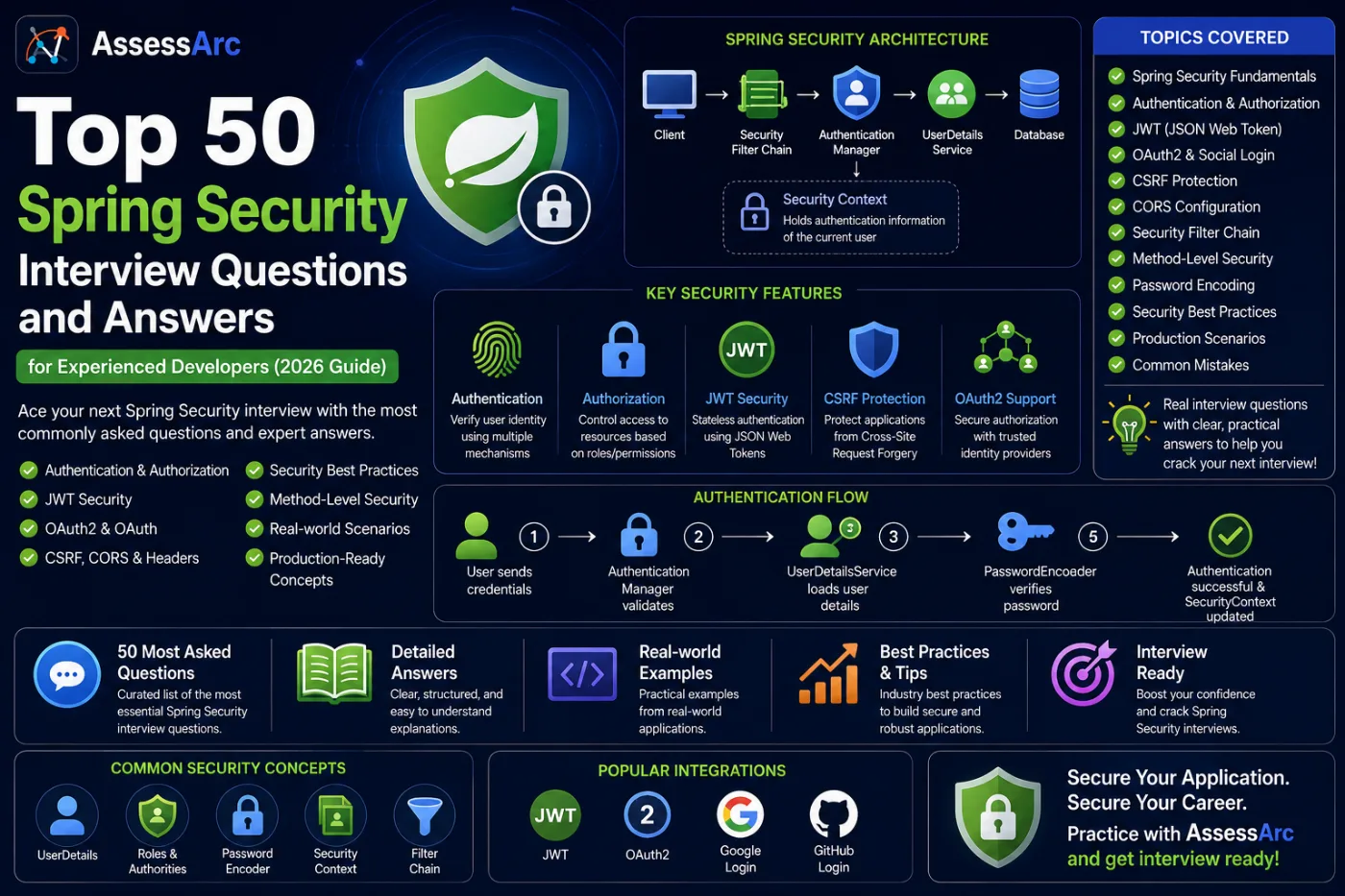
11. How Does Spring Security Authentication Work?
Answer
Flow:
User sends credentials
AuthenticationManager validates
UserDetailsService loads user
PasswordEncoder verifies password
Authentication succeeds
12. What is AuthenticationManager?
Answer
Core component responsible for authentication processing.
Delegates validation to providers.
13. What is AuthenticationProvider?
Answer
Handles actual authentication logic.
Examples:
Database Authentication
LDAP Authentication
Custom Authentication
14. What is UsernamePasswordAuthenticationToken?
Answer
Represents authentication requests and authenticated users.
Contains:
Username
Password
Authorities
15. What is InMemory Authentication?
Answer
Stores users in application configuration.
Useful for:
Development
Testing
Not recommended for production.
JWT Interview Questions
16. What is JWT?
Answer
JWT (JSON Web Token) is a compact token used for stateless authentication.
Structure:
Header.Payload.Signature
17. Why Use JWT?
Answer
Benefits:
Stateless
Scalable
Lightweight
Microservice Friendly
18. What Information Does JWT Contain?
Answer
Common claims:
User ID
Username
Roles
Expiration Time
19. What is JWT Signature?
Answer
Signature prevents token tampering.
Generated using:
Secret Key
Public/Private Keys
20. What Happens if JWT Expires?
Answer
User must:
Login again
orUse Refresh Token
21. What is a Refresh Token?
Answer
Refresh Token generates new access tokens without requiring login.
Improves user experience.
22. Access Token vs Refresh Token
Access Token | Refresh Token |
|---|---|
Short-lived | Long-lived |
API Access | Token Renewal |
23. Is JWT Encrypted?
Answer
No.
JWT is encoded, not encrypted.
Sensitive data should never be stored inside JWT.
24. Where Should JWT Be Stored?
Answer
Best practice:
HttpOnly Cookies
Avoid storing sensitive tokens in localStorage.
25. What is JWT Authentication Filter?
Answer
Filter that:
Extracts JWT
Validates Token
Creates Authentication Object
for each request.
OAuth2 Questions
26. What is OAuth2?
Answer
OAuth2 is an authorization framework allowing applications to access resources on behalf of users.
27. Why is OAuth2 Popular?
Answer
Used by:
Google Login
GitHub Login
Facebook Login
LinkedIn Login
28. What are OAuth2 Roles?
Answer
Components:
Resource Owner
Client
Authorization Server
Resource Server
29. What is Authorization Code Flow?
Answer
Most secure OAuth2 flow for web applications.
Widely used in production.
30. Difference Between OAuth2 and JWT
Answer
OAuth2:
Authorization Framework
JWT:
Token Format
Often used together.
CSRF & CORS Questions
31. What is CSRF?
Answer
Cross-Site Request Forgery attack tricks users into performing unintended actions.
32. How Does Spring Security Protect Against CSRF?
Answer
By generating CSRF tokens.
Requests without valid tokens are rejected.
33. When Can CSRF Be Disabled?
Answer
Commonly disabled in:
Stateless JWT APIs
Example:
http.csrf().disable();
34. What is CORS?
Answer
Cross-Origin Resource Sharing controls requests from different domains.
Example:
Frontend:
app.assessarc.com
Backend:
api.assessarc.com
35. Why Do CORS Errors Occur?
Answer
Browser blocks requests from unauthorized origins.
Security Best Practices
36. How Do You Secure REST APIs?
Answer
Use:
HTTPS
JWT
OAuth2
Rate Limiting
Input Validation
37. Why Use HTTPS?
Answer
Encrypts communication.
Protects:
Passwords
Tokens
Sensitive data
38. What is Role-Based Access Control?
Answer
Users receive roles.
Examples:
ROLE_ADMIN
ROLE_USER
Access decisions depend on roles.
39. What is Method-Level Security?
Answer
Secure methods using annotations:
@PreAuthorize
40. What is Security Filter Chain?
Answer
Sequence of filters processing every request.
Core of Spring Security.
Production Scenario Questions
41. Users Randomly Get 401 Unauthorized. What Would You Check?
Answer
Investigate:
Token expiration
Clock synchronization
JWT validation logic
42. How Would You Secure a Microservices Architecture?
Answer
Use:
JWT
API Gateway
OAuth2
HTTPS
43. How Would You Implement Google Login?
Answer
Use:
OAuth2 Client
Google Identity Provider
Spring Security OAuth2
44. How Would You Prevent Brute Force Attacks?
Answer
Use:
Account Locking
Rate Limiting
CAPTCHA
45. How Would You Secure Admin APIs?
Answer
Use:
Role-Based Access
Method Security
Audit Logging
46. Why Is Storing Passwords in Plain Text Dangerous?
Answer
Database leaks expose all user credentials.
Always hash passwords.
47. How Would You Rotate JWT Signing Keys?
Answer
Use:
Key Rotation Strategy
Multiple Active Keys
Grace Period
48. How Would You Audit Security Events?
Answer
Log:
Login Attempts
Failed Logins
Permission Changes
49. What Are Common Security Vulnerabilities?
Answer
SQL Injection
XSS
CSRF
Broken Authentication
50. What Are Interviewers Looking For?
Answer
Interviewers evaluate:
Authentication Knowledge
JWT Understanding
OAuth2 Concepts
Security Best Practices
Production Experience
Common Spring Security Interview Mistakes
❌ Confusing Authentication and Authorization
❌ Weak JWT understanding
❌ Not knowing OAuth2
❌ Ignoring HTTPS
❌ No production examples
How AssessArc Helps You Prepare
Spring Security interviews often include scenario-based discussions.
AssessArc helps candidates practice:
JWT Questions
OAuth2 Questions
Security Scenarios
Java Backend Interviews
through AI-powered mock interviews and detailed feedback.
Conclusion
Spring Security is one of the most important skills for modern Java developers.
Understanding authentication, authorization, JWT, OAuth2, CSRF, CORS, and security best practices can significantly improve your interview performance.
Master these Spring Security interview questions and practice explaining concepts clearly to confidently crack your next Java interview.