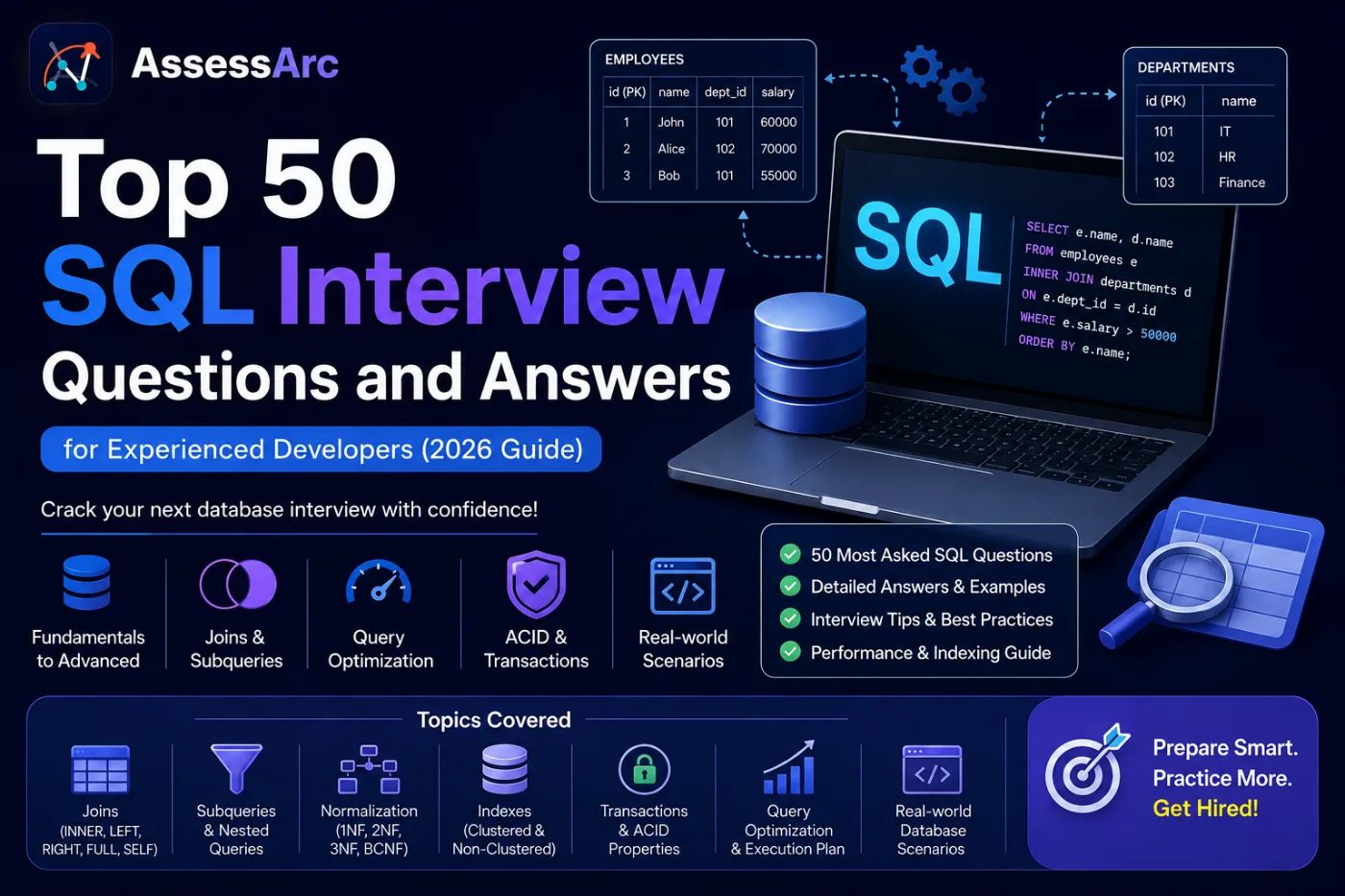
Top 50 SQL Interview Questions and Answers for Experienced Developers (2026 Guide)
Prepare for your next database interview with the top 50 SQL interview questions and answers. Covers joins, indexes, normalization, transactions, ACID properties, query o
Top 50 SQL Interview Questions and Answers for Experienced Developers (2026 Guide)
Introduction
SQL (Structured Query Language) remains one of the most important skills for software engineers, backend developers, data engineers, analysts, and database administrators.
Almost every modern application relies on a database, and regardless of whether you're working with Java, Spring Boot, .NET, Python, Node.js, or React, chances are you're interacting with SQL databases daily.
This is why SQL questions frequently appear in technical interviews.
Companies such as Amazon, Google, Microsoft, Uber, Netflix, TCS, Infosys, Accenture, Capgemini, and startups regularly ask SQL-related questions to evaluate a candidate's understanding of databases, performance optimization, and real-world data handling.
This guide covers the top 50 most frequently asked SQL interview questions with practical answers and examples.
SQL Fundamentals
1. What is SQL?
Answer
SQL (Structured Query Language) is a language used to interact with relational databases.
SQL is used for:
Creating databases
Reading data
Updating records
Deleting records
Managing database structures
Popular SQL databases:
MySQL
PostgreSQL
Oracle
SQL Server
MariaDB
2. What is a Database?
Answer
A database is an organized collection of data that can be stored, retrieved, and managed efficiently.
Example
Employee Database:
EmployeeId | Name | Department |
|---|---|---|
1 | John | IT |
2 | David | HR |
3. What is a Table?
Answer
A table stores data in rows and columns.
Example
Employee Table:
EmployeeId | Name | Salary |
|---|---|---|
1 | John | 50000 |
4. What is a Primary Key?
Answer
A Primary Key uniquely identifies each row in a table.
Characteristics:
Unique
Cannot be NULL
One per table
Example:
CREATE TABLE Employee (
    EmployeeId INT PRIMARY KEY,
    Name VARCHAR(100)
);
5. What is a Foreign Key?
Answer
A Foreign Key establishes a relationship between two tables.
Example:
CREATE TABLE Orders (
    OrderId INT PRIMARY KEY,
    CustomerId INT,
    FOREIGN KEY(CustomerId)
    REFERENCES Customers(CustomerId)
);
6. What is a Unique Key?
Answer
A Unique Key ensures all values are unique.
Difference from Primary Key:
Multiple Unique Keys allowed
Can contain NULL values (database dependent)
7. What is a Composite Key?
Answer
A Composite Key consists of multiple columns.
Example:
PRIMARY KEY(EmployeeId, ProjectId)
Useful when a single column cannot uniquely identify records.
8. What is NULL?
Answer
NULL represents missing or unknown data.
Example:
SELECT *
FROM Employee
WHERE ManagerId IS NULL;
9. Difference Between DELETE, TRUNCATE and DROP
Answer
Command | Removes Data | Removes Structure | Rollback |
|---|---|---|---|
DELETE | Yes | No | Yes |
TRUNCATE | Yes | No | Usually No |
DROP | Yes | Yes | No |
10. What is a View?
Answer
A View is a virtual table based on a SQL query.
Example:
CREATE VIEW ActiveEmployees AS
SELECT *
FROM Employee
WHERE Status='ACTIVE';
Benefits:
Security
Reusability
Simplicity
SQL Joins
11. What is an INNER JOIN?
Answer
Returns matching records from both tables.
SELECT *
FROM Employee e
INNER JOIN Department d
ON e.DepartmentId=d.DepartmentId;
12. What is a LEFT JOIN?
Answer
Returns:
All records from left table
Matching records from right table
SELECT *
FROM Employee e
LEFT JOIN Department d
ON e.DepartmentId=d.DepartmentId;
13. What is a RIGHT JOIN?
Answer
Returns:
All records from right table
Matching records from left table
14. What is a FULL OUTER JOIN?
Answer
Returns all records from both tables.
Matching records are merged.
Non-matching records contain NULL values.
15. What is a SELF JOIN?
Answer
A table joined with itself.
Example:
Employee → Manager relationship.
SELECT e.Name,
       m.Name AS Manager
FROM Employee e
LEFT JOIN Employee m
ON e.ManagerId=m.EmployeeId;
16. What is a CROSS JOIN?
Answer
Produces Cartesian Product.
Example:
3 employees × 4 departments = 12 rows
Use carefully.
17. Difference Between INNER JOIN and LEFT JOIN
Answer
INNER JOIN:
Returns only matching rows.
LEFT JOIN:
Returns all rows from left table.
18. Which Join Is Most Commonly Used?
Answer
Typically:
INNER JOIN
LEFT JOIN
are most commonly used in production systems.
Normalization & Database Design
19. What is Normalization?
Answer
Normalization organizes data to reduce redundancy.
Benefits:
Reduced duplication
Improved consistency
Easier maintenance
20. What is First Normal Form (1NF)?
Answer
Rules:
Atomic values
No repeating groups
Bad:
Employee | Skills |
|---|---|
John | Java,SQL |
Good:
Separate rows for each skill.
21. What is Second Normal Form (2NF)?
Answer
Eliminates partial dependency.
All non-key columns must depend on the entire primary key.
22. What is Third Normal Form (3NF)?
Answer
Removes transitive dependency.
Non-key columns should depend only on the primary key.
23. What is Denormalization?
Answer
Denormalization intentionally introduces redundancy.
Benefits:
Faster reads
Reduced joins
Often used in reporting systems.
Indexing & Query Optimization
24. What is an Index?
Answer
An Index improves query performance.
Without Index:
Database scans entire table.
With Index:
Database quickly locates records.
25. Why Do We Use Indexes?
Answer
Benefits:
Faster searches
Faster sorting
Faster filtering
26. What is a Clustered Index?
Answer
Data is physically stored according to the index.
Only one clustered index per table.
27. What is a Non-Clustered Index?
Answer
Stores pointers to actual data.
Multiple non-clustered indexes allowed.
28. Can Too Many Indexes Be Harmful?
Answer
Yes.
Disadvantages:
Increased storage
Slower INSERT
Slower UPDATE
Slower DELETE
29. Why Is a Query Slow?
Answer
Common reasons:
Missing indexes
Full table scans
Large joins
Poor query design
High data volume
30. How Do You Optimize SQL Queries?
Answer
Strategies:
Use indexes
Avoid SELECT *
Filter early
Analyze execution plans
Optimize joins
31. What Is an Execution Plan?
Answer
Execution Plan shows how SQL executes a query.
Used to identify:
Full scans
Expensive operations
Missing indexes
Transactions & ACID
32. What is a Transaction?
Answer
A Transaction is a group of operations executed as a single unit.
Example:
Bank transfer:
Debit account
Credit account
Both should succeed together.
33. What are ACID Properties?
Answer
Atomicity
All or nothing.
Consistency
Data remains valid.
Isolation
Transactions don't interfere.
Durability
Committed data survives failures.
34. What is COMMIT?
Answer
Permanently saves changes.
COMMIT;
35. What is ROLLBACK?
Answer
Reverts changes.
ROLLBACK;
36. What is SAVEPOINT?
Answer
Creates rollback checkpoints.
SAVEPOINT sp1;
37. What is a Deadlock?
Answer
Deadlock occurs when transactions wait for each other indefinitely.
Example:
Transaction A locks Row 1.
Transaction B locks Row 2.
Each waits for the other.
38. How Do You Prevent Deadlocks?
Answer
Techniques:
Consistent lock order
Smaller transactions
Proper indexing
Advanced SQL Questions
39. What is a Stored Procedure?
Answer
Stored Procedure is reusable SQL code stored inside the database.
Benefits:
Reusability
Performance
Security
40. What is a Trigger?
Answer
Trigger automatically executes when:
INSERT
UPDATE
DELETE
occurs.
41. What is a Cursor?
Answer
Cursor processes rows one by one.
Generally avoided when set-based operations are possible.
42. What is a Subquery?
Answer
Query inside another query.
Example:
SELECT *
FROM Employee
WHERE Salary >
(
   SELECT AVG(Salary)
   FROM Employee
);
43. Difference Between WHERE and HAVING
Answer
WHERE:
Filters rows before aggregation.
HAVING:
Filters after aggregation.
Real Production Scenario Questions
44. Database CPU Suddenly Reaches 100%. What Would You Check?
Answer
Investigate:
Slow queries
Missing indexes
Locking issues
High traffic
Long-running transactions
45. A Query Takes 20 Seconds. How Would You Troubleshoot?
Answer
Steps:
Check execution plan
Verify indexes
Review joins
Analyze data volume
Optimize query structure
46. How Would You Archive Millions of Records?
Answer
Approach:
Batch processing
Partitioning
Archival tables
Scheduled jobs
Avoid moving everything at once.
47. How Would You Design a Highly Scalable Database?
Answer
Use:
Read replicas
Partitioning
Indexing
Caching
Connection pooling
48. How Would You Handle Duplicate Records?
Answer
Use:
Unique constraints
Deduplication queries
Data validation
49. What SQL Concepts Should Experienced Developers Master?
Answer
Focus on:
Joins
Indexing
Transactions
Normalization
Query Optimization
Execution Plans
Deadlocks
ACID Properties
50. What Are Interviewers Looking for in SQL Interviews?
Answer
Interviewers evaluate:
Database Knowledge
Can you design schemas?
Query Writing
Can you solve problems efficiently?
Performance Understanding
Can you optimize queries?
Real Production Experience
Can you troubleshoot issues?
Communication
Can you explain tradeoffs clearly?
Common SQL Interview Mistakes
❌ Memorizing queries without understanding
❌ Ignoring indexing concepts
❌ Weak understanding of joins
❌ Not knowing ACID properties
❌ No knowledge of query optimization
❌ Lack of production examples
How AssessArc Helps You Prepare for SQL Interviews
SQL interviews are not just about writing queries.
Candidates must explain:
Why a query is written a certain way
Indexing decisions
Performance improvements
Database design choices
AssessArc helps candidates practice realistic SQL interview questions through AI-powered mock interviews and detailed feedback reports, helping improve both technical depth and communication skills.
Conclusion
SQL remains one of the most important interview topics for software engineers and backend developers.
Whether you're preparing for product companies, startups, or enterprise organizations, a strong understanding of SQL fundamentals, joins, indexing, transactions, optimization, and production troubleshooting can significantly improve your interview performance.
Master these 50 SQL Interview Questions and Answers, practice explaining concepts clearly, and you'll be well prepared for your next technical interview.