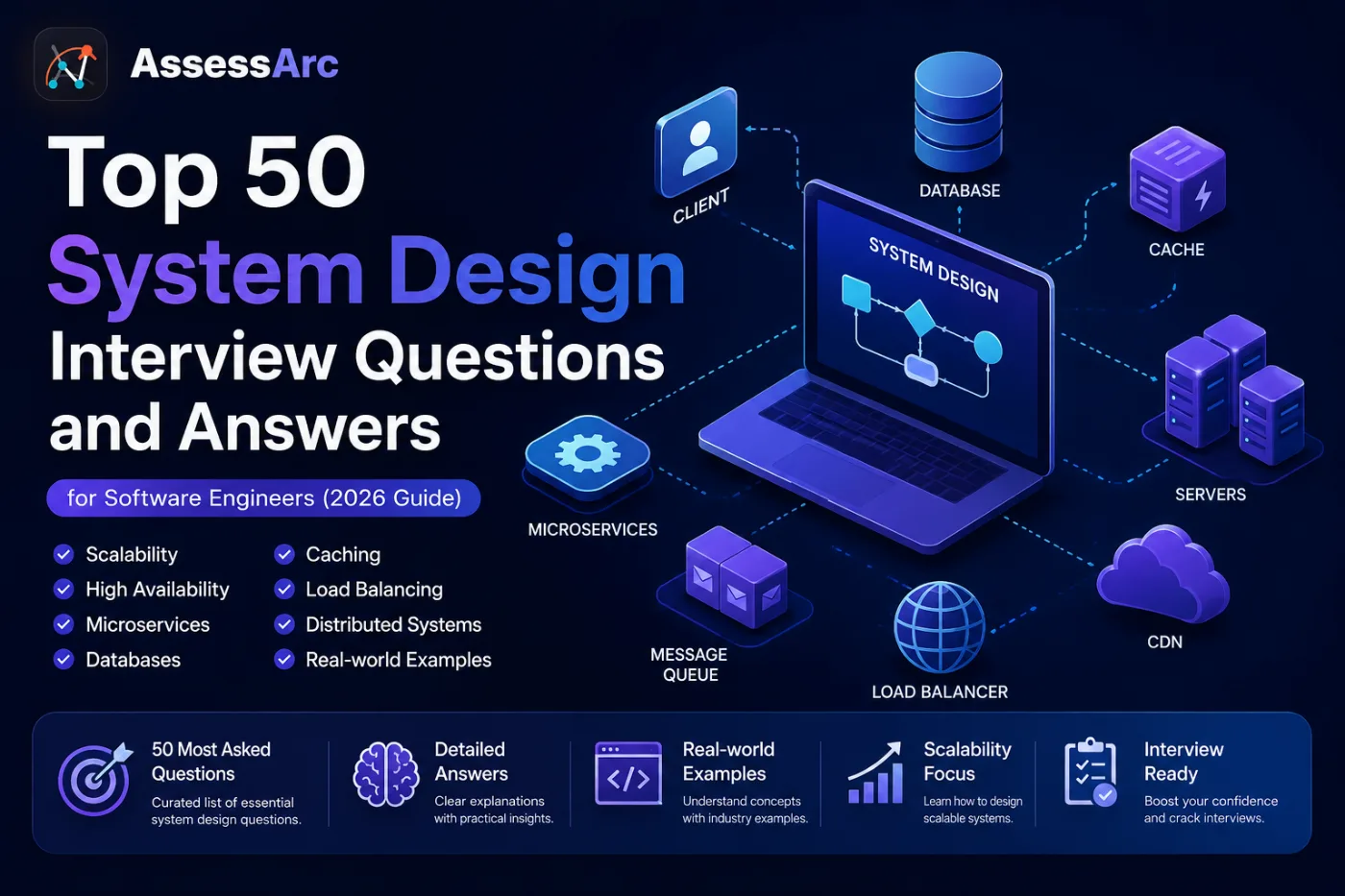
Top 50 System Design Interview Questions and Answers for Software Engineers (2026 Guide)
Prepare for system design interviews with the top 50 most asked system design interview questions and answers. Covers scalability, load balancing, caching, databases, mic
Top 50 System Design Interview Questions and Answers for Software Engineers (2026 Guide)
Introduction
System Design interviews have become a critical part of hiring for Software Engineers, Senior Developers, Tech Leads, Engineering Managers, and Architects.
Unlike coding interviews that focus on algorithms and data structures, system design interviews evaluate your ability to build scalable, reliable, maintainable, and high-performance applications.
Companies like Google, Amazon, Microsoft, Uber, Netflix, Meta, LinkedIn, Airbnb, and many startups heavily emphasize system design during technical interviews.
Common system design topics include:
Scalability
Load Balancing
Caching
Databases
Microservices
Distributed Systems
Message Queues
Event-Driven Architecture
High Availability
Fault Tolerance
In this guide, we cover the top 50 most frequently asked system design interview questions along with practical answers.
1. What is System Design?
Answer
System Design is the process of defining the architecture, components, modules, interfaces, and data flow of a software system.
It focuses on:
Scalability
Reliability
Availability
Performance
Security
Maintainability
2. What is Scalability?
Answer
Scalability is the ability of a system to handle increasing traffic without performance degradation.
Types
Vertical Scaling
Increase CPU
Increase RAM
Horizontal Scaling
Add more servers
Most modern systems prefer horizontal scaling.
3. What is High Availability?
Answer
High Availability ensures a system remains operational even during failures.
Example
If one server crashes:
Traffic automatically shifts to healthy servers.
4. What is Fault Tolerance?
Answer
Fault Tolerance is the ability of a system to continue functioning despite component failures.
Example
If one Kafka broker fails:
Other brokers continue serving requests.
5. What is a Load Balancer?
Answer
A Load Balancer distributes incoming traffic across multiple servers.
Benefits
Better performance
High availability
Failover support
Popular Load Balancers:
NGINX
HAProxy
AWS ALB
AWS ELB
6. Difference Between Load Balancing and Scaling
Answer
Load Balancing | Scaling |
|---|---|
Distributes traffic | Increases capacity |
Improves availability | Improves throughput |
Works with existing servers | Adds resources |
7. What is Caching?
Answer
Caching stores frequently accessed data in memory to reduce database load.
Benefits
Faster response times
Reduced database queries
Better user experience
8. What is Redis?
Answer
Redis is an in-memory key-value store commonly used for:
Caching
Session management
Rate limiting
Real-time analytics
9. What is Cache Eviction?
Answer
Cache eviction removes old data when memory becomes full.
Common policies:
LRU (Least Recently Used)
LFU (Least Frequently Used)
FIFO
10. What is a CDN?
Answer
CDN (Content Delivery Network) stores static content closer to users.
Examples:
Cloudflare
Akamai
AWS CloudFront
11. What is Database Sharding?
Answer
Sharding divides a database into smaller databases.
Example
Users:
Shard 1 → User IDs 1-1M
Shard 2 → User IDs 1M-2M
Benefits:
Better scalability
Reduced load
12. What is Database Replication?
Answer
Replication creates copies of databases.
Types
Master-Slave
Writes → Master
Reads → Replica
13. SQL vs NoSQL
Answer
SQL | NoSQL |
|---|---|
Structured | Flexible |
ACID | Eventually Consistent |
Joins | Denormalized |
PostgreSQL | MongoDB |
14. What is CAP Theorem?
Answer
CAP Theorem states a distributed system can provide only two of:
Consistency
Availability
Partition Tolerance
When a network partition occurs:
Choose either:
Consistency
Availability
15. What is Eventual Consistency?
Answer
Data becomes consistent over time rather than immediately.
Example
Social media likes.
Different servers may briefly show different counts.
Eventually all become synchronized.
16. What is Microservices Architecture?
Answer
Microservices break applications into smaller independent services.
Examples:
User Service
Payment Service
Order Service
Notification Service
17. Advantages of Microservices
Answer
Independent deployment
Better scalability
Technology flexibility
Fault isolation
18. Challenges of Microservices
Answer
Distributed transactions
Network latency
Monitoring complexity
Debugging challenges
19. What is API Gateway?
Answer
API Gateway acts as the entry point for all client requests.
Responsibilities:
Authentication
Routing
Rate limiting
Logging
20. What is Service Discovery?
Answer
Service Discovery helps services find each other dynamically.
Examples:
Eureka
Consul
Kubernetes
21. What is Circuit Breaker Pattern?
Answer
Circuit Breaker prevents cascading failures.
States:
Closed
Open
Half Open
Popular Tool:
Resilience4j
22. What is Bulkhead Pattern?
Answer
Bulkhead isolates failures.
Example:
Separate thread pools for:
Payments
Notifications
Orders
Failure in one service doesn't affect others.
23. What is Rate Limiting?
Answer
Rate Limiting restricts request volume.
Example:
100 requests/minute/user
Prevents:
Abuse
DDoS attacks
24. What is Message Queue?
Answer
Message Queue enables asynchronous communication.
Examples:
Kafka
RabbitMQ
ActiveMQ
AWS SQS
25. Why Use Kafka?
Answer
Kafka provides:
High throughput
Durability
Scalability
Event streaming
Used by:
Netflix
Uber
LinkedIn
26. What is Idempotency?
Answer
Multiple identical requests should produce the same result.
Example:
Payment API should not charge twice if retried.
27. What is Distributed Locking?
Answer
Distributed Locking ensures only one instance performs a task.
Examples:
Redis Lock
Zookeeper Lock
28. What is Consistent Hashing?
Answer
Consistent Hashing distributes data evenly across nodes while minimizing redistribution.
Used in:
Redis Cluster
Cassandra
29. What is Data Partitioning?
Answer
Splitting large datasets into smaller parts.
Benefits:
Scalability
Performance
30. What is CQRS?
Answer
Command Query Responsibility Segregation separates:
Commands
Write operations
Queries
Read operations
Benefits:
Better scalability
Optimized performance
31. What is Event Sourcing?
Answer
Store events instead of current state.
Example:
Bank Account:
Money Deposited
Money Withdrawn
Current balance is reconstructed from events.
32. What is Saga Pattern?
Answer
Saga manages distributed transactions across microservices.
Each service:
Executes local transaction
Provides compensation logic
33. What is Distributed Tracing?
Answer
Tracks requests across multiple services.
Tools:
Zipkin
Jaeger
OpenTelemetry
34. What is Observability?
Answer
Observability helps understand system behavior.
Components:
Logs
Metrics
Traces
35. What is Monitoring?
Answer
Monitoring continuously checks system health.
Tools:
Prometheus
Grafana
Datadog
36. What is a Health Check Endpoint?
Answer
Provides service status.
Example:
/healthReturns:
{
 "status":"UP"
}
37. What is a Reverse Proxy?
Answer
Reverse Proxy receives requests and forwards them internally.
Examples:
NGINX
Apache
38. What is Sticky Session?
Answer
Load balancer sends a user to the same server repeatedly.
Useful for:
Session-based applications
39. What is Stateless Architecture?
Answer
Server stores no client session data.
Benefits:
Easier scaling
Better fault tolerance
Preferred for cloud-native applications.
40. What is Blue-Green Deployment?
Answer
Two production environments:
Blue
Current version
Green
New version
Traffic switches after validation.
41. What is Canary Deployment?
Answer
Release software gradually.
Example:
5% users
20% users
50% users
100% users
42. What is Auto Scaling?
Answer
Automatically adds or removes servers based on traffic.
Benefits:
Cost optimization
Better performance
43. What is a Read Replica?
Answer
Database copy used only for read operations.
Benefits:
Reduced load
Better scalability
44. What is Database Connection Pooling?
Answer
Maintains reusable database connections.
Benefits:
Better performance
Reduced latency
45. What Causes Database Bottlenecks?
Answer
Common causes:
Missing indexes
Large joins
Slow queries
High traffic
46. How Would You Design a URL Shortener?
Answer
Components:
API Layer
Database
Cache
Short URL Generator
Analytics Service
47. How Would You Design a Chat Application?
Answer
Components:
WebSocket Server
User Service
Message Service
Database
Notification Service
48. How Would You Design a Notification System?
Answer
Channels:
Email
SMS
Push Notification
Architecture:
Queue
Notification Workers
Retry Mechanism
49. How Would You Design YouTube?
Answer
Components:
Upload Service
Video Storage
CDN
Recommendation Engine
Streaming Service
50. What Are Interviewers Looking for in System Design Interviews?
Answer
Interviewers evaluate:
Requirement Gathering
Can you ask clarifying questions?
Scalability Thinking
Can the system handle millions of users?
Tradeoff Analysis
Can you explain design decisions?
Communication
Can you clearly explain architecture?
Practical Experience
Can you relate concepts to production systems?
Common System Design Interview Mistakes
❌ Jumping directly into architecture
❌ Ignoring scalability
❌ Ignoring failure scenarios
❌ Not discussing tradeoffs
❌ Forgetting caching
❌ Overengineering solutions
❌ Not considering database choices
❌ Poor communication
How AssessArc Helps You Prepare for System Design Interviews
System Design interviews require more than theoretical knowledge.
You must practice explaining:
Architecture decisions
Scaling strategies
Database selection
Caching approaches
Failure handling
Tradeoffs
AssessArc helps candidates practice realistic technical interviews through AI-powered mock interview sessions.
You can practice answering system design questions, receive detailed feedback, improve communication skills, and build confidence before real interviews.
Conclusion
System Design has become one of the most important skills for software engineers preparing for mid-level, senior, and architect roles.
Understanding concepts like scalability, load balancing, caching, databases, distributed systems, Kafka, microservices, and fault tolerance is essential for success.
Use these 50 System Design Interview Questions and Answers as a foundation for your preparation and practice explaining your solutions clearly, just as you would in a real interview.
The best candidates don't just know the concepts—they know when and why to use them. 🚀