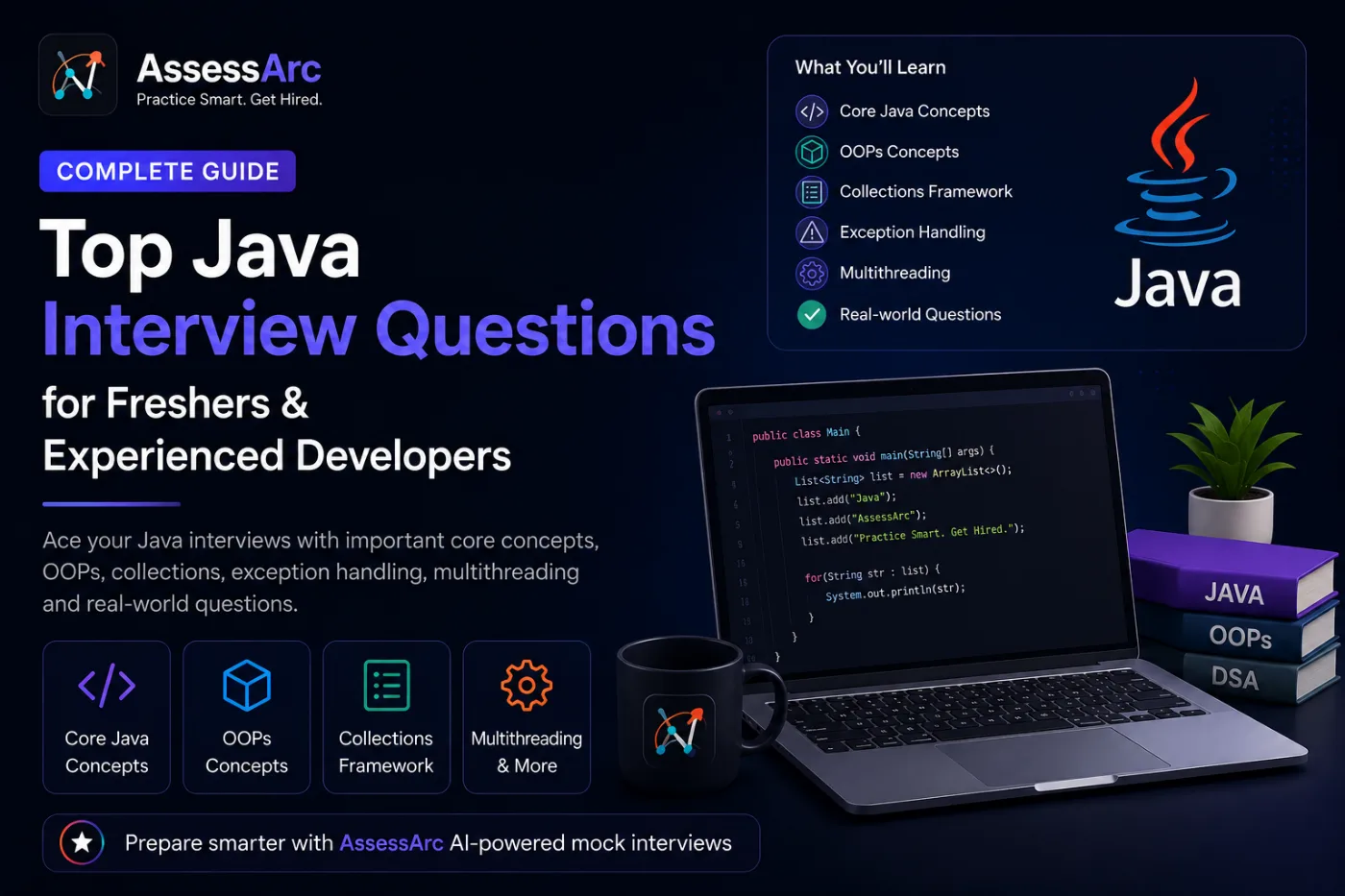
Top Java Interview Questions for 4 Years Experience in 2026
Prepare for Java developer interviews with the most asked Java, Spring Boot, Microservices, Kafka, and SQL interview questions for 4 years experienced professionals.
Top Java Interview Questions for 4 Years Experience in 2026
Preparing for a Java developer interview with 4 years of experience is very different from fresher-level preparation. At this level, companies expect not only strong Java fundamentals but also hands-on knowledge of Spring Boot, Microservices, Kafka, SQL optimization, multithreading, REST APIs, cloud concepts, debugging, and real production experience.
In this blog, we will cover the most commonly asked Java interview questions for experienced developers along with practical explanations.
1. Explain the Difference Between HashMap and ConcurrentHashMap
This is one of the most frequently asked Java interview questions.
HashMap
Not thread-safe
Multiple threads can cause data inconsistency
Faster in single-threaded applications
ConcurrentHashMap
Thread-safe
Designed for concurrent environments
Uses bucket-level locking internally
Better performance compared to Hashtable
Example Use Case
If multiple users are updating shared cache data in a microservice application, ConcurrentHashMap is preferred.
2. What Happens Internally When You Call String Objects?
Example:
String s1 = "Java";
String s2 = new String("Java");
Important Difference
s1uses String Pool memorys2creates a new object in heap memory
Why It Matters
This question checks your understanding of JVM memory management.
3. Explain Dependency Injection in Spring Boot
Dependency Injection is one of the core concepts of Spring Framework.
Instead of creating objects manually using:
new Service();
Spring automatically injects required dependencies.
Advantages
Loose coupling
Better testability
Easier maintenance
Cleaner architecture
Example
@Service
public class EmployeeService {
}

@RestController
public class EmployeeController {

    @Autowired
    private EmployeeService employeeService;
}
4. What Is the Difference Between @Component, @Service, and @Repository?
@Component
Generic Spring-managed bean.
@Service
Used for service/business logic layer.
@Repository
Used for database layer and exception translation.
Even though internally all are Spring beans, using proper annotations improves code readability and architecture clarity.
5. Explain Microservices Architecture
Microservices architecture means breaking a large application into smaller independently deployable services.
Advantages
Independent deployment
Better scalability
Fault isolation
Technology flexibility
Common Components
API Gateway
Service Discovery
Config Server
Messaging Queue
Centralized Logging
Tools Commonly Used
Spring Boot
Eureka
Kafka
Docker
Kubernetes
6. What Is Kafka and Why Is It Used?
Apache Kafka is a distributed event streaming platform.
Why Companies Use Kafka
High throughput
Real-time processing
Decoupled architecture
Reliable messaging
Real Example
When a user places an order:
Order Service publishes event
Notification Service consumes event
Inventory Service consumes event
Analytics Service consumes event
All services work independently.
7. Explain Kafka Partitioning
Partitions are used to distribute data across brokers.
Benefits
Scalability
Parallel processing
Better performance
Important Interview Point
Messages with the same key always go to the same partition.
This maintains ordering.
8. Difference Between Monolithic and Microservices Architecture
Monolithic | Microservices |
|---|---|
Single application | Multiple small services |
Difficult scaling | Independent scaling |
Tightly coupled | Loosely coupled |
Single deployment | Independent deployment |
9. What Is JWT Authentication?
JWT stands for JSON Web Token.
It is commonly used for stateless authentication.
JWT Structure
Header
Payload
Signature
Flow
User logs in
Server generates token
Client stores token
Token sent with every request
10. Explain Exception Handling in Spring Boot
Common Approaches
Using try-catch
try {
    // code
} catch(Exception e) {
}
Using Global Exception Handling
@ControllerAdvice
public class GlobalExceptionHandler {
}
Best Practice
Use centralized exception handling.
11. What Is the Difference Between Checked and Unchecked Exceptions?
Checked Exceptions
Checked at compile time
Example: IOException
Unchecked Exceptions
Occur at runtime
Example: NullPointerException
12. Explain Java Multithreading
Multithreading allows multiple tasks to execute simultaneously.
Benefits
Better CPU utilization
Faster execution
Improved responsiveness
Common Concepts
Thread lifecycle
Synchronization
Deadlock
ExecutorService
Callable and Future
13. What Is ExecutorService?
ExecutorService manages thread pools efficiently.
Example
ExecutorService executor = Executors.newFixedThreadPool(5);
Advantages
Better performance
Thread reuse
Controlled concurrency
14. Explain REST API Best Practices
Important Points
Use proper HTTP methods
Proper status codes
Validation
Pagination
Versioning
Swagger documentation
Common Status Codes
200 OK
201 Created
400 Bad Request
401 Unauthorized
404 Not Found
500 Internal Server Error
15. Explain Database Indexing
Indexes improve query performance.
Without Index
Database scans entire table.
With Index
Database quickly locates required data.
Important Note
Too many indexes can slow down insert/update operations.
16. What Is Hibernate First-Level Cache?
Hibernate automatically stores objects in session cache.
Benefits
Reduces database calls
Improves performance
Scope
Session-level.
17. Difference Between PUT and PATCH
PUT
Updates entire resource.
PATCH
Updates partial resource.
18. Explain SOLID Principles
S — Single Responsibility Principle
One class should have only one responsibility.
O — Open Closed Principle
Open for extension but closed for modification.
L — Liskov Substitution Principle
Subclass should replace parent without breaking behavior.
I — Interface Segregation Principle
Avoid large interfaces.
D — Dependency Inversion Principle
Depend on abstractions.
19. Common HR Questions for Experienced Java Developers
Why do you want to switch?
Keep answer professional.
Explain your current project.
Focus on:
Architecture
Responsibilities
Challenges solved
Performance improvements
Biggest production issue handled?
Explain:
Problem
Root cause
Fix
Impact
20. Final Tips to Crack Java Interviews in 2026
Focus On
Java fundamentals
Spring Boot
SQL
Microservices
Kafka
Multithreading
Real project explanations
Practice Mock Interviews
The biggest mistake candidates make is only reading questions without practicing answers.
Mock interviews help improve:
Confidence
Communication
Technical clarity
Problem solving
Real interview handling
Practice AI Mock Interviews with AssessArc
If you want realistic AI voice-based mock interviews with deep analysis, performance scoring, technical feedback, communication analysis, and improvement suggestions, try AssessArc.
AssessArc helps freshers and experienced professionals practice real interview scenarios for:
Java
Spring Boot
React
Data Science
Python
System Design
SQL
HR interviews
Backend development
Frontend development
The platform provides:
AI voice interviewer
Performance summary
Deep answer analysis
Communication scoring
Technical scoring
Improvement suggestions
Conclusion
Java interviews for experienced developers now focus heavily on practical implementation and real-world problem-solving.
Instead of memorizing definitions, focus on:
Understanding concepts deeply
Explaining real project work
Practicing communication
Solving production scenarios
Consistent practice and mock interviews can significantly improve your interview performance.
Good luck with your preparation.